





To comment on Mayflies, Dimitra Dede’s book exploring grief, loss and motherhood, is challenging to say the least — especially when we consider this is not simply a book about, but one born of recent experiences in the loss of Dede’s mother. Of course, that the book has been published (by Void in an edition of 500), suggests that the author sees potential connections with readers who are not familiar with her personal circumstances. And this is a great thing for those that will encounter Dede’s work which is a well constructed and thoughtfully produced piece occupying a space clearly in the lineage of the artists’ book.
***
The music stopped.
The music along with the veritable cornucopia of love for me, are buried now.
***
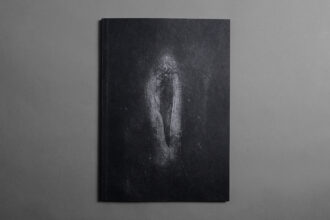
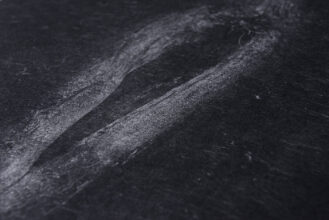
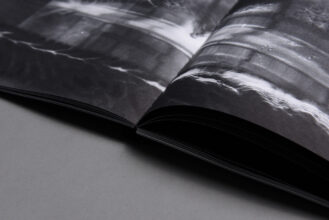
It is a large format, softcover publication which if not luxurious, feels rich, with its predominantly heavy-weight black matte paper and range of grey and earthy tones. A yonic tree trunk features faintly as the cover image and hints at the metaphors of body, landscape and motherhood present within.
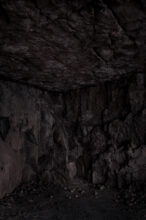
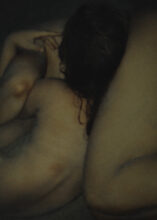
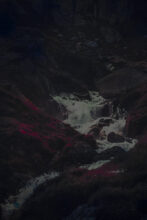
The photographs themselves are eclectic in style; some fall on the page as abstractions, heavily manipulated by chemicals, wax, fire or paint, whilst others present moments of uncluttered, and temporary, reprieve. Few are memorable as isolated moments, though an image showing a pair of pale hands carefully holding a small pile of soil seems to fade slower than others. The work is full of dualisms; life and death, vulnerability and strength and the roles of mother and daughter are sketched bold enough to provide shape, yet light enough for the gaps to be filled in or re-imagined by the reader. Dede’s recurring landscapes in which we might imagine solace and escape seldom offer it directly, though their other-worldliness becomes an oddly comforting motif.
The form of the book accentuates the fleeting nature of the visual work and demands continual looping back and forward — ultimately feeling more akin to a short film than a series of still images for this reader.
***
Burning sun and feelings overwhelmed me.
Insane thoughts.
Is she going to melt?
Is she going to move now?
Last kiss.
***
What guidance is presented beyond the images, comes in the form of a poem towards the end of the book. Dede’s words, like her images, are deftly chosen, avoiding the trite or clumsy, helping to focus and develop, rather than alter, an interpretation of the work. After a dedication to the author’s mother and the colophon, an outro or epilogue is found in images seen (like the poem) against a contrasting white, rather than black paper. Though the images continue the visual themes that have been established already, the paper choice has a surprisingly potent impact given our time spent in the dark of most of the book, and impresses a sense of new life with assimilated grief.
Few readers will be able to engage with Mayflies with distance and objectivity, though I imagine fewer still would try. This is a work which if not on the first reading, by the second, shall bear the weight of Dede’s narrative as well as those actual and imagined, of the reader.
__________
Mayflies by Dimitra Dede was published in an edition of 500 by Void.
Reviewed for Photomonitor by Matt Johnston