


Sian Bonnell has been developing work on a variety of subjects but for many years her terrain has been the domestic sphere. Playing with scale and format she takes everyday objects outside into the landscape to photograph them at monolithic scale. In When domestic meets the wild (1999) bright coloured pan scrubbers are placed on wires across a more traditional landscape shot; for Putting Hills in Holland (2001) jelly and blancmange moulds are piled on top of each other to create leaning towers and in Glowing (2003) luminescent rabbit jelly moulds nestle in the grass.
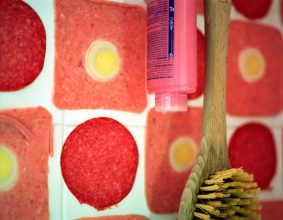
When not working outside, often the setting for her images has been her home, using food as a material for her sculptures and installations. In her series Everday Dada (2003-5) Bonnell places slices of tinned luncheon meat over bathroom tiles, and in the sub-series Scenic Cookery she creates mounds of mash potato, peas and sausages, shaped like iconic landscapes such as Stonehenge.
Recently Bonnell completed a PhD which has given her the opportunity to reflect on her practice, and in it she unpicks a term ‘Wilful Amateurism’ stating that it :
“functions within a paradoxical space between sculpture, performance and photography. It is made manifest through my own lived domestic experience and is fuelled by the following characteristics: play, imagination, dysfunction, irreverence, absurdity, chance and fiction.”
The amateurism to which she refers speaks not only about the subject matter but also about how the photographs are taken. These are not badly taken photographs but neither are they Gursky’s highly polished productions. Bonnell’s work is more spontaneous, immediate and, one could argue, authentic. For Bonnell part of her reason for adopting this approach was to reclaim the media of photography for the passionate amateur, and away from the technically accomplished male domain. In that respect her approach and subject matter becomes almost a defiant act, sticking two mash potato fingers up at the photography establishment.
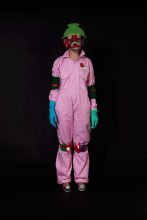
In her work she often theatrically stages the objects she uses that become the actors in her constructed plays. Over the years these animated objects are being replaced by Bonnell herself, as she has emerged from the background to become the protagonist of the work. In 2006 Bonnell worked on a commission to produce the series Kaput! made in Brno, Czech Republic. She made a video work in which she dressed up in a variety of workplace outfits. Making herself into a 1930 style automaton, this work was an intervention into the work place environment and a move away from the domestic sphere. The themes explored here were taken further in her work Health and Safety in 2007. Here Bonnell dresses herself up with protective clothing. The work is similar to a set of stills from a video as she progressively makes herself look more alien and absurd with the layers of clothing worn over her pink overalls. She states on the work:
“The images are overtly absurd, hinting at madness and obsession. They are unsettling and confrontational.”
The work speaks of performance art in many ways, with the photographs or video stills becoming the artefacts recording the event. Bonnell does not call these self-portraits but self-staged photographs.
It would seem that her video pieces Risk Assessment Frying an Egg (2007) and Risk Assessment Bathroom (2007) bridge well between the domestic and work place spheres of her practice. Here Bonnell enacts everyday domestic chores whilst wearing over-the-top health and safety protective gear. The work explores in part the clash between the patriarchal systems and codes of conduct in a work place environment, such as a factory or laboratory, with the more female domain of the home. The juxtaposition of these two worlds of work has a strong comical impact but also speaks volumes of the practical experience of living life as a woman in what remains a male world.
In 2011 Bonnell was awarded the Photoworks Senior Research Fellowship at the British School of Rome. In this she has taken the performance element of her practice further and there are signs of growing confidence at being in front of the camera. Bonnell explores the visual language of religion, both referring to art history but also everyday kitsch objects she saw sold on the streets of Rome. In her series of photographs How to be Holy (2011 -2013) her movements mimic religious genuflection to almost balletic affect. The work considers the iconography of religious art. Typically she has made the halo from everyday banal objects, in this case a disposable party plate. She demonstrates the absurdity of what it might be like to have to live wearing a halo. In these works Bonnell wears the highly patterned garments of day coats that women, often over 50, wear when doing their housework in Italy. These garments render them sexually neutral but also make them somewhat invisible, in their middle age. The work seems to speak of the restricted role women play in religious society. The awkwardness in the poses she attempts to reach are moving and touching; whatever their specific context they seem to speak volumes about the contrast between the ideal and the lived experience.
Over the years Bonnell’s work has often been made in the cracks and spaces she has found in everyday life. Being a mother and living in a rural context she has often been making work outside the mainstream. As with many women she is juggling priorities and decided to make work using the materials that were around her. Now that her family are grown up, she is starting to develop her practice on residencies, taking opportunities to work abroad. The context in which she is now developing her work allows for a more studio-based practice and one in which she is increasingly using herself as the main subject. She is currently considering taking this one step further in her work to the arena of live performance. Now that the performer that has long been lurking in the work has emerged, I for one hope that we will continue to see more of her.
– Essay by Camilla Brown
———-
For further information: www.sianbonnell.com