__________
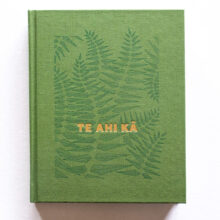
The Whanganui River in New Zealand is officially recognised as a human being with legal rights. It is an ancestor to the local Māori people. Flowing through the Māori lands at the centre of the North Island, it is the life force giving both material and spiritual nourishment. Te Ahi Kā: The Fires of Occupation sees the Danish photographer Martin Toft (born 1970) revisit New Zealand, 20 years after he took his first trip there in 1996. The book, shortlisted for the Kassel Dummy Award in 2018, is covered in vibrant green linen stamped with a fern pattern, the symbol of New Zealand. This is the female version of the cover while the male counterpart is a fiery orange with an ember motif.
Toft documents life around the river on Mount Tongariro, the area known as the King Country, photographing the locals and the striking scenery. Toft’s work is accompanied by historic photographs drawn from museum collections in New Zealand. The book also includes a short dictionary of Māori language and an extraordinary apology from the Crown, which officially recognises the relationship between the people and the Whanganui River.
The interviews with Māori describe their profound, mythical relationship with their ancestral land. Images of nature are printed as fold-out panoramas, with the local people’s portraits hidden within. It is as if they are wrapped inside the embrace of the ancient woods. The text traces discussions about disruptive plans of the Departments of Conservation and Tourism for the area, which the locals are determined to fight. Conversations touch on young people leaving and losing touch with the land, with some eventually returning home. The ancestral landscape is the outline for all these stories, always on the horizon.
The contemporary and the historical are interwoven into layers like lush ferns on the deep forest floor. Portraits of the 19th century ancestors of modern New Zealanders are shown alongside their descendants, past lives brought to the present. They lived with the historic injustices that only now are being corrected.
Monochrome images appear as abstract patterns. Sunlight filters through heavy branches, black waters of the river ripple into white foam. Once the eyes adjust, outlines emerge from tones of grey and paths appear through the dense forest. Tracks are layered with greenery as they weave past unyielding tree trunks, ferns arching into the distance where daylight glows. The Māori interviewees describe listening to the trees and waiting for them to call for you. They meet the tree like a person, and Toft captures trees as if they are portraits.
The cycle of life is ever-present, from seed to tree to fruit to rot and then seed again. The pacing of the images also tells a story, from forests and the sea to people, then to forest and sea again. The people are a part of the ever-renewing cycle of nature, where past is present.
“We are all of our land… We concern ourselves with ourselves between our mountain. Acknowledge our mountains that are our genealogy.”
– reviewed for Photomonitor by Riikka Kuittinen