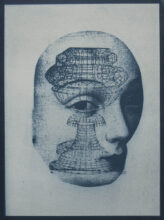
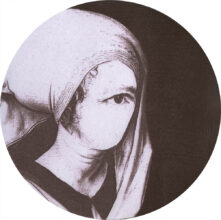
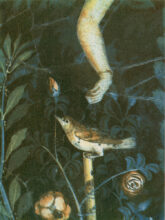
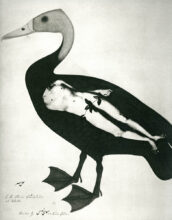
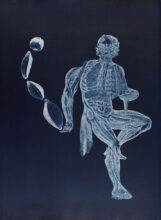
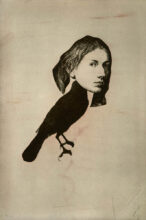
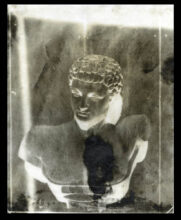
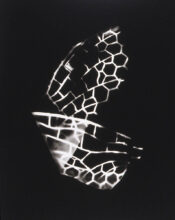
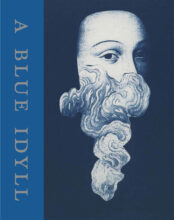
A Blue Idyll – Cyanotypes and Dreams is the first trade publication to feature the work of Brenton Hamilton, a Maine-based artist, historian and educator whose practice employs the cyanotype, gum bichromate and ambrotype as well as other methods that are often referred to as ‘arcane processes’. It is worth noting that this is a relatively traditional photographic book, unsurprising given its remit as a 25 year retrospective of Hamilton’s work. As such, for those who may already be enamoured with the artist’s output, this publication will be welcomed as a comparatively accessible investment with high production values and the range of blue, grey, peach and cyan hues that flow through the work rendered consistently with depth and detail. All of this wrapped up with silver endpapers, book cloth and debased lettering, suggestive of a certain sense of authority and timelessness often ascribed to the physical codex.
A departure from the artist’s work with the print in relative isolation, A Blue Idyll offers a significantly different experience for the reader. Where the individual artwork presents connections, references and an aesthetic world in a single space, now we seek to comprehend the illusive corral that is a ‘body of work’. At times this is a real strength of the publication. There are careful pairings which encourage the reader to appreciate the subtle but integral differences in the repetition of processes which tend to resist uniformity, as well as places which encourage the reader to witness their own, or Hamilton’s thought process in bringing disparate visuals together. At other moments however, this abstract mental connection we engage in can end up reminiscent of an exclusive intellectual’s game of spot-the-intertextual-reference.
The influence of the surrealists will be apparent to many readers of Hamilton’s work, so too the artist’s interest in sculpture, natural history and science which is visible throughout the publication. In this manner, it is hard not to think of Hamilton as a stationary flaneur (or ‘mental traveler’ as the excerpt from Blake’s poem suggests), and the image-making process as more akin to painting or literature than photography in its conventional form. Such grand motifs — and consequently sources — provide a heady aesthetic and conceptual melange for the reader which begs to be unpicked and explored more explicitly, though such elucidation never seems to arrive from Hamilton himself. Instead we turn to the accompanying essay by writer and critic Lyle Rexer (author of Photography’s Antiquarian Avant Garde: The New Wave in Old Processes) to seek more from these sumptuous and chimerical visuals.
Rexer positions our reading as one of a personal nature, stating that rather than a book of photographs, we are instead engaged with ‘an interior autobiography, with accompanying illustrative images, a dream book if you like’. It is unsurprising then that Hamilton’s influences are brought to the fore with associations to Henry Fox Talbot, William Blake, Sir Henry Davy, Hieronymous Bosch, William Wordsworth and Pieter Bruegel: figures that help to locate the work in a timeless space of curiosity and esoteric thought. It is a shame that Hamilton’s methodology is not interrogated fully in A Blue Idyll, as there are numerous openings which could provide rich material for a discourse regarding the contemporary use of historical processes. Rexer makes clear that such a methodology is not the work of a luddite, and nor part of a ‘war on digital media’, but never quite addresses instead what it is, pointing to Hamilton’s oeuvre as a product of ‘choices that are aesthetic and intentional rather than automatic and mechanical’ — a statement that is suggestive of lingering hierarchies of taste. Similarly, there is a comment regarding nature as a ‘physical partner’ in the production of the images: a beautiful way to speak about the cyanotype certainly, but also an avenue of thought not taken.
Curiously, the most recent reference in Rexer’s writing are the cyanotypes of John Dugdale from the 1990s, this despite numerous contemporary artists incorporating similar methods to Hamilton today — Meghann Riepenhoff, Adam Jeppesen, Melanie King and Paula Riff come to mind — as well as countless practitioners who unlike Rexer’s assertion are not ‘agonising over photography’s descriptive limits’. Of course, reference and inspiration need not be tied to the present, but to eschew the context of production and reception seems at odds with the billing of the Hamilton’s vision as one that is ‘thoroughly contemporary’. Despite these criticisms, which contribute to a slight sense of under-fulfilment, it is likely that for many, A Blue Idyll will serve the purpose not only of viewing Hamilton’s work up-close, but of encouraging a reading which serves to highlight the power of our networks of influence and creativity.
___________
Reviewed for Photomonitor by Matt Johnston
A Blue Idyll – Cyanotypes and Dreams by Brenton Hamilton was published by, and is available from Schilt Publishing