


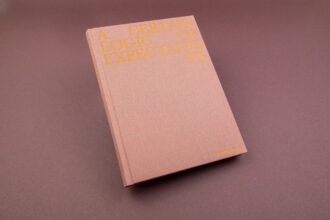
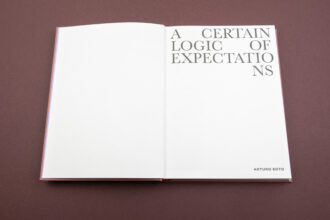



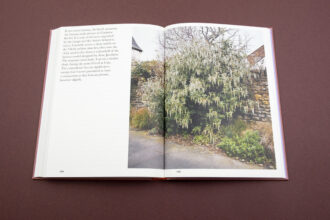
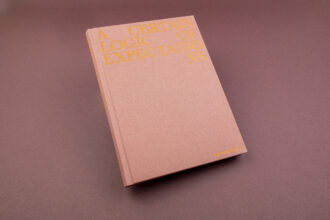
Expectations are indeed raised, and logics are certainly and purposefully disrupted in Arturo Soto’s multi-layered image/text narrative that completely disrupts the usual rendering of the tri-cultural city of gown, town and tourists, remaking a portrayal of Oxford. This concept is advertised clearly and immediately from the colour of the cloth binding against that of the (beautifully embossed) type and the title that has been designed to (not) fit.
A missive to the city’s fractured, diverse, problematic nature, Soto’s constructed documentation of exploration represents his reflexive process of making the book with a sense of shifting social circles as well as positions: the eye of a Mexican photographer/writer on the UK city, once student, now tutor. Illustrating social mores and cultures through everyday life (and many dates), he is at both at home and distant from it, another version of the flaneur with shades of Perec, Sinclair and Drummond.
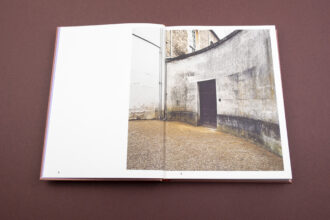
Impressions, via either medium, can be fleeting but connections are remade and relaid, with slippages in adjacency, adding to the sense of what kind of city this is. The frontispiece, a closed dark door set in a weathered wall of discoloured blocks, could be read as shutting you out. Or as an invitation to step inside, to see what you might find. The book’s first actual spread – an image of a stonework detail, very pink but still cracked and weathered – returns us to the cover colours.
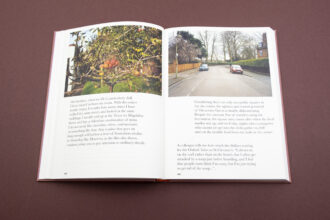
With dislocations between what’s represented in word and image, images act as prompts, and sometimes post-prompts following writing on the same subject. The effect is both jarring and productive, underlining the sense of what Oxford is. Soto’s text brings people – famously absent in architecture-related photography – back into the picture: often in self-portraits, as it were, in bars and coffee shops, passing landmarks like the Radcliffe Camera. Sometimes the proximity between image and text is closer and more explicit, such where JMW Turner’s painting of Oxford High Street at the Ashmolean is mentioned, beneath an image of paintings in a bay window by, presumably, the inhabitant. In places the sense of enquiry may fall into overly simplistic assumptions and statements such as the idea that it was surprising that ‘cultivated liberals’ should have an ‘opulent piano by the window’. And why not?
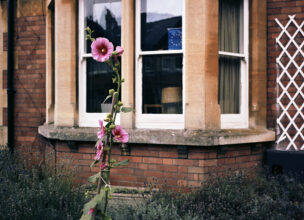
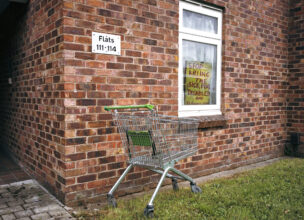
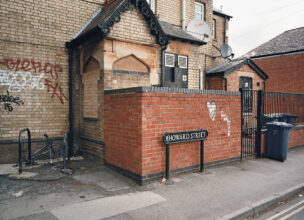
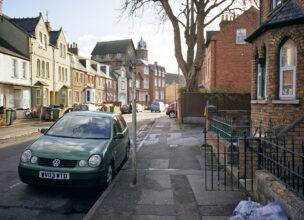
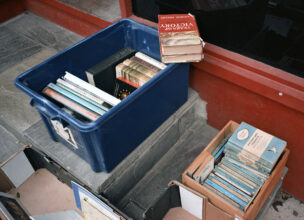
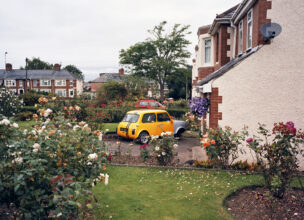
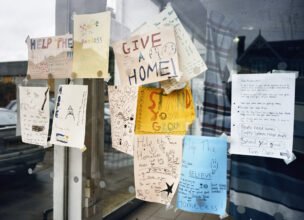
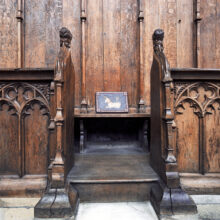
Whether in shopfront advertising, worn murals, streetscapes detritus, temporary shelters, cars, textures, spatial or surface ruptures, domesticity or its absence, the images depict precisely how ‘history can be literally embedded on the surface of things’. Signs, literal and semantic, abound.
Soto’s last sentence finishes: ‘the wealth of histories embedded in the prominent places as much as in the hidden corners guarantees there will always be room for surprises’, which could have served as a starting point. As could the final image – a barred view of a street of imposing sandstone buildings, another strong message of access for the few; a theme repeated in a black-and-yellow striped pole loosely tied with string to a permanent rail marking the side wall of what looks like an Oxford college building, and in a wall of arches blocked by an indented metal screen. To my eye, the repeats in tone in the imagery give substance in a way that is less effective in textual repetitions.
This was a project undertaken as the alienations of Brexit cast shadows, published as Covid intensifies the impact. Covid also has the effect of increasing the lure of anything not already seen, whether Oxford’s periphery or architectural details like sundials. Like any city with its multiple stories to tell, this book demands to be revisited repeatedly.
__________
A Certain Logic of Expectations by Arturo Soto was published by The Eriskay Connection and reviewed for Photomonitor by Rosa Ainley