

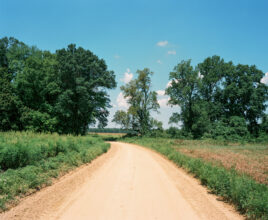
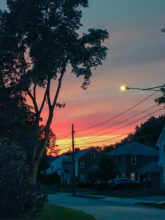


Not only a staple of popular culture, and deeply enmeshed with historical and contemporary notions of the elusive American Dream, the road is also a longstanding motif in photography. As facilitator of the visual journey or subject in itself, the American road features heavily in White-constructed canons of photographic history and school curricula. But the Black reality of the road has remained out of view. It is an uncomfortable truth which challenges the constructed myth of freedom that blacktop and asphalt provide, and as such has been acknowledged in much the same way that roads tearing through stolen lands are an inconvenient footnote rather than prominent point of discourse. And, as a reader who first engaged with photography through rose-tinted glasses as a student, looking at America via Ruscha, Ormerod, Morath and Shore, I am not apart from performing both exclusions.
In Amani Willett’s latest publication, and the second with Overlapse, the artist challenges this ignorant omission by exploring ‘the Black experience of driving in America over the past 85 years’, seeking to encourage dialogue and inclusivity where it has been absent. In doing so, A Parallel Road brings together multiple visual and historical sources to swell each page with overlapping images from a range of sources, including Willett’s own family archives, screenshots from police assaults on Black drivers and reproductions of pages from Victor Green’s Negro Motorist Green Book. A publication born of a need for Black Americans to find food, accommodation and repairs on the road, The Green Book is central to the mélange Willett creates. In re-activating the publication which was printed from 1936-56, a historical document is both witnessed anew and augmented by contemporary hostilities. So, while there are other resources that help engage readers with the Green Book — like the New York Public Library Lab’s journey planner — they provide succour in treating the circumstances in which the publication existed as exclusively situated in the past.
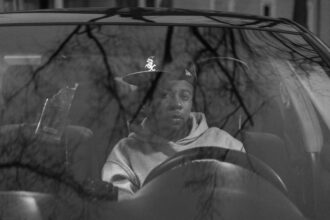
Progressing through the book the reader is pulled in different directions as parallel worlds go by. We see Black families standing in front of newly acquired cars layered on top of maps — with all the autonomy and freedom they imply, but are shortly after confronted by images of physical segregation in roadside amenities. These parallel experiences continue — from the smiling faces of a white family getting directions from a police officer in a ’40s advertisement, to the bloodied t-shirt of Philando Castile, killed by police in 2016 during a traffic stop. Sharp and contrasting junctures are interspersed with Willett’s own photographs which serve both to provide a distinctly human element (Willett’s photographs of drivers seem to exhibit a short film’s worth of emotion in the static frame), and to anchor the work in the here and now. Without an overt organising principle the atmosphere is one of a hectic scrapbook, asking the reader to grapple with violent juxtapositions and violent perpetrations. All of this, which contributes to an intense reading experience, is belied by the publication’s modest proportions (A Parallel Road mirrors the size of the original Green Book) that, together with uncut papers and single signature bind contribute to a price point which aids its finding a large, and deserved, audience.
In 1995 bell hooks called for hyper vigilance to the role images play in constructing Black narratives and narratives of Black Americans (1) . She highlighted that desegregation had provided a ‘vision of racial progress’ that to many, was a distracting salve for the equally important issue of representation as a ‘site of ongoing struggle’ (p.57). Here, in 2021, Willett shows just why such vigilance is needed, and how photography is pivotal in constructing, countering and witnessing inequality.
__________
(1) hooks, bell. (1995). In Our Glory: Photography and Black Life. In Art on my mind: Visual politics (pp. 54–64). New Press : Distributed by W.W. Norton.
__________
A Parallel Road by Amani Willett was published by Overlapse.
With thanks to Matt Johnston for this review.