“Photography was invented in the years between the publication of Adam Smith’s The Wealth of Nations (1776) and Karl Max and Friedrich Engel’s The Communist Manifesto (1848),” write Kevin Coleman and Daniel James in the introduction to Capitalism and the Camera, a collection of essays they’ve edited which includes contributions from Ariella Aisha Azoulay, Walter Benn Michaels, TJ Clark, Kajri Jain, and Tong Lam. Later Coleman and James add: “Beyond this twinned birth of technologies of reproduction in the age of empire, what are the connections between capitalist accumulation and photography? And might photography play a role in refusing capital’s infringements upon human freedom and planetary life?” These questions form the basis of the book, but it offers no easy answers.
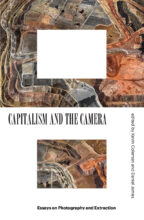
Capitalism and the Camera is subtitled “Essays on Photography and Extraction”, and the front cover features an image by Edward Burtynsky with a chunk taken out. Both the subtitle and cover suggest an idea that runs through the book, that photography extracts images just as capitalism extracts resources, and that both transform what’s taken into commodities. “Photography should be understood as part and parcel of the imperial world, that is, the transformation of others and their modes of being into lucrative primary resources, the products of which can be owned as private property,” writes Azoulay in her opening essay.
Azoulay concludes her contribution by considering a court case brought by Tamara Lanier – descendent of a slave named Renty Taylor whose image was held by Harvard – and “a limit on the imperial right to penetrate, photograph, and appropriate”. She considers, that’s to say, when not to photograph. In this conception, it seems, photography is underpinned by capitalism or even imperialism, and that it’s therefore ill-placed to critique this worldview.
This insight is emphasized in Siobhan Angus’ essay, which investigates the exploitation woven into the fabric of photography via the physical labour of the mine, the lab, or the darkroom. Historically unsung, this labour is now more obscure than ever, she argues, though it continues with digital imaging. “Narratives of dematerialisation dominate our contemporary understanding of technology,” she points out, “but raw natural resources and the exploitative forms of labour required to extract them continue to facilitate the possibility of representation”.
Christopher Stolarski contributes a similarly cautionary tale, tracing the camera’s position as “an instrument of socialism – or, at least, of anti-capitalism” in the early years of the USSR to an instrument of the state under Stalin. “The camera might be the quintessential tool of capitalist creativity, always engaged in the efficient, detached, reproduction of the world as-it-is, rather than creating anything authentically new – a world as-it-could-be,” Stolarski writes.
But then there are other readings. Azoulay describes a project titled Collaboration she’s working on with Wendy Ewald, Susan Meiselas, Leigh Raiford and Laura Wexler, for example, in which photographers “reconsider their form of involvement with others and seek alternative ways to engage with participants in the photographic event”. Kajri Jain writes about networks of dissemination in “the Image-world of the Bazaar” meanwhile, situating Dayanita Singh’s work in the context of “the complicated dance between uniqueness and reproducibility, chance and control, intimacy and distance, domestic and public, and gift and commodity”.
In short this book includes a multiplicity of perspectives on the relationship between photography and capitalism; it is “not an exercise in groupthink”, as Coleman and James write. They also assert that “while capitalism and photography have grown up as siblings, they have rarely been thought of together”, however, whereas I’d say perhaps there are a multiplicity of voices doing just that. As Coleman and James’ own examples show, historically there are thinkers such as Walter Benjamin, Siegfried Kracauer, Allan Sekula, and Martin Jay; in the current moment, related texts include recent books by Ariella Azoulay and Walter Benn Michaels, as well as publications such as Ben Burbridge’s recent Photography After Capitalism.
There are also clear links with books such as Mark Sealy’s Decolonising the Camera: Photography in Racial Time, which is informed by Marxist sociologist, cultural theorist, and political activist Stuart Hall, and analyses photography “within and against the political and violent reality of Western imperialism”. If anything it seems there’s a new wave of thinking about photography and its relationship with capitalism – though, like this book, there are many perspectives.
Either way, Capitalism and the Camera is a key addition, which perhaps informs another, wider issue – how these perspectives might unite. As Marxist critic Fredric Jameson wrote, quoted by Coleman and James, it’s a question of “how a society without hierarchy, a society that has also repudiated the economic mechanisms of the market, can possibly cohere”.
__________
Reviewed for Photomonitor by Diane Smyth
For further viewing: versobooks.com