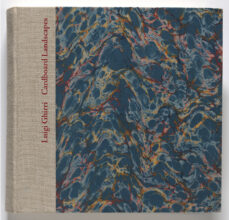


Luigi Ghirri Cardboard Landscapes, Museum of Modern Art, New York, 2020
__________
In March 1975 a handbound book of Luigi Ghirri’s Cardboard Landscapes, with a sequence of 111 colour photographs, was handed to the then Director of Photography at MoMA, John Szarkowski. Ghirri had tasked the Italian art historian Arturo Carlo Quintavalle to give this book to the influential American curator. The book was catalogued and logged and then ignored, remaining in the department vaults for nearly four decades, lost to the history of photography, until it was tracked down in the wake of growing interest in Ghirri’s work. This beautiful facsimile edition of this forgotten album now makes the book publicly available for the first time.
Ghirri’s Cardboard Landscapes was unusual for its time in that it was a book predominantly made up of photographs of other photographs, all on display, in shop windows, on billboards, on walls, as wallpaper and, in a remarkable sequence that ends the book, as discarded scraps of images on the ground. Ghirri was addressing the problem of how to photograph in a world full of images by picturing this “invasion of images into our living environments”. The world had become for him “a colossal photograph” and faced with the photomontage of this image landscape, his “photodismontages” relished the ironies of the visual juxtapositions and collisions abundant in this new environment.
A year after receiving Ghirri’s book, in 1976, Szarkowski presented his curated show of William Eggleston’s colour photographs at MoMA, which created an upset over aesthetic value in terms of their seeming affinity to amateur snapshots. In the essay for the book accompanying Eggleston’s exhibition Szarkowski had raised the question and problem of being a photographer at a time of photography’s ubiquity. In a rather odd comparison, he said how the world, then, contained more photographs than bricks and that they were “astonishingly, all different”.
Ghirri’s book would seem to have arrived at a good time. Here was a book that clearly chimed with what Szarkowski was wrestling with in this essay on Eggleston. And Szarkowski had from the very outset always been fascinated with amateur and anonymous photographs. An anonymous photograph that looked a bit like a Walker Evans adorned the cover of his book The Photographer’s Eye, his 1966 credo for photography’s distinction and merit as an aesthetic medium. Szarkowski also singled out Walker Evans’s Penny Picture Display— a photograph of many penny picture portraits presented in the corner of a Dance Studio window— for his selection of a hundred photographs from the MoMA collection Looking at Photographs in 1973. The first picture in Cardboard Landscapes, a cabinet of black and white portraits, appears to take its cue from Evans’s photograph. But Ghirri’s book seemed to not have interested Szarkowski. Why? Did its questioning of the limits of the aesthetic worth and value of photography simply go too far? Eggleston was not photographing photographs, and his pictures while resembling “the Kodachrome slides of the ubiquitous amateur next door”, as Szarkowski was careful to note, resembled them only in the same way “the belles-lettres of a time generally relate in the texture, reference, and rhythm of their language to the prevailing educated vernacular of that time.”
There is much ironic comedy in Cardboard Landscapes. A close-up detail of the corner of a billboard picturing blue sky behind a broken brick wall— serving as an effective symbol for the freedoms of consumerist desire— is set below and against the dark bricks of another wall, real, non-illusory and impassable. In Ghirri’s picture of an advert showing a couple blissfully wrapped in a blanket decorated with flowers, the green foliage above the hoarding underscores their sense of pleasure, the little Eden conjured by the advertising is augmented by canny reframing. Readymade images preoccupied Ghirri and in what was to be one of his last projects, picturing the painter Giorgio Morandi’s two studios after his death, he photographed after and in the wake of another artist’s vision. The photographs as well as showing the artist’s humdrum still life objects— jars, bowls, vases, bottles— also fixed upon paint smeared on the rags on Morandi’s easels or paint dabbed on boards and walls. Ghirri photographed paint as unformed matter.
Photography’s pervasiveness is his subject in Cardboard Landscapes. But just as he is attentive to painting as matter in his pictures taken in Morandi’s studios, one could suggest we have a parallel in this book’s focus and concentration on the materiality of its photographic images that are pictured on display, in use and discarded. We see the creased surfaces of the adverts in many of his photographs— in his detail of the broken brick wall ad, raking sunlight picks out the curl of the billboard image at its corner.
On a number of occasions Ghirri homes in on image deterioration. In a dynamic two-page spread he plays with serial repetition through the recurrence and gradual disintegration of a black and white image of a young woman’s face pasted upon brick walls. The papery image is not durable, it is in tatters, and by the last photograph we have lost the face completely. These pictures cue the final pages of the book which consist of pictures of nothing more than scraps of photographs, a photography of photographic fragments, photography as little more than waste and litter. A newspaper scrap showing Picasso’s face, happens to be a fragment from Irving Penn’s well-known portrait of the artist. Picasso died in 1973 and these photographs by Ghirri are dated 1971-3, so there is every chance this portrait fragment is the remains from the news of the great artist’s death. The picture is paired with a small rectangular card, bearing six identical graphic prints, stamped with the recognisable features of Charlie Chaplin’s face. The last newspaper scrap bears the word FELICITA (Happiness), a final somewhat ironic note in relation to these photographs of discarded images. It is paired with a photograph of a little yellow cinema ticket for a Tarzan film, among yellow Autumn leaves. FELICITA also is a reminder of what is promised over and over by so many of the commercial images he has pictured.
Ghirri acknowledges that there is no unmediated photograph, photography implicates other representations and this enfolding and mirroring of pictures is integral to the pleasure in his photography. He seems less concerned with the sheen or allure of consumer imagery and the commercial pictures that he photographs often seem more local and low grade than high-end. His photographs are a counterpoint in this respect to Richard Prince’s later Rephotography, begun in 1977, pictures concentrating us upon the glossed-up and heightened image world of advertisements. There is a certain entropic logic to the sequencing of Cardboard Landscapes— the sense of the thinness and insubstantiality of images as we are shown them wearing out in the sequence of portraits on brick walls and then the scraps of photographic litter that close the book. That many of the colour photographs themselves have faded and discoloured is no loss but becomes beautifully appropriate, another temporal layering that adds to rather than distracts from the subtle riches of this quite extraordinary book.
__________
Images presented here include spreads from Cardboard Landscapes (Paesaggi di cartone), 1971–73. The Museum of Modern Art, New York. Gift of the artist. © Eredi di Luigi Ghirri/Heirs of Luigi Ghirri
A link to MoMA’s listing for the sale of the reviewed publication (2020 facsimile with introduction by curator Sarah Hermanson Meister) can be found here.
Reviewed for Photomonitor by Mark Durden.