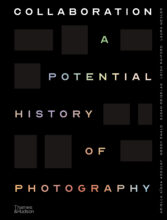



Collaboration – A Potential History of Photography, the new book published by Thames & Hudson, is presented as a compendium of more than 600 images that focus on the deconstruction of the ‘one photographer’ idea as the sole creator. The contents hone in on the perceptiveness of the photographer/subject relationship, revealing the underlying tensions and conditions in a photographic project. The objective of this publication is to challenge dominant narratives around photographic history and authorship that are the result of colonial and patriarchal dynamics embedded in society.
Co-written by five distinguished scholars and practitioners—Ariella Aïsha Azoulay, Wendy Ewald, Susan Meiselas, Leigh Raiford and Laura Wexler—this is a culmination of numerous exchanges and conversations that took place during seminars, lectures, workshops and exhibitions held on the same topic in past years.The book thus responds to a compelling need: that of investigating the intricate political, ideological and sociological ramifications behind the medium of photography through the lens of collaboration, that is, the interpersonal relationships and mechanics between photographer and subject—in the positive sense of enriching encounters with the other, but also in the negative sense of coercion and threat.
A very significant book on the subject is Daniel Palmer’s Photography and Collaboration. Published in 2017, this essay introduced me to an awareness of photography as a means of relationship rather than mere representation, enticing me to seek out and apply the book’s concepts in the way I conceive photography and the power dynamics behind it. I therefore approached this new publication with great joy and expectation, also being familiar with the work of the authors, which I follow and admire.
Collaboration – A Potential History of Photography is divided into eight clusters that seek to circumscribe the forms of micro-collaboration that can be encountered: from “The Photographed Person Was Always There” to “Reshaping the Authorial Position” and “Sovereign and Civil Power of the Apparatus,” just to mention a few. Structured according to a layout that spans throughout double spreads, the narrative of each illustrated project is composed of several graphic and textual elements: the images, the quotes from the work’s authors or participants, a varying description by the book’s authors and critical commentary by external contributors (curators, critics, scholars and more). These double pages come across as a bulletin board of notes that reproduce the scattered aesthetics of exhibitions and workshops held by the authors prior to this publication. As a result, the dense volume of content is designed to portray multiple perspectives on a single photographic project.
Throughout its 288 pages, Collaboration highlights many critical topics in the photographic medium: though, the feeling at times is that too many themes are placed under the collaborative umbrella, all of which are undoubtedly cross-connected but somehow deflecting from what should be the outlook of the book.
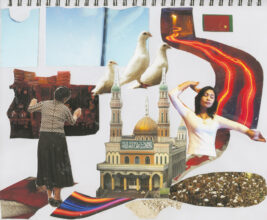
Many photographic works are presented, of different types and breadth: some noteworthy mentions include Jim Goldberg’s “San Francisco Residents”, Claudia Andujar’s “The Yanomami Struggle”, the Kamoinge Collective’s efforts to preserve the history and culture of the African Diaspora, and Carolyn Drake’s “Wild Pigeon” created with the Uyghur Community—all these projects return to the idea of an active and deep involvement between authors and subjects, or at least a reflection on the relationship of mutual exchange that is created between the two parties involved. At the same time, the choice to include certain works raises questions, or at any rate, is unusual. Likewise, names that I would have expected to find are missing. One among them, Anthony Luvera, who has been working for many years with collaborative projects and today is a key figure in such practices.
As someone deeply interested in researching, practicing and advocating collaborative photography, this book is an invaluable source for me, a sort of encyclopaedia to not so much further my studies but expand them. Yet, I wonder what it might be for those who have never really ventured into this subject. What will they get out of it? Will they really feel welcomed and accompanied on the journey along a potential history of photography based on the concept of collaboration? Or will they wander in a state of confusion trying to grasp the key concepts amidst the enormous amount of information? What kind of encounter will it be, that between an uninformed reader and this publication? After all, the book is introduced precisely as a pedagogical tool for practitioners and scholars of photography, and thus not a book for just anyone. Perhaps therein lies the answer to such questions.
Regardless, a publication like this was missing and is certainly a precious addition to the roster of countless titles on the history of photography. So far, too often have others focused on a colonialist vision imbued with social, gender and racial inequality. For those who are sensitive to these issues, it’s a must-have on your shelves. For those who are not, perhaps it is time for you to become sensitive.
reviewed for Photomonitor by Rica Cerbarano
__________
Collaboration: A Potential History of Photography by Ariella Azoulay, Wendy Ewald, Susan Meiselas, Leigh Raiford, Laura Wexler was published by Thames & Hudson .
Rica Cerbarano is a curator, writer and project coordinator specialising in photography. She writes regularly for Vogue Italia and Il Giornale dell’Arte, of which she is the co-editor of the Photography section. In addition to editorial collaborations, she works as an exhibition manager for various festivals, institutions and non-profit organisations. In 2017 she co-founded the Kublaiklan collective, which explores accessible ways of interacting with photography through the design of exhibitions and educational activities. Her curatorial research focuses mainly on collaborative and cross-disciplinary practices and the generative role of photographic installations in public space.