
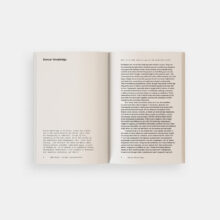
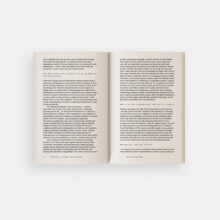


One of the interesting things about Curator Conversations is the fact it exists at all. A series of Q&As with 21 photography curators, it’s published by 1000 Words, an online magazine founded and run by Tim Clark – who is also himself a curator. These Q&As originally started life as a series of articles on 1000 Words, “initiated and published online during the first UK-wide lockdown to keep conversations around exhibition-making going, and to envision different ways of being, seeing and knowing against the backdrop of the Black Lives Matter movement, as well as the ensuing spectacles of police violence and world-wide protests – a point at which we have all been forced to check ourselves and what we’re doing in order to be extra mindful of privilege and positionality”, as Clark puts it in his introduction. These conversations could have stayed online, so publishing them as a book feels like drawing a line in a sand – though, as Clark suggests, these are quickly shifting sands.
The curators Clark has picked out are impressive and come from all over the world, including names familiar to anyone interested in contemporary photography (at least from a UK perspective), such as Clément Chéroux, Charlotte Cotton, Renée Mussai, Azu Nwagbogu, Mariama Attah, Urs Stahel, and Anna-Kaisa Rastenberger. They largely represent well-established institutions though there are also more left-field galleries and independent curators; private galleries don’t figure large, nor do collectives, though many of the curators stress it’s not a job done solo. All the curators were asked the same eight questions, three of which invite responses to the factors Clark picked out in his introduction – What is it that attracts you to the exhibition form? What does it mean to be a curator in an age of image and information excess? and What constitutes curatorial responsibility in the context in which you work?
The curators’ replies suggest that shifts that were already happening have intensified recently, and perhaps especially over the last year. Galleries were already using digital media but offered more when their physical buildings shut by Covid lockdowns, for example, and institutions have long acknowledged photography shouldn’t be dominated by wealthy, white, Western men, but have made more tangible progress of late. Louise Fedotov-Clements references intriguing-sounding “Minecraft production spaces” run at QUAD Derby pre-pandemic, for example, but says the institution will do more with digital media in future; Renée Mussai joined Autograph nearly two decades ago, but artists she’s worked with, such as James Barnor and Zanele Muholi, are now getting shows in big-name institutions.
Mussai argues there are still structural inequalities though, “notions of heteropatriarchy and Euro-centrism, and other deeply engrained regimes that must be undone”, and it’s interesting to consider how both digital media and widening representation in photography may hinge on access. These factors have the potential to overlap, not least when it comes to audiences – MoMA’s Roxana Marcoci stating that “online viewing has far surpassed (by millions) the traffic within the institution’s tangible walls”, for example.
Clark’s introduction also references privilege, however, another aspect of access that suggests another question in these interviews, What was your route into curating? This question opens personal insights into the curators, and it’s sometimes striking to see the cultural capital involved; Mussai suggests curators ask themselves if they are complicit in upholding power structures, if there might be “someone local who could speak to the topic instead, someone less privileged or less salaried perhaps?” Meanwhile movements such as BLM and digital access are, perhaps, helping to evolve what topics are discussed, and what bodies of knowledge are used to discuss them. It’s a multifarious approach that suggests being open to other perspectives, and for this reason and more, Curator Conversations is an interesting and timely intervention. My one criticism is that selected sentences in the text have been underlined in print. I like doing my own underlining.
Reviewed for Photomonitor by Diane Smyth
__________
Curator Conversations, edited by Tim Clark, is published by and available from 1000 Words.