__________
Karianne Bueno’s latest book concerns itself with ‘Doug’, a man Bueno met in the forests of Vancouver Island in 2010 and has since revisited, conversed and built a relationship with. Doug is an apparently solitary man of whom we get only glimpses, a figure who remained in a military town after the base closed and others moved away. Doug’s Cabin is a work which blurs fiction and document, creating a ‘labyrinth of stories and legends’ as Doug’s life is adopted as a lens through which Bueno is able to explore some of her own fantasies about an existence ‘away from society’.
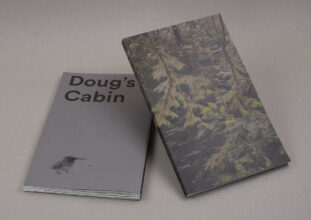
On initial inspection Doug’s Cabin is somewhat unruly — the title page appears on the back cover and the tall ratio of the softcover book suggests a deliberate choice to break from convention. Inside is no different as we encounter dense forest-scapes, messy interiors, grainy archive images, reproduced text conversations and curiously a colophon two thirds of the way through the pages. We see also the use of perforated pages which must be destroyed to be seen in their whole and an orientation which changes frequently. It is clear that this is a work that enjoys its playful interaction with the book form and asks of its reader a physical and cognitive engagement of some depth.
The playfulness of Doug’s Cabin runs deeper though than these first impressions. It employs the language and aesthetics of the photo-essay photobook combined with pressing contemporary concerns and an ever-present fascination with artist-subject relationships and veracity to create a true tangle of work ‘across multiple layers of time and reality’. Quite how much untangling might be possible is up for debate and relies not only on a reader’s position on a spectrum of belief and disbelief but also how much Bueno and the team behind this project have created a space for comprehension or obfuscation.
Most journeys through the book will however reveal some beautiful poetic sequences carefully constructed across various forms of media and other points at which the stifling forest makes way for the focus of clearings in the woods and narrative. These moments along with the reproduction of Bueno and Doug’s ‘conversations’ help to anchor some of the central themes explored amidst a multi-layered and multi-media narrative which is densely packed. Solitude, simplicity, place history and the natural world are at the core of much of this book and as such it is hard not to locate it within an increasing pool of recent works which deal with similar ideas. To name a few, Doug’s Cabin brings to mind themes brought up also in Alec Soth’s Broken Manual, Oscar Tuazon’s Leave Me Be, Amani Willett’s The Disappearance of Joseph Plummer and Lucas Foglia’s A Natural Order as well as the interactive web documentary Welcome to Pine Point by Paul Shoebridge and Michael Simons.
At €40 and with complex visual storytelling, this is firmly a book for photobook and artist’s book readers which is a shame as there are substantial components of this narrative that will chime with a wider readership. Nevertheless it is an enjoyable book, and aside from the perforated pages which might fall slightly on the side of gimmick for some readers, is one which is nuanced in its construction and presentation. What’s more, with the motifs of the work, visual tropes and design work, it is an exemplar of the post-millennium crossover of the photo-essay and artist’s publication in book form.
– reviewed for Photomonitor by Matt Johnston
__________
For further viewing:
Doug’s Cabin by Karianne Bueno was published and is available from The Eriskay Connection.