________
‘4give me ma’ reads the screen of a Nokia cell phone. The text message is being drafted, yet to be sent – if ever. It’s an image that quakes with inhibition, vulnerability, regret and longing, and comes from Edgar Martins’ judicious new twin publication, What Photography & Incarceration have in Common with an Empty Vase. Working in collaboration with the inmates of Her Majesty’s Prison Birmingham in the West Midlands and their families, Martins proffers a multi-layered meditation on the absence of the inmates, as experienced by those on the outside.
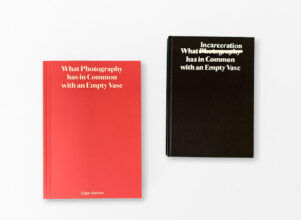
Both books are supplied within a prison evidence bag. The first, slightly larger with a red cover, takes us through puzzling and irresolvable sequences that move through image and information, evidence and fiction. The transitions are subtle and not directorial, because associations are often made at the turn of the page or foldout rather than on facing pages. We encounter deserted residential streets lined with barricaded houses, seascapes superimposed by chalk outlines of heads and, recurringly, figures – loved ones, perhaps – stood outside the towering prison walls. The absence of photographs taken within the prison and of prisoners is a positive act on Martins’ part. Skewing the medium away from its preoccupations with the referent, the artist renounces our predisposition for certainties, all the while eschewing the dominant narratives concerning crime and punishment.
Photographs of telephones, postcards and letters form the core – the tragic motif and melancholic resonance – of the photobook. There are improvised communicative tools, too: cigarette packets ingeniously inscribed with dark messages overlaying their health warnings show how one prisoner sought to communicate with other inmates during his solitary confinement, whilst another’s engravings on pencils read almost like private articulations with the self: ‘let it go’… ‘tonight’. Describing a world delicately tethered by traces, these poignant artefacts are products of the oppressive, life-denying conditions the penal system has imposed upon them; a pursuit of justice in the name of the greater good of society.
Martins realises its human anchor-point via the photobook’s counterpart, a facsimile of an inmate’s journal entitled What Incarceration Has in Common with an Empty Vase. It introduces John F., who recently turned 50 and is currently completing a 15-year sentence for drug-trafficking. His frank, eloquent scribbles, spanning a period of nearly three years, narrate his despondencies serving time, his training with the Samaritans to be a listener and his strained relationship with his children.
An entry dated 9 March 2018 reads:
Unbelievable! Just got off the phone with my lad and feel a million bucks. I needed that! Since his phone broke it’s been nigh impossible to get hold of him. And when we have spoken, the one syllable mutterings have made me feel like he’s not bothered to hear from me. Today he started the conversation by saying he’d been thinking of me, which made me feel good. OK, granted, apparently it was whilst he was having a shit, but I’ll take that. I’m buzzing with joy that he thought of his old man whilst having a shit.
We chatted for so long the money ran out. Brilliant, no computer games in the background.
Twenty days later, the journal reads:
Just feel like everything is going the wrong way again.
No visits booked. No expecting mail. No courses to get into. No initiatives to push.
Just nothingness!
Gradually, John F.’s entries indicate an increasingly explicit fear of being forgotten behind bars; a becoming-unseen that is intrinsic within a penal structure that hides lawbreakers from the public gaze. The exchanging of both information and emotion, within and beyond the prison gates, is obstructed, the journal thus speaking to the ways in which the prison apparatus holds people apart, whilst exposing the fragility of the bonds that hold them together. This play is visualised most memorably through Martins’ nod to Piero Manzoni’s Artist’s Breath (1960) in the photobook: two balloons which were blown up by the prisoners and then delivered to their families by Martins – the artist-conduit – himself. The prisoners technically smuggled ‘into’ the outside, even if only their breath.
Naturally, Martins’ appropriation of John F.’s diary harks back to Danny Lyon’s documentation of Texan penitentiaries in his seminal Conversations with The Dead (1971). Incorporating ephemera such as prison records, convict writings and letters, the book centres on Billy McCune, whose startlingly vivid drawings offset the parched black-and-white of Lyon’s photography. In one, an orange hand holds a pen to a piece of paper, enveloped by a blanket of twinkling stars; but, of course, the practice of expression is never as unceasingly constant as the infinite night sky. Where John F. experienced mental blanks, he collaborated with, and confided in, Martins to integrate archival imagery as a surrogate to language. From Sisyphean figures confronting boulders up mountains to fathers elevating their prized babies, they are allegorical as well as psychologically suggestive.
As evidenced by Martins’ act of sous rature – crossing out the word ‘photography’ on the journal’s front cover – this work seeks to both question and advance our grasp of the documentary genre and develop a new critical and visual language. The concurrent use of text and image indicates that neither is, in itself, a medium capable of fulfilling a documentary function; a disjunct that results in a feeling of estrangement to the inmates. Perhaps it’s an exposure of the fantasy of identification that McCune envisaged – in advance of a 1970 exhibition which coupled his drawings with Lyon’s photographs – in his closing letter in Conversations with The Dead: ‘My feelings to your feelings, from my heart and brain to your heart and brain.’[1]
Investigating absence through an ontological framework, What Photography & Incarceration have in Common with an Empty Vase disrupts the status of the photograph when its so-called “subject” eludes visibility; when it exists beyond the confines of the frame, in the realm of the imagined. A parallel is drawn between the photograph’s partiality and the context of incarceration: the loss and longing experienced by both those inside and outside the cell. Just like an empty vase, after all; without, missing, incomplete. Or an unsent text message, which may or may not plead for a mother’s forgiveness.
– reviewed for Photomonitor by Alessandro Merola
__________
[1] Danny Lyon, Conversations with The Dead (London: Phaidon Press, 2015), p. 198
What Photography & Incarceration have in Common with an Empty Vase was commissioned by GRAIN Projects. This project will be exhibited at the Macau Museum of Art, from 31 July – 11 November 2020
Image of cover from What Photography & Incarceration have in Common with an Empty Vase © Edgar Martins courtesy the artist and The Moth House