__________
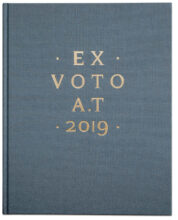
Halfway through Ex-Voto, the spellbinding first monograph by Brighton-based photographer Alys Tomlinson, your gaze rests on two images, side by side. In lush, large-format black-and-white they show two sections of a moss-covered wall. Just visible between the rough heft of the stones are several white forms – tattered pieces of folded paper. These are “ex votos”, offerings left by pilgrims; material manifestations of their gratitude and their faith. We don’t know when they were left, or by whom, or what might be written on them. Perhaps the inky words have long since washed away. In a sense, though, none of this matters. What matters is the mere fact of their presence, however fleeting. Like anchors, they link a spiritual moment to a physical place.
Tomlinson’s series has won her a string of accolades, including 1st place in the 2018 Sony World Photography Awards and, most recently, the 2019 Rencontres d’Arles New Discovery Award. Deservedly so. A sophisticated approach to photographic storytelling runs through the work, which brings together images shot at three pilgrim sites in Ballyvourney in Ireland, Grabarka in Poland, and Lourdes in France, shot over five years. Framing the book are three essays, by Dr Rowan Cerys Tomlinson, Professor John Eade and Sean O’Hagan, which together offer historical, personal and sociological context but Tomlinson eschews over-explanation. Instead of captions, maps or chronology, we have a rhythmic, almost tidal, sequencing. We are swept along, back and forth, into still-life close-ups of the Ex-Votos, then out again into landscapes, punctuated by subtly dramatic portraits of pilgrims.
Much of contemporary photography’s originality comes from concept-heavy, process-oriented approaches. Against that backdrop, this feels fresh for the fittingly unshowy approach it takes to a surprisingly enduring topic. Who would have predicted the rising popularity of pilgrimage in the digital age? The influence of the great documentarians of the 20th century – Dorothea Lange, Walker Evans, or Diane Arbus – is clear stylistically and also in terms of sensibility. Particularly in the portraits, we find an uncanny beauty, a muted intensity, that recalls, for example, Evans’ portrait of Allie Mae Burroughs. Sometimes subjects’ uniforms, their faces, seem dislocated in time, as though they have been transposed from another age – the 1950s, or the 1850s.
Everything about the book inspires contemplation. Reading the introductory essay by Dr Rowan Cerys Tomlinson, printed with bronze typeface on dark grey paper, you’re forced to peer closely. Similarly the photographs, immaculately printed on creamy, thick paper, are so ravishingly dense in detail you feel compelled to observe them through touch, as well as sight. Some have an ethereal air – the first picture of the book, which appears to be twinkling dappled shade on a dewey, leaf strewn forest floor, seems to dance off the page in a delicate interplay of dark and light, focus and blur. Others feel more solid – such as a weather-beaten rock face, marked with cross carvings. You don’t need to be a person of faith to recognise this very human impulse to say, “I’m here”, to make your existence felt, to connect with something greater.
– reviewed for Photomonitor by Rachel Segal Hamilton
__________
Ex-Voto © Alys Tomlinson (2016-2018) was published by GOST in March 2019.