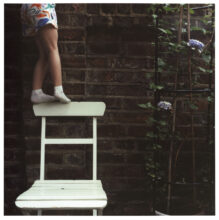
A pair of small, cotton-socked feet balance, gracefully, precariously, on the back of a fold-up garden chair. So much of childhood and parenthood and the space between them is contained in this frame. To a child, every object is a climbing frame, the world a boundless obstacle course where new adventures emerge with every step. That a chair is designed for sitting on is irrelevant, a challenge. To the parent watching, this acrobatic curiosity is a thing of wonder and also of terror. At any instant, they think, heart in throat, the chair could slip. It doesn’t, but it could.
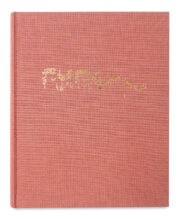
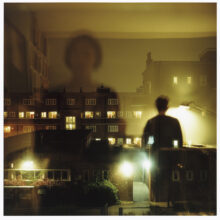
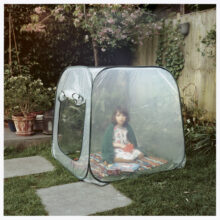
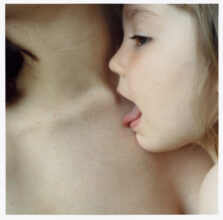
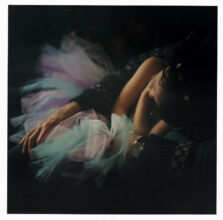
Fugue is a book about love and loss, about mothers and daughters. Combining photography with poetic prose, the narrative delicately weaves memories and moments from a period when Goldblatt was mourning her parents while raising her own young daughters, Covid-19 lurking. There is a long history of female photographers focusing their lens on their offspring, from Julia Margaret Cameron to Sally Mann, but recent years have seen a welcome proliferation in new multi-layered representations of motherhood. Among these, Goldblatt’s work stands out.
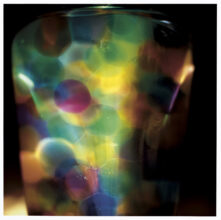
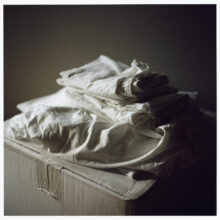
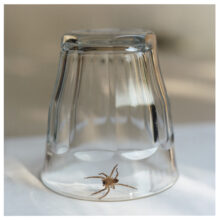
The conflicting emotions of motherhood – at once stifling, frustrating, enraging, nourishing, extraordinary – play out. In one pairing of words and image, an abstracted kaleidoscope of glittering light, she considers how after a disagreement “the invisible twists and fibres of attachment pull us back into our tiny cosmos, threaded with supernovas and stars”. Heightened attention is turned to domestic scenes, where piled up tupperware or hanging laundry become startling still lifes. A child’s tactile, imaginative dominion of space manifests in a fist stuffed into a glass, bodies rolling across a sofa, chairs reimagined as a surreal sculpture.
Fugue excels in its portrayal of the contorted connections between generations. No images of the artist’s mother appear. Her absence is a presence keenly felt through her objects. Goldblatt talks about the sad, painstaking process of clearing out her parents’ house before selling it, siblings laying claim to different items, gifts received though not given. The ‘law of contagion’ is a kind of magical thinking that even the most rational of us engage in – the idea that something residual of a person inhabits their belongings: Goldblatt’s grandmother’s teapot wrapped in newspaper by her mother whose comb she now pulls through her daughters’ tangled manes.
Children are time made flesh, materialised in milk teeth, collected and kept like relics, in the condensation of warm breath on a mirror. “I am afraid that everything will be taken away from me,” Goldblatt writes at one point, perfectly underlining the way that the pleasures of motherhood are constantly undercut with a sharp awareness of mortality. Photography also does this, attempting to hold onto something that is gone as soon as it’s captured.
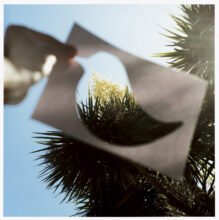
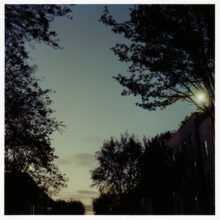
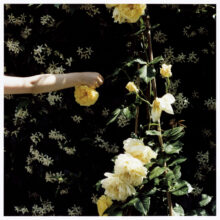
But similar to the comb, the teapot, analogue film does have a physical connection. The light of then is a trace that remains. Punctuated by seasonal nature references – conkers in autumn, blossom in spring – Fugue reminds us that beginnings and endings are cycles and repetitions. Motherhood braids past, present and future, like hair, rooted but growing somewhere else.
__________
Lydia Goldblatt (*1978, GB) holds a Master’s from the London College of Communication. Her series Still Here was published in 2013 as an artist monograph by Hatje Cantz. Her second book Fugue was published in spring 2024 by GOST Books. Her work has been exhibited internationally, including at the Felix Nussbaum Museum, Osnabrück; Somerset House, London; the GoEun Museum of Photography, South Korea; and the National Museum, Gdansk. She was awarded the Grand Prix at 2014’s Tokyo International Photography Festival and, in 2020, the Taylor Wessing Portrait Prize for her portrait Eden from the series Fugue. She lives and works in London.
__________
Fugue by Lydia Goldblatt was published by GOST and reviewed for Photomonitor by Rachel Segal Hamilton. An exhibition of photographs from Fugue are currently on display at Robert Morat Galerie in Berlin.