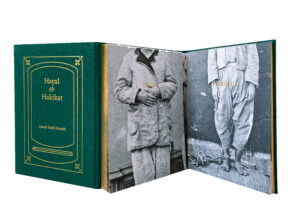
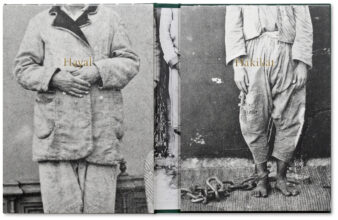
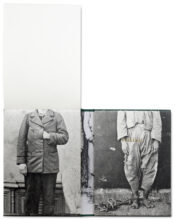
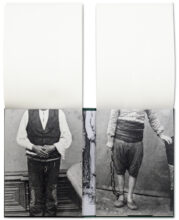


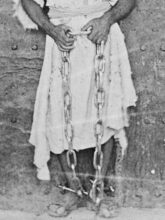


Hayal & Hakikat: A Handbook of Forgiveness & A Handbook of Punishment by Cemre Yeşil Gönenli is an innovatively designed book presented in three sections. It includes re-presented photographic images taken from the Abdul Hamid II photographic albums (1893/94) together with a contextualising essay by Refik Akyüz, translated by Orhan Cem Çetin. The photographs are shown in two sections that sit side by side. This includes a re-presentation of a number of photographs, the Hayal portraits that have been cropped to anonymise the subject in the photograph, and in order to focus on the gestures of the hands in the image. Alongside of these images Hakikat shows bodies shackled with chains, again the images are cropped so the subject cannot be identified. The essay is separated from the images and can be accessed when reading the book in reverse. In doing this the text becomes another physical element that contributes to the overall publication.
There is a regency green cloth book cover that wraps the book, which is embossed with a gold diagram that draws its design from the early photography albums. This design and book title can be accessed whichever way the book is engaged with, this includes back to front, front to back, left to right or in reverse. In addition to this, each page is edged with gold. Although this may sound strange, according to Gönenli the size of the ‘hand’ book has been determined by the size of her husband’s hand when spread flat. This is far more relevant than you may imagine as I will go on to explain.
It is crucial for the reader to know the historical context of the Abdul Hamid II photographic albums to fully understand the intent of Gönenli’s intervention of these archival photographs. The albums were created by Abdul Hamid II against a backdrop of a failing Ottoman Empire with the intention of re-writing the Orientalist framing of the Ottoman world. They were produced for an occidental audience to evidence the modernisation of Turkey. However, Gönenli’s intervention reveals another narrative latent within archive, that is the narrative of punishment and forgiveness.
According to Akyüz, Hamid II had an avid interest in phrenology and physiognomy, and he was particularly interested in the notion that ‘any criminal with a thumb joint longer than the index finger joint, is inclined to murder.’ This he claimed was the basis of the declared amnesty of convicted murders. Ahead of the planned absolution of murders and in order to reveal their criminal intent, Hamid II ordered that all prisoners be photographed with their hands-on show.
Under Gönenli’s scrutiny the catalogue of hands sits alongside of those still incarcerated in chains. In employing this strategy, the reader is invited to reflect on the original purpose of the photographs and in doing so, consider the arbitrary nature of an imposed taxonomy in determining the fate of those in the photographs. Overall this book is an exquisite object that reveals a tragic and somewhat forgotten history.
__________
Reviewed by Caroline Molloy for Photomonitor.
Hayal & Hakikat: A Handbook of Forgiveness & A Handbook of Punishment by Cemre Yeşil Gönenli, with an essay by Refik Akyüz translated by Orhan Cem Çetin, was published by GOST Books (2020), Co-Edition with FiLBooks.