Reviewed by Mark Durden
How can I do her justice, left with half-clues, a lot of “allegedlys” and the hollowed-out memories of people who met her long ago, trying to stitch together the fabric of her life with only a few bare threads at my disposal?
Dragana Jurišić raises this question about two thirds of the way into her rich and distinctive book Her Own. Jurišić’s doubts arise from delving into a compelling mystery in her family history, surrounding the life of a beautiful and glamourous aunt, Gordana Čavić, who left her rural home village in Yugoslavia for Paris in the 1950s. At this point in her auto narrative Jurišić has mused on André Breton’s ill treatment of the woman, Léona Camile Ghislaine Delacourt, who inspired his book Nadja, and beginning to wonder if she is not much better than Breton in drawing on someone’s life for her art.
Her Own is not just a story about the mystery-shrouded life of her aunt. It also entails powerful accounts drawn from Jurišić’s own life, as well as giving us brief portraits of other strong female family members, including her mother and grandmother and oldest aunt, Milanka. Her grandmother’s resilience and strength was shown when she faced a Nazi firing squad three times. It was her refusal to dig her own grave, which in the end saved her.
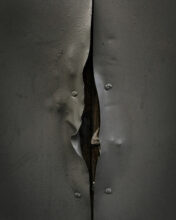
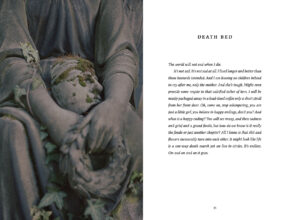
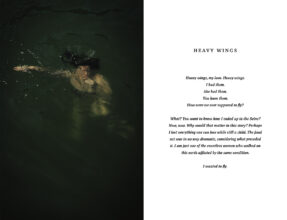
Dragana Jurišić’s Her Own is a standout photobook— if indeed it can still be described as a photobook, so distinct is it from the established format and convention. For a start writing is central and the writing is good, engaging, frank, and at times even brutally funny as Jurišić muses on the absurdities and ironies life throws up. Photography supplements the writing, enlivens, expands, and enriches it. But the photographs also impact on the writing, which takes the form of a succession of vivid fragmentary chapters or scenarios, often resting on striking visual situations or recollections. The writing involves a mix of voices, as Jurišić adds fictional diaristic narratives of Gordana’s to her own first-person accounts, and brief lyrical passages in response to the fate of L’Inconnu de la Seine, the beautiful, unknown woman believed to have drowned in the river in the 1880s, immortalised through her death mask, copies of which became a muse for writers and artists. An interview with the daughter of the family who cared for Gordana when she was dying in Paris – her cause of death is never explained – refers to the aunt having a plaster cast of the death mask. Gordana said it could have been her and the death mask offers another important facet in the portrait of her enigmatic aunt, emblem of the beauty, mystery, and tragedy of her life.
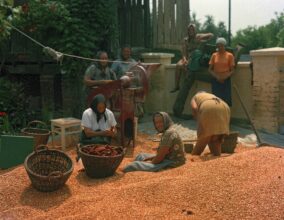
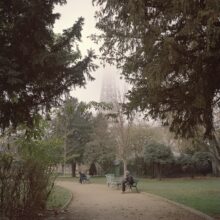
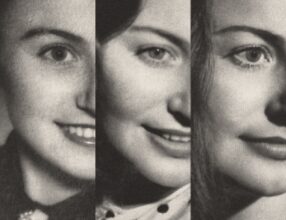
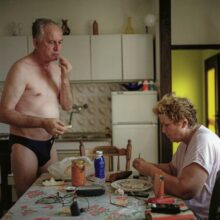
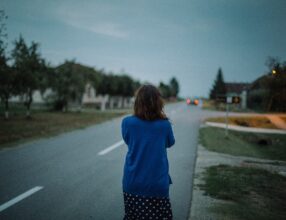
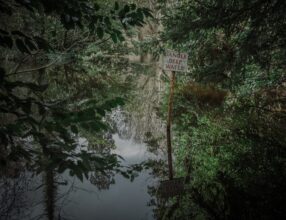
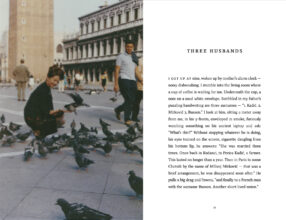
An opening double page photograph showing a pond bearing a sign “Danger Deep Water” provides the metaphoric cue to the journey Jurišić undertakes in this book, as she delves into the family secret surrounding her aunt’s life. The writing is interspersed with a series of photographs taken by Jurišić and from some of the remaining “bare threads” of Gordana Čavić’s life: family photos that Jurišić managed to salvage from a couple who looked after Gordana’s mother when she was dying and who as a result inherited the family home and what possessions remained. The author also presents us with a series of self-portraits, in which her own face is variously diffused and broken up in screens and mirrors. When she visits Gordana’s grave, she makes a double portrait, her image reflected in the shiny marble etched with a portrait of her aunt— a succinct visualisation of the dynamic upon which the book rests
The book begins with the author’s blunt and powerful account of her own traumatic loss of twins by miscarriage in Dublin, where she lives. The death of the twins signals the end of a relationship. Not much is said about the breakup, the ending of her relationship is given short shrift. Women not men are the central focus in this book. In her opening account of the miscarriage, she must endure the sexist rant of a Catholic preacher on the radio as she takes a taxi to the maternity hospital. After an examination she is left to carry the dead twins inside her for four days— “a living tomb”— before they are “scraped out of me”.
Her writing often has a visceral power and immediacy: “Never felt body grief before. Its primal intensity rooted in the magma at the centre of the earth. It radiates from my innards. The mind could never conjure this up. I can see the pulp of the pain as clearly as those blood clots I just flushed away in the hospital toilet.” When she sleeps in her grandmother’s ancient bed in Kućanci, she throws the pillow aside and presses her:
nose deep into the rough mattress. She is still here. A woman who stood before the firing squad three times. A woman who gave birth to eleven children. Six of them, all sons, were born and died on this same bed. On her deathbed, her cancer metastasized; Dragica Lazić refused painkillers, telling her daughters she wanted to know what death feels like.
The mattress becomes “An olfactory photograph” of her grandmother’s tough life and death.
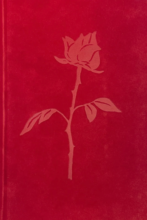
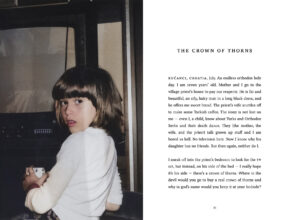
The book is sumptuously bound in red velvet, with an embossed shape of a thorny rose on its cover. It stands out from other books, has presence and distinction, in keeping with its subject, Gordana. The red cover also links with the blood imagery that recurs— beginning with the photograph visualising Jurišić’s miscarriage, showing blood puddled by her left foot with painted red nails. There is a story about a real crown of thorns in a priest’s house that she puts on as a child and shreds her forehead. It is an incident that makes her mum say to her father that she is “Just like Gordana”. In her vivid recall and descriptions of the slaughter of people on the street she witnessed, in the aftermath of a shell exploding during the war in 1992, we get the brutal analogy of a girl’s leg being “like Bolognese”. In a following chapter the author recounts a dream or nightmare in which she finds a beating, bloody heart outside her apartment door and carries it around in a panic until she realises the only way to “save it” is “to open my mouth wide as possible, shove it down my throat and swallow.” The nightmare rebounds back on what Dragana is doing, makes us think that making art from the life of another might be seen as a kind of cannibalism.
The rose on the book cover is connected to a profile portrait of Gordana holding a rose. This tender romantic self-image is counterposed to the taxidermy bear’s head on her lap, with its jaws open and fangs bared, it points to something fundamentally other, but nevertheless a part of Gordana— something dangerous, violent, wild and untamed. A closing portrait in the book of Dragana staring to camera and holding a startled cat in her arms offers a slightly tongue in cheek echo of Gordana’s photo and the screaming bear.
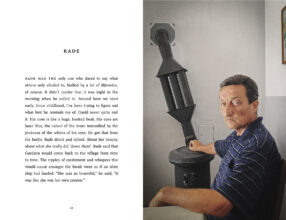
Through Gordana two worlds collide. As Rade, the gravedigger, recounts to Jurišić, when she would come back to the village from time to time it was as if “an alien spaceship had landed”. In the description of her funeral in Kućanci, the colourful flamboyant clothing of foreigners attending her funeral in contrast to the faded blacks and browns of the locals is likened to “A smashed rainbow on the dark clay”.
Jurišić discovers that Gordana married three times. She worked as a seamstress in Paris, but there were also rumours she was a spy and a sex worker. Gordana’s diaristic fragments culminate in an account of her being an informer on enemies of the Communist state, a fictional scenario stemming from a real story involving two young Yugoslav men living with the French actor Alain Delon, known as “beautiful beasts”. Both were murdered. In the final line in Jurišić’s imaginary account, having witnessed their violent and abusive behaviour to the women they are with, it is Gordana who is implicated in their deaths, reporting to her boss to monitor them as “they had ‘bad news’ written all over their pretty faces”.
The book relays a shift in tone and emphasis as it moves from the brutal realism of her account of a miscarriage at its opening, through the conflicts and collisions between her and her family and the people in her home village as she researches her aunt’s life, to the closing immersion in the clandestine and glamourous world in which Gordana is imagined to have operated within in Paris. It makes a lot of sense to understand that the book is set up as a kind of prequel to a film that will dwell upon Gordana’s life and work in Paris. Film seems the perfect next step. But that is not to downplay the effectivity or completeness of the form of this photo-narrative book – poised brilliantly between the frankness and directness of so much of Jurišić’s writing and the alluring beauty and unfathomability of Gordana.
__________
The self published first edition of Her Own is currently sold out on Jurišić’s store, but remains available through other stockists.
Mark Durden is a writer and artist. He has taught both Art History and Fine Art at Kent Institute of Art and Design, Canterbury and at Staffordshire University. He taught History of Photography at University of Derby where he became Reader in 2002 and Programme Leader for the BA (Hons) in Photography in 2003. He left Derby in 2007 to join the University of South Wales as Professor of Photography. He has published extensively on photography and contemporary art and since 1997 has worked as part of the artists’ group Common Culture.