
Reviewed for Photomonitor by Isabella Seniuta
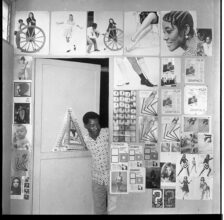
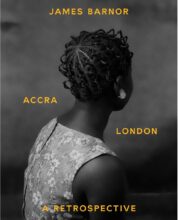
One image in black and white from the early 1970s symbolises James Barnor’s career between Accra and London in the 1950-1980 period: a man opening the door of the Studio X23. In this picture we can see around the door a composition of pasted photographs – of Drum models taken in London, of studio and street portraits from the 1950s in Accra, a calendar made in colour for Agfa-Gevaert in the 1970s, photographs of relatives (babies, women, children.) These are people who crossed Barnor’s path, and whom he dutifully captured, brought back home, and archived. When he saw this newly rediscovered image in the archives, the photographer told me, “I really like this one, I’d like to have it in large format so I can have it at home too.” This image is printed in the book James Barnor: Accra/London – A Retrospective which is published in a specific context: the organisation of the first major monographic exhibition of the photographer at the renowned Serpentine Galleries in London (until October 24th), coinciding with the digitisation of his archive of almost 20,000 images.
James Barnor’s career is unprecedented in that it spans two continents in the post-World War II era, leading up to Ghana Independence in 1957, and that he has kept all of his archives, unlike most of his contemporaries. Born in 1929 in Accra, Ghana (then still the British colony of the Gold Coast), Barnor is known for having opened Ever Young studio, one of the first portrait photography studios in Ghana in the early 1950s. In the 1960s, he moved to London and undertook assignments for Drum, a South African anti-apartheid/ Black lifestyle magazine. Barnor went back to Ghana in the 1970s, opened a second studio in Accra, Studio X23, one the first colour-processing laboratories in Africa, before switching his focus to the music business. He returned to London, his current home, in the late 1980s, becoming a cleaner at Heathrow Airport, until he retired. The recognition for his body of work only came later in his life, following a series of encounters: first with the Black Cultural Archives which organized his first show in London in 2007, then with Autograph ABP, and finally with the Clémentine de la Féronnière gallery, which is today in charge of all his archives and of the digitisation of his work.
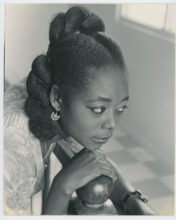
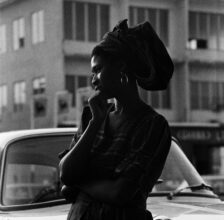
This new publication is part of a program by Serpentine Galleries which puts the spotlight on elderly artists who have not, so far, benefited from such individual attention by museum institutions – one example being the Luchita Hurtado show in 2019, which brought unprecedented attention to the Venezuelan painter. The book presents texts commissioned from various authors, alongside several portfolios from the 1950s all the way to newly digitized and rediscovered images from the 1970s. The photographs are selected from a vast collection of glass negatives, vintage images, and contacts sheets. Of that number, some unfortunately reveal issues with colour and some of the tones of the prints are faded, which is a shame considering Barnor himself is a printer. However, the book demonstrates the photographer’s instincts and experience across a range of subjects: studio portraits, of course, but also the documentation of the Ghanaian Independence, the representation of the African and Afro-diasporic lives in London in the 1960s, and the brilliantly composed portraits of women in natural light taken between 1950-1980.
The merit of this book is to propose socio-political reflections on the work of James Barnor. On the one hand, the text by architect Sir David Adjaye, best known for designing the National Museum of African American History and Culture in Washington, D.C., highlights the notion of Western Gaze and also brings new perspectives to the discourse of the representation of the Black diasporic community by establishing a dialogue between photography and architecture. On the other hand, the text written by the visual artist David Hartt is undoubtedly, according to me, one of the most interesting in the book, because it places Barnor in the history of photography by drawing comparisons with photographers such as Kwame Brathwaite or Charlie Phillips. His essay deals with one of the most important themes in James Barnor’s work, which is still under-researched: interracial couples in England in the 1960s.
The book also includes a text by one of Drum‘s models named Erlin Ibreck, which contrasts with the other essays as it is actually a ‘friendship statement’ addressed to James Barnor. This text gives us some unique insights into the African diaspora communities in London in the 1960s and the context of producing fashion photographs for the influential Drum magazine. The essays written by Christine Barthe and Alicia Knock are in between: these are texts written by two French museums curators, which offer interesting historical reflections on his photographs, and contextualise his work. In contrast to those by Adjaye and Hartt, these essays are partly based on interviews with the artist and raise a question that could be transposed to many monographic works: how to write about the work of an artist who is still alive? This is precisely what Lizzie Carey-Thomas, Serpentine’s Chief Curator, asks in a short Curatorial Acknowledgment that would have deserved to be placed at the beginning of the book, and not at the end, to form a real introduction. Indeed, this short text raises what I consider to be the most fundamental question: how can one conceive of a book and an exhibition that does justice to James Barnor’s multiple and generous anecdotes on almost all of his images?
The purpose of this book is precisely to give space to the artist’s words, which is why Hans Ulrich Obrist (HUO), the director of Serpentine Galleries, has conducted a long interview which opens the book. Despite the fact that James Barnor’s answers sometimes veer into the realm of storytelling, this interview offers some thoughts on the questions of networks and on the circulation of Barnor’s photographs within a transatlantic perspective. Indeed, HUO introduces the notion of influence, linking Barnor’s work to young contemporary photographers like the American Tyler Mitchell. Mitchell, who was the first Black photographer to shoot a cover for Vogue in 2018, recently recognised Barnor as a pioneer for the work he did for Drum magazine in the 1960s. Although James Barnor was not always credited for his commissions in Drum, the sharing of his images on the Internet has created a new phenomenon: several American and British photographers have discovered his work, and now use him as a role model.
James Barnor: Accra/London – A Retrospective shows us that there are still many themes to be explored that take political questions, British postcolonial identities, but also the circulation of images and their impact on artistic practice into account. A number of upcoming projects will undoubtedly shed new light on James Barnor’s work: Margaux Lavernhe’s PhD thesis in preparation at the EHESS in Paris, Damarice Amao’s project on the Independence of Ghana for Arles Photo Festival, and the platform Culture Art Society, amongst others.
__________
James Barnor: Accra/London – A Retrospective was published by Serpentine Galleries in collaboration with Koenig Books, which is co-produced with MASI Lugano and Detroit Institute of Arts, and is available through Serpentine Galleries (UK) and Maison CF (FR).
All images courtesy Galerie Clémentine de la Féronnière
Isabella Seniuta is a French-Polish Research Assistant at the Department of Photography of the Centre Pompidou. She obtained her doctorate from Paris 1-Panthéon Sorbonne University where she wrote a PhD thesis on the history of “The Eye Club”, a network of actors that helped shape the emerging photography market between Paris and New York in the 1960s and 1980s. Her research interest includes Queer Studies, Feminist Art and Experimental Photography.