__________
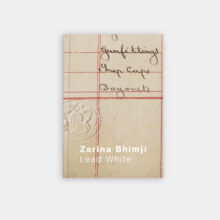
Published to mark Tate Britain’s ‘Spotlight’ display of Zarina Bhimji’s work (19 November 2018 – 2 June 2019), Lead White turns ten years of research at the Zanzibar National archives into a document that is both political and poetic. The historical ties between India, East Africa, and the United Kingdom have long been a source of inspiration for Bhimji; born in Mbarara, Uganda, in 1963, the artist’s family were expelled following Idi Amin’s decree to rid the country of its South Asian minority, and the events of 1972- 74 have informed her work since she first returned to the country twenty years ago.
During the period of British colonialism in East Africa, many Indian immigrants travelled through Zanzibar on route to Kenya and Uganda and it is, in part, traces of their journey – linguistic and material – that Lead White documents. The pictures are accompanied by a series of texts authored by the artist. Written from the perspective of ‘Fatima’, a researcher who hops around the world buying black and white postcards wherever she goes, visiting archives in the hope of developing a script for a film. As an instantly recognisable stand-in for the artist – “Fatima wanted to understand what the 1964 Zanzibar revolution was” … “Fatima decides she would like to become a historian of visual culture”… – the voice that sounds through these sketches falls flat as a device to orient the project. Far more effective, when it comes to thinking history and place together, are the photographs themselves. One image of a typed address, the letters jumping up and down on their line – 14, Queens Court, Victoria Road, Karachi – or a close up of the stamp of the Government of India dominated by the Royal Arms of the United Kingdom, the outer edge of its circle pierced by a rusty pin, are far more articulate.
Bhimji’s careful curation, her sensitivity to pattern and sequence in particular, successfully draws attention to how ideology, that which is considered ‘normal’, relies on repetition, like the many grids that recur in the book, repeating red ruled lines that separate items – Cartridges, Barrels Powder, Sniper Rifles – in a military ledger. The section of the book titled Needlework, easily the most colourful, is mainly made up of maps coloured in with pastel pinks and baby blues so that the visual language of power is translated into something that wouldn’t look out of place on a nursery wall.
Included is a thoughtful essay by M. Neelika Jayawardane that examines how Bhimji’s work makes its analysis of the material culture of empire. Importantly, Jayawardane recognises how Bhimji is most interested in making work grounded in “the perspective of individuals”, while still looking to “universal questions of power” as possible explanation. The two attitudes can be traced throughout the book as part of its attempt to perform a balancing act between noticing, even delighting in, the aesthetic of the archive, its colour and form, and telling a story, however oblique, about the millions of people who lived and died under colonial rule. The tension between the two is held tight like a line of thread throughout.
It is only by following the paper trail left by the colonial powers that we can answer questions about how it is sugar cane that ends up a cube stirred into a cup of tea, or a cotton boll becomes a tie knot around a white man’s neck. Institutions are not made of brick and mortar alone and the project presents colonialism as the culmination of many minor decisions made day-to-day. The installation’s location at Tate Britain is itself meaningful since although Henry Tate was not himself a slave owner having never owned any sugar plantations – he was 14 in 1833 when the act to abolish the slave trade in the British Empire became law and made his initial fortune from a chain of grocery shops in Liverpool before investing in sugar refineries – Bhimji’s work makes clear how injustice can produce tendrils that stretch into the present long after its official cessation. The transatlantic slave trade and its grim aftershocks did not simply stop the day a bill was signed, something that Lead White, which includes an old editorial asking for provisions, a few yards of calico and a few days’ shelter and food, for recently freed slaves sent to Zanzibar, confirms:
The Colonial Office is sorely puzzled to know what to do with the slaves rescued by our cruisers on the east coast of Africa … To turn these poor creatures adrift with a bit of paper of which they neither understand the meaning nor the use, is merely to offer them one of two alternatives – to lie down and die, or to go to the slave market and be sold.
While Lead White offers a narrative written in lowercase – Bhimji has said that she wants the work to be “quieter” than the noise of polemic – the book’s strength lies in its willingness to stand-back from, as well as get up close to, its objects. A double-page spread of a document that’s blank except for three printed words, a British Subject, typed in indigo-coloured ink, catches the eye. The page could be read as emptied of meaning or, perhaps, as generous enough to allow for multiple interpretations.
– reviewed for Photomonitor by Rebecca Sykes