



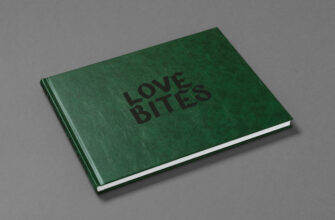

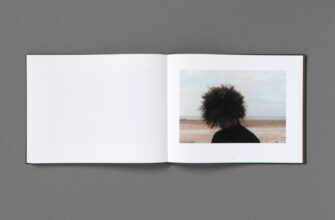
The first impression when one grabs Love Bites by Tim Richmond (published by Loose Joints, 2022) is that it’s a bold and brave book. Even prior to opening it, leather covers, albeit faux leather, are a rarity, and even more so are photo book covers with no images on them. The title is pithy and memorable, hand drawn in large letters by Guy Gormley, and it really doesn’t give much away apart from the feeling of rock and roll or a tattoo on someone’s shoulder. It opens with a short phrase, some of the only words in the book: “To a small section of the Bristol Channel – a love letter”, which powerfully sets the tone of the body of work and the way in which it will be read.
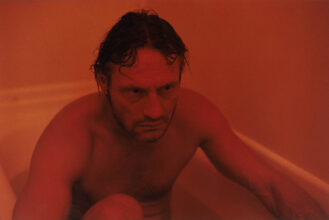
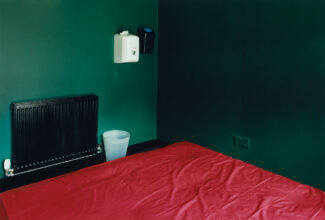
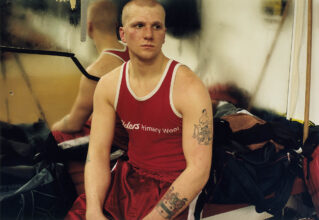
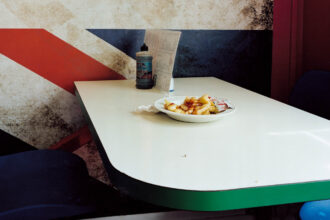
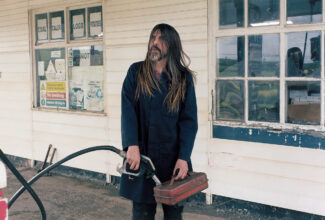
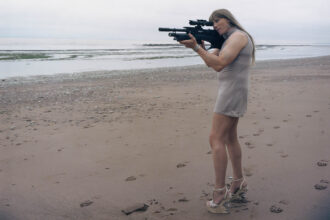
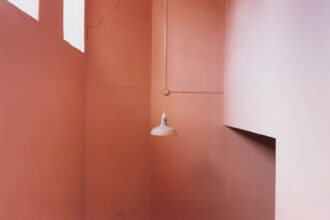
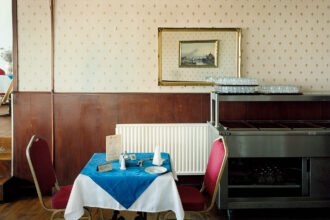
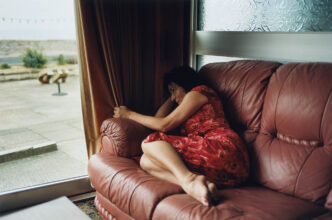
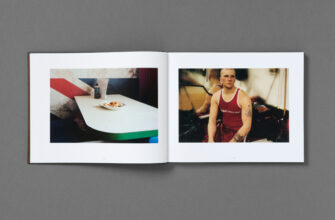
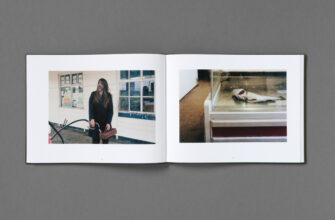
I decided to do a small experiment and not re-read the press release of the book before reviewing it. Obviously I read it when I decided to review it, but as this was a while ago I thought it would be interesting to see what I can make out of it with a pair of fresh eyes. The images vary wildly, but all have a similarly muted colour palette. We see a muscly looking, presumably transgender woman holding a gun on the beach; a miserable plate of chips with open sachets of sauce and the colours of the Union Jack on the wall; a hunky tattooed bloke with a red tank top; a crate of tins, indoors, neatly stacked, followed by a woman curled up on the couch in distress; a young man with a shaved head who has covered up his mouth, probably lighting up a cigarette, the dull grey sea in the background; frozen rabbits heads right next to ice cream; a room with lines and a light fixture vaguely reminiscent of Eggleston, apart from the fact that this one is pale orange; a sweaty topless blond man in his underwear, a thick rope on his left, fire extinguisher on his right, followed by a cinematically lit young girl, looking something between confused and lonely, her reflection framed by two bottles of beer. People look far from happy, in fact some even appear to be in agony – not the result of a sudden injury or pain but rather something that follows after a prolonged chronic suffering.
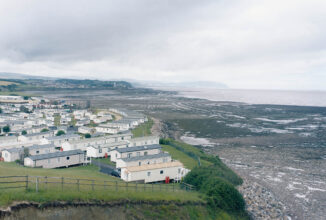
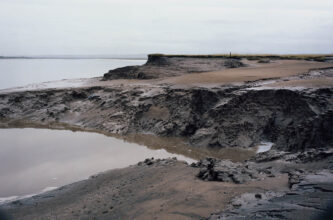
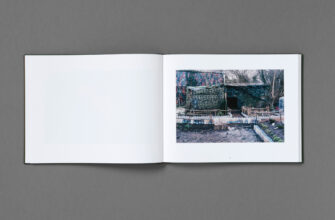
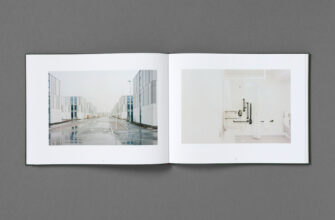
British flags and Bibles, deserted looking interiors, idyllic scenic landscapes. The interiors are bizarrely confusing as it’s mostly unclear which ones are domestic scenes in somebody’s home, and which ones are a communal kitchen, restaurant or something else. The last two photographs in the book are the car park in Burnham-on-Sea with a single lonely trolley and no cars around, and an image of the Bristol Channel, very similar to the one the book began with. It’s a peaceful set of pictures to end with, an interesting pair of book ends of sorts, yet what’s between the first and last image is anything but – yes, some of the pictures have a sense of serenity but there is an overwhelming feeling of unsettlement and despondency. Is this utopia, or a place in which one would like to spend their days? Far from it. Not a single face expresses joy or content.
At times the viewers are reminded of Gregory Crewdson’s images, both in terms of the cinematic quality of the pictures, but also the expressions of the participants we encounter – some appear in a state of semi-consciousness, somnambulism or even exorcism. The obvious difference, of course, is that Richmond’s photographs are a genuine documentary depiction while Crewdson’s are a highly staged and stylised fiction. When one consumes the book from cover to cover a few times the feeling of watching a slightly jagged film appears. Some scenes, such as the woman on the beach looking through a sniper rifle followed by another beach scene, force us to make instant connections – is this what she is looking at? Could this be a nod to La Jetée, the 1962 French classic composed almost entirely of still photographs (bar one ever-so-subtle movement), whose power lies in the blurring of the boundaries between the two artistic genres, photography and moving image, combined with voiceover narration?
Going back to the press release after flicking through the book cover to cover a few times, Richmond states that the series “holds up a mirror to the wider issues being experienced in Britain at the time; it felt important to take a lyrical, poetic approach rather than a polemic one”. The photographer had been searching for people and places “out of the ordinary”, either those who had stepped away from it by choice or, more interestingly, who had been “pushed outside the mainstream”. The word “push” implies force and we are left to wonder if it’s pushed by pure circumstance or malicious political intent. According to him, it’s an open-ended narrative, one without a beginning or end, and due to the restricted geographical scope he would revisit places and people many a time. The images were taken over the course of six years and the book’s publishing coincided with Richmond’s relocating to America. It’s a eulogy of sorts, or, as he says in the book, a love letter, to a place and people far from ideal, yet genuinely human. Some of the issues tackled include isolation, the housing crisis, food poverty, and commercial decline.
It’s uncanny that Love Bites is released in a year in which not much seems to be getting better, but in fact taking a turn for the worse on a global scale. One would imagine that when Richmond photographed food banks, shelters and the general effects of post-austerity and post-Brexit Britain he was hoping that one day these would serve as historical documents for a place and time that belongs to history as we are off to better and more prosperous times. Hope dies last, as the wise people say; nevertheless, we might have to wait just a little bit longer than we’d like to see the brighter days.
__________
Love Bites by Tim Richmond is published by Loose Joints.
Reviewed for Photomonitor by Zak R. Dimitrov