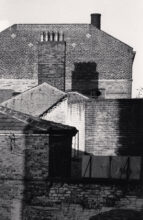
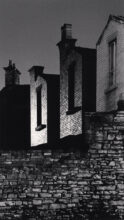
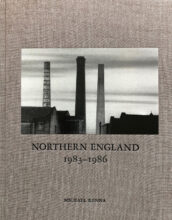
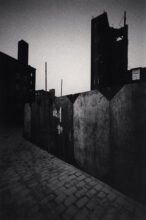
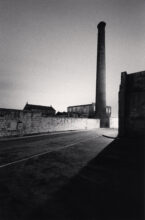
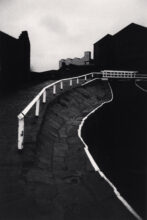
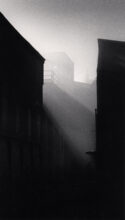
In 1983, more than a decade after moving away, Lancashire lad Michael Kenna began making pictures back up North. Three years later, in his early thirties and with his career building momentum, Kenna moved on to new photographic pastures abroad. Filed away and perhaps forgotten, most of these images he made in the crucible of the Industrial Revolution may never have seen the light of day. But when the globetrotting Kenna was unexpectedly grounded by the 2020 lockdowns, he revisited this archive at home in Seattle. “It has been highly satisfying to now reconnect with this special part of my homeland,” he says(1), with more than a hint of expat nostalgia. “I discovered this treasure trove.”
This assessment is a reasonable one, and the trove is done justice by this beautiful cloth-bound book, thoughtfully edited and sequenced. The occasional blank page breaks the work into sections: we have a bucolic, almost pre-industrial opening section; an atmospherically misty chimneys-and-mills section; and so on. We find frequent visual correspondences between images: a viaduct’s arches emulate a ruined church’s windows; wheels follow wheels; washing lines become power lines; the backs of empty iron benches undulate like an abandoned rollercoaster. Neither contrived nor overdone, this never overpowers the pictures themselves, making the book almost consummately coherent.
As anyone familiar with Kenna’s work will know, time seems to stand still in his (often long) exposures. Devoid of people, there is an overwhelming sense here of places already abandoned, of a soon-to-be-bygone age. “Much of what I photographed in the eighties no longer exists, and I cannot even trace some of the structures,” says Kenna(2), confirming these photographs’ insinuation that he was, albeit briefly, a latter-day Atget of the North. But their occasional frontal and geometric style also owes a debt to 1970s American and German trends, a kind of English New Topographics of the olden days. Somehow all this coexists happily, even within individual images (such as the one on the cover), without any jarring conflict.
But we get much more than a British Atget via Baltz. At the same time as Martin Parr was on Merseyside perfecting his modus operandi with full-on flashlit colour pictures of people(3) , Kenna was mastering his monochrome métier with these silent Northern scenes. What will later become Kenna’s photographic signatures after his move to square format are already present in these rectangular photographs: a preference for the poetic over the prosaic; a predilection for twilight and the dark; the reduction of a scene to sparse, often graphic elements; a continuation of the use of black-and-white film (to which he remains loyal); and the use of long exposures to reveal the unseen.
Some of this isn’t quite fully formed here. The cooling tower section is prosaic compared to Kenna’s (partly contemporaneous) studies of Ratcliffe Power Station(4) in the English Midlands. The reductive lyricism doesn’t yet hit the heights of, say, Kenna’s later photographs of Japan(5). And the first of the two seaside sections – light, bright and crisp – sits a little incongruously with the book’s otherwise uniformly elegiac tone. But unlike John Davies’ black-and-white panoramas of Britain , which tend to be dense with detail and deliberately dispassionate, every one of Kenna’s Northern English sparsely sketched vistas manufactures a mood. “I often use the reference to writing,” Kenna said recently(7) . “I prefer my work to be more of a haiku poem with just a few elements – a lot of simplicity, but a great amount of suggestion – as opposed to an encyclopaedia with huge amounts of facts and description.” This now long-standing philosophy is already expertly executed in these early ‘80s images.
And while there are hints throughout the book, the night-time vistas in the last three full sections of Northern England have a definite haunted, cinematic quality. “At times, I felt an intriguing, dark presence, particularly in some of the run-down mill towns,” says Kenna(8). And you really do get the feeling that only ghosts now occupy these warehouses and walk upon these cobbles, as if the end of the line has already been reached for this civilisation, a point eerily underscored by a terrace of boarded-up houses.
But then again, perhaps these Northern English scenes might best be read as self-portraits, despite the photographer never appearing in them. Maybe the only spectre on these streets was Kenna himself, wistfully revisiting his former life, his former self, before spiriting himself away to explore other continents, to discover other homes.
__________
Reviewed for Photomonitor by Simon Bowcock
Northern England by Michael Kenna is published by Nazraeli Press
All images © Michael Kenna
__________
(1) In Kenna’s Afterword to Northern England
(2) Ibid.
(3) Photographed in 1983-5, Martin Parr’s The Last Resort was published by Promenade Press in 1986
(4) Ratcliffe Power Station was published as a book in 2004 by Nazraeli Press
(5) Kenna has photographed extensively in Japan since 1987 (see website), resulting in several published books
(6) The British Landscape was published by Chris Boot in 2006. A selection of images are on Davies’s website
(7) Frames Photography Podcast Episode 1, first broadcast 18th March 2020
(8) In Kenna’s Afterword to Northern England