__________
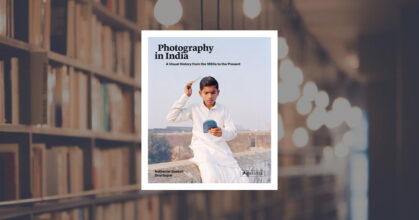
Following the invention of photography in Europe in the late 1830s, it took mere months to arrive in India. Since then, the subcontinent has gone on to have a rich, varied and, at times, fraught relationship with the medium. Nathaniel Gaskell and Diva Gujral’s Photography in India: A Visual History from the 1850s to the Present (Prestel) gives a comprehensive journey from photography’s first appearance at the height of the British Empire to the work of contemporary practitioners.
In keeping with the international origins of photography in the Subcontinent, this book looks beyond national boundaries. As the introduction explains: “…in a world pervaded by the forces of globalisation, it is no longer possible to understand the photographic medium through conventional lenses such as nationality and geography.” The result is hugely successful, revealing through magnificent imagery the global connections and counterpoints across the last 180 years.
Each of the ten chapters in Photography in India identifies themes that run roughly concurrent to the history of the country, providing an erudite introduction and a detailed caption for each image. The first chapters explore how, either overtly or unthinkingly, British imperialists used photography as a means of recording the peoples and landscapes of India. A more detailed history of these early years of photography in India can be found in John Falconer’s excellent catalogue for the exhibition ‘Under Indian Skies’, which was recently exhibited at the David Collection in Copenhagen.
From the earliest days Indians were enthusiastic photographers, often adopting, then adapting European conventions. For instance, the portraits revealed in chapter three combine the formal studio with Indian elements even until the 1970s and 1980s, as seen in Suresh Punjabi’s 1978 portrait, which, reminiscent of a Mughal miniature, shows a man posing with a song bird.
The book highlights ambiguities about the many masters that photography in India has served. For instance, the chapter Proof and Propaganda presents pictures from the Indian Uprising of 1857 to independence, partition and beyond. There is a telling juxtaposition of shots of the opulent Delhi Durbar of 1911 and victims of the 1919 Amritsar Massacre pointing at bullet holes made by Imperial troops.
Differing visions of the country persisted after 1947. On one hand there is an imagined exoticism – exemplified here by photographers including Norman Parkinson, Cecil Beaton, Derry Moore and Steve McCurry. On the other, as India tried to define itself as a new nation, modernist imagery, photojournalism, photo essays and street photography all contributed to a new picture of the subcontinent.
The book closes with an exploration of the recent role of photography and the position of the medium in India today. The output is diverse, often humorous and subversive, making references to earlier photographers. Photographers such as Pushpamala N. and Clare Arni revisit Victorian ethnographic images, while Vivan Sundaram recalls paintings and photographs of Umrao and Amrita Sher-Gill.
In bringing this history to the present the authors acknowledge that it is impossible to predict how photography in India might develop. Increased globalisation has meant geographical labels are less applicable, while the growth of the Indian economy will change the status of the country and how it is seen. What is clear is, as the authors say, “…the camera will be on hand to capture the results.”
– reviewed for Photomonitor by Malcolm Cossons