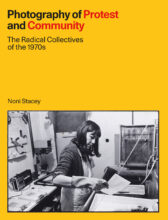
The first thing I want to say about Noni Stacey’s Photography of Protest and Community – The Radical Collectives of the 1970s is that it’s great. But the second is that it isn’t about all the radical collectives of the 1970s, as the title maybe implies. As Stacey does clearly set out in the first chapter, it’s about six London-based groups of the time – the Hackney Flashers, Half Moon Photography Workshop, the producers of Camerawork magazine, Exit Photography Group, North Paddington Community Darkroom, and Blackfriars Photography Project. These collectives were interrelated and sometimes shared members, with many of the photographers involved in some way with Camerawork. Jo Spence, for example, was co-founder of Camerawork and also part of the Hackney Flashers and the Half Moon Photography Workshop.
Within this remit, Stacey’s research is outstanding. The people involved with these collectives lived and worked in ad hoc circumstances in low-cost premises and squats, so they didn’t always archive their projects; the archives they did amass have scattered over the intervening 50 years into universities, libraries, public and private galleries in the UK and abroad, or remained tucked away in the participants’ homes. Stacey has painstakingly tracked these records down, picking out gold from them and other related though unpromising sources such as “Hackney Trades Council Women’s Sub-committee, Hackney Archives, File 2/7 on the working of the Women’s Sub-committee”. She’s also interviewed many of the key players, getting first-person accounts that have an added pathos and urgency given the passage of time. Stacey interviewed Ed Barber, photographer and member of the Camerawork collective, in 2013, for example; sadly in 2017, he passed away. If nothing else, Stacey made an important contribution just by speaking with these people on the record.
There is plenty else though, because Stacey has marshalled this information into an intriguing account of an exciting, idealistic, and sometimes fractious period. The collectives aimed to think through and bypass existing hierarchies in photography and empower the working-class communities they worked with – sometimes, as with the Exit Group, by photographing and interviewing them; in other cases, such as the Half Moon Photography Workshop, by giving them access to photographic equipment, darkrooms, and training, so that they could present their own lives. The collectives also aimed to bypass existing narratives in galleries and the media, creating robust, laminated exhibitions that toured local libraries, community centres and even council estates. They hoped photography could liberate, not serve up underprivileged communities for middle class consumption.
As Stacey shows – and the collectives knew – there were inherent contradictions. Some of the photographers came from what Stacey describes as middle-class backgrounds (the current word might be ‘privileged’); despite the good intentions, there’s a whiff of trying to tell people the right way to think. It would be great to hear what the local communities thought about the projects and what, if any, difference they made to their lives; Stacey, to her credit, states she tried and failed to track down participants in (for example) the chapter on community darkrooms. “Over time, the focus of my research shifted in part from the transfer of photographic skills to the marginalised and uninitiated, to the interconnections between, and affiliations of, the collectives,” she writes in her introduction.
But if this is a criticism, it’s one that bears testament to the power of Stacey’s achievement – arguing the collectives’ position so convincingly I want to know more. The book also suggests other possible avenues too. I’d love to know more about other collectives of the period, some of which are fleetingly pop up; it would be intriguing to flesh out the contemporary relevance of these collectives, which Stacey sketches out in her conclusion – both in terms of the resurgence of interest in their work, and also the current reappraisal of who photographs who, why, and for whom. Stacey’s research took years and this book stems from her PhD; it’s great, and in the spirit of the thing, that she’s repurposed it for a wider audience. “I wrote this book in this way to make this research accessible to those outside of academia,” she writes, “who are engaged with photography, protest, and politics.”
__________
Reviewed for Photomonitor by Diane Smyth
Noni Stacey’s Photography of Protest and Community – The Radical Collectives of the 1970s was published by and is available from Lund Humphries.