


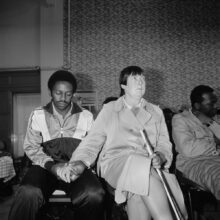
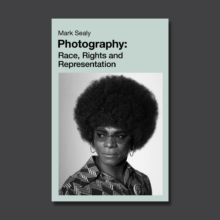
Photography: Race, Rights and Representation is the second book authored by Mark Sealy that sits as a companion to his first publication Decolonising the Camera: Photography in Racial Times (2019). The content of the book draws from Sealy’s archive of writing compiled over the past 30 years, during which he has been actively involved in Autograph (formerly the Association of Black Photographers). The texts anchor some of the points made in Decolonising the Camera (2019) about the politics of representation by using concrete examples that draw from over 30 contemporary and historical photographic works. Through Sealy’s writing – analysis, reflections and interviews – he offers critical dialogues that intersect with traditional histories of photography and brings to the fore what Sealy describes as missing chapters of photography. The publication incorporates a variety of approaches to photography, inclusive of commercial studio photography, participatory practices, documentary photography and conceptual photography, all of which Sealy historicises within the context of race, rights and representation.
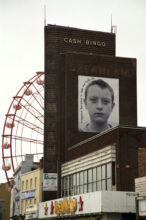
The primary focus of Sealy’s writing is on the socio-political context that scaffolds the discussed work. In emphasising this approach, the reader is encouraged to understand the images within specific cultural contexts, anchored to precise historical moments. For example, in ‘Moments Outside of the Frame’ (2020), Sealy reflects on numerous interviews with artist Sunil Gupta. He writes about the constraints of Gupta’s upbringings as a gay Indian man and how this underpins the politics of Gupta’s work, which explores his own queer identity through the lens. This writing becomes the backdrop that provides the political context for Gupta’s hugely influential body of work Christopher Street (1976) and subsequent works. Another example sees Sealy consider the ethical collaborative approach of Wendy Ewald in making the portraits Towards a Promised Land (2005-06). In this body of work the portrait participants, 20 children unrooted from their homeland and newly arrived and housed in Margate as refugees, are given a visibility. Ewald gives agency to the participants in how they are photographed and invites them to reflect on their experience of their new homeland. These images were then exhibited across Margate. In doing this Ewald enables the participants to be seen and heard.
This publication contributes to the growing multiple histories of photography and sits alongside influential publications such as Photography’s Other Histories (2003)(1) , Photography and Migration (2019)(2) and Camera Orientalis: Reflections on Photography of the Middle East (2016)(3) that succeed in expanding beyond conventional Eurocentric histories of photography. It offers great insight into Sealy’s sustained relationship with photography over the past 30 years, and how through his voice he attempts to decentre and expand traditional photographic histories. It is essential reading for anyone interested in raising their awareness of marginalised photographic voices and succeeds in reminding the reader that the context of the photograph is crucial in understanding the intent of the work.
__________
(1) Pinney, C., Peterson, N. (2003) Photography’s Other Histories. USA: Duke University Press
(2) Sheehan, T. (2019) Photography and Migration. Routledge: Taylor & Francis.
(3) Bedhad, A. (2016) Camera Orientalis: Reflections on Photography of the Middle East. USA: Chicago Press
Photography: Race, Rights and Representation by Mark Sealy was published by Lawrence Wishart and reviewed for Photomonitor by Caroline Molloy.