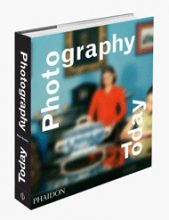
Surveys of photographic practice inevitably collate the work of many familiar figures. Such large collections of photographs in book form can resemble the family album, and as with the first viewing of a family’s album there is an impulse to check each new survey to see who and what is included or left out. This action draws our attention to who sits next to whom in the compilation leading to surprise and, sometimes, new insight. Similar to the album the survey tends to include newcomers to the family fold. Mark Durden in Photography Today has organized a survey of photography that ostensibly attempts to give a simple listing of practitioners old and new. While this book can function as an accessible and authorative guide there lies beneath this a complex weaving of material that raises questions about how we construct our understandings of the history of photography and its classifications.
Durden’s survey narrates the development of photography as an art form from the 1960s through to the present day. This history of photography is the overarching ordering mechanism that could provide an uncomplicated narrative, however throughout the eleven chapters Durden both reinforces and disrupts this lineage. The chapters of the book identify genres within photography rather than covering specific historical periods. The reader follows a historical progression through each of these subjects for photography but the discussion is not bound by the blunt instrument of dating. Although each section in Durden’s book is titled as a chapter, and divided further into subtitled parts, the chapter components are profiles of photographers that can be read as separate essays. Within each short essay Durden draws our attention to individual photographs. The structure of this book dissects the overview of photographic practice from the impersonal whole to the personal statement.
The first chapter in Durden’s book – The Copy: Authorship and Reproduction – both establishes photography as an artform and demarcates the boundaries of the discourse that this book covers. Tying photography to Pop and Conceptual Art of the 1960s, Durden then follows photography’s trajectory as it responds to the developments in mainstream art practice and achieves its gradual ascension as a prime medium of expression for current art practice. Robert Rauschenberg and Andy Warhol, along with William Klein and Daido Moriyama, become the antecedents for artists committed to working with the medium. Although the core narrative of the book is photography as art, Durden does include reference to non-art photography, such as the work of the war photographer James Nachtwey and fashion photographer Guy Bourdin. The final picture in the book is a gallery installation by Erik Kessels made up of 350,000 prints of images uploaded to Flickr over a twenty-four hour period. Piled high against the walls of the gallery these prints impress upon us the glut of photographic images in our contemporary world and consequently the difficult task of providing order to this material.
Durden divides his material into recognisable genres that include portraiture, street photography, landscape, the body, documentary, and constructed photography. Perhaps less obvious as genres are colour photography -Colour: Surface and Depth – and the photographing of history in the making -History: Witnessing Atrocity. The two topics sit at opposite extremes of photographic practice. Photographers whose work emphasises colour as a formal component are at cross-purposes with those who see the camera as a recording tool for bearing witness to important events in the world. However, Durden challenges this dichotomy with the inclusion of colour pictures shot by Larry Burrows in Vietnam that are clearly reliant upon their use of vivid hues, while Alfred Jaar makes use of abstraction to critique media fascination with images of genocide. It appears that both history and genre cannot contain the work of photographers in simple classifications.
The chapters in Durden’s Photography Today, unlike those in a conventional book, are made up entirely of individual profiles of the work of selected photographers. A number of photographers appear in several chapters, emphasising the limitations of using genre to label a practitioner. The work of Burrows and Jaar appear in two chapters, whereas Andres Serrano and Thomas Struth are discussed at length in three chapters. Photographers work across genre divides and their work does not fit neatly into historical slots; these relationships are complex and require constant revisit. Durden does not give mere biographical detail in each profile but focuses his attention on singular images to bring out the qualities of the photographs rather than their makers. History, genre, and biography are Durden’s coordinates, but it is photographs that he catalogues and places within his chronicle of post-war practice.
Similar to the book that Mark Durden edited in 2013 titled Fifty Key Writers on Photography (Routledge), he has set out to provide the reader with an understanding of relationships within photography. Fifty Key Writers was a complex reference book that focused its attention on written texts about photography rather than the photographs themselves. Durden interwove texts by writers, about writers, producing a web of connections. Photography Today from Phaidon can be seen as its companion, as again, Durden points out the richness of open and expansive discourse in contrast to a rigid, linear account or simple taxonomy. A family album is only complete when the family ceases to live and no new members can be added. This clause can be applied to photography, its continued health means that there will be an ever-increasing number of relatives that will need accommodating. Durden is aware of photography’s myriad connections and so concentrates upon methods of accommodation rather than closing the doors to new relationships.
– Reviewed by Stephen Clarke
————–
Mark Durden is a writer, artist and lecturer. He has written extensively on photography and contemporary art and is currently Professor of Photography at the University of South Wales, UK.