

The title of Martin Parr’s book of photographs published in 1986, of New Brighton on the Wirral Peninsula, indicated an end rather than a beginning. The Last Resort depicted a seaside town in decline, and reflected the fortunes of the city in decline that sat facing it across the river Mersey. Liverpool and the industrial north of England did not fare well under the premiership of Margaret Thatcher: by contrast, the south east prospered. In the 1980s Martin Parr and Paul Graham – two photographers at the forefront of what is referred to as British ‘New Colour Documentary’ – were tutors at The Surrey Institute in Farnham (now University for the Creative Arts). Amongst their students was Anna Fox who, in relation to her student project Basingstoke, has acknowledged the impact that her tutors Parr, Graham and Karen Knorr, had on her work. Fox graduated the same year that Parr’s The Last Resort was released, this coincidence marking the beginning for the student and a significant point of departure for the tutor.
On initial viewing Work Stations (1988), Fox’s first published project after graduation, seemingly replicates Parr’s achievement in style and content. This is unsurprising as what we learn from our teachers is what they know; it is left to the student to add something new. Undoubtedly Fox used Parr’s photographic language but what she brought to this conversation was a personal perspective. The office life that Fox photographed was an environment with which she was familiar having worked in similar offices before her degree. This connection to her subject matter is the distinction between Fox and her mentors. In further projects, such as Friendly Fire (1989-1994) – an extension to Work Stations that recorded the leisure pursuit of paintball warfare – Fox’s approach has been as an informed insider: her work incorporates self-exploration as well as objective documentary.
Recurring motifs in Fox’s oeuvre are the village and family life. Anna Fox was raised in the country and lives in the village of Selbourne near to Farnham. In the early 1990s she collaborated with the curator Val Williams on the commissioned project The Village that signalled her interest in the domestic. Much closer to home, literally, were the projects Cockroach Diary (1996-1999) and My Mother’s Cupboards and My Father’s Words (1999) which focused on the micro-environment of the family home. In the former the home was under siege from an infestation of roaches, whilst in the latter domestic harmony was disrupted by the conflicts of a married couple.
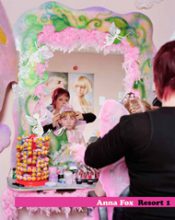
The family on holiday is the theme of Fox’s 2013 publication Resort 1 that documents visitors to Butlin’s Holiday Camp in Bognor Regis (the first of two volumes published by Schilt). Conscious of the photographs produced by John Hinde’s postcard company in the late 1960s and early 1970s to promote Butlin’s, Fox worked with a large format camera to construct her pictures. With the help of campers staying on the site, she created vividly coloured tableaux that mimic the artificiality of Hinde’s postcard images, but which emphasise current consumer culture. In one picture a family of four on a pedal go-kart pose before a kiosk; the sign stretched across the gable end reads ‘thirsty?’ and hovers above their heads. They, and the viewer, are invited to submerge themselves in saturated colour signage that purports to offer fun, excitement and play.
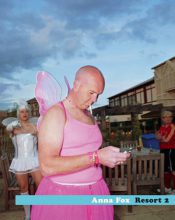
Cover image: Resort 2, by Anna Fox, published by SchiltThe photographs published as Resort 2 predate those in the first volume and take as their theme the adult weekend. For this set of images Fox worked with a medium format camera – more familiar to her practice – to record the time when make-believe adopts a perverse identity. Since her project Friendly Fire she has documented adults dressing up to engage in fantasy. Photographs of her friend, the musician Linda Lunus posing in extraordinary outfits and wigs, date back to 1983 (Pictures of Linda). Theatricality is central to her series Country Girls (1996-2001) and Back to the Village (1999-ongoing) where the eccentricities of village life are captured. Perhaps the most controversial pictures are those Fox made of the Dutch character Zwarte Piet (1994-1999): each Christmas the citizens of Holland ‘black up’ to become Black Pete the helper to Sinterklaas. The cover of Resort 2 shows a burly, shaven headed man dressed in a pink outfit with fairy wings, smoking a cigarette and looking down at his mobile phone. Inside the book bawdy antics continue with adult schoolgirls, Batman, Robin, and a pale young man in a lurid lime green Borat mankini.
Roni Brown informs the reader that the word ‘resort’ is derived from the 18th century French word resortir, and denotes a place frequently visited to restore oneself. In his essay Bull links Fox’s project to Parr’s The Last Resort and so we revisit the relationship between teacher and student, as well as the state of the British at leisure. Nearly thirty years after Parr had published what was seemingly an ending for place and subject, Fox has restored both. Located at the opposite end of the country to New Brighton, Bognor’s royal connection indicates a different clientele, and Butlin’s – the village that exists within the town – has reinvented itself. For Anna Fox, now Professor of Photography at Farnham, there is a new resort to document and student in turn becomes teacher.
– reviewed by Stephen Clarke
__________
Resort 1, by Anna Fox, Hardback with dust jacket, 104 pages, 40 illustrations, ISBN 9789053308035, Published by Schilt
Resort 2, by Anna Fox, Hardback with dust jacket, 104 pages, 58 illustrations, ISBN 9789053308400, Published by Schilt
‘Family’, 2011, from ‘Resort 1’, by Anna Fox
Orange and Green, 2010, from ‘Resort 2’, by Anna Fox