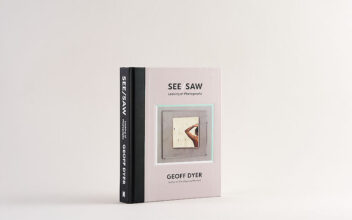
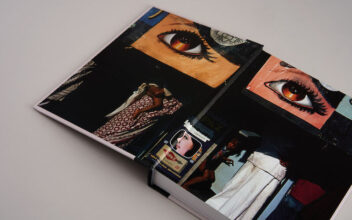
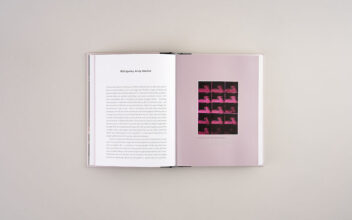
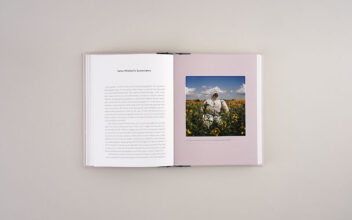

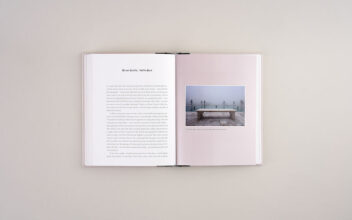

At 330 pages, Geoff Dyer’s See/ Saw may seem a bit daunting. But there’s no need to feel overfaced, because its 51 bite-sized pieces are easily digested. These self-contained essays on photography – culled from newspapers, magazines and monographs published over the past decade – are served up as a loose chronology of photographers, with Victorians at the beginning and Millennials towards the end. Within this framework, the material is thoughtfully arranged, with nice aesthetic groupings (such as the three consecutive essays on Düsseldorfers) and some thematic flow (for example the sex-based pictures by Thomas Ruff and Prabuddha Dasgupta arrive together).
While most of the texts are accompanied by one photograph and are about one particular photographer, they are usually garnished with wider cultural context, often with a dollop of Dyer’s personal experience thrown in. It’s a generally successful recipe. Choice cuts include the short article on Tomas van Houtryve: even though it packs a stack of literary, photographic, sculptural and even ancient artistic references into a mini tour de force, it somehow still comes off as effortlessly coherent and unshowy. In a tremendous piece on Helen Levitt, Dyer outlines how times have changed not only for childhood but also for photography (and much else). And while situating Matt Stuart’s pictures of London within photography more widely, as well as making connections with literature, art, music and film, Dyer also smoothly blends in his own relationship with the city. Throughout See/ Saw, this kind of concentrated complexity invariably seems natural and unforced, and the book is an accumulation of proof that Dyer is among the most astute and readable of writers on photography.
Dyer is a master of the insightful oxymoron: Peter Mitchell’s scarecrows are waiting “in a state of transient permanence”; in Luigi Ghirri “nothing is hidden, everything is withheld.” He is equally good when tackling time (which he does quite a bit). August Sander’s subjects’ faces “are stuck like fossils in the geology of time”. In Philip-Lorca diCorcia “it’s not that time has stopped; it’s just nowhere to be seen”. And a Dayanita Singh photograph “is what time looks like after history has moved on and left it for dead”.
Anyone familiar with his 2005 book The Ongoing Moment will know the United States can dominate Dyer’s photographic worldview. So while there’s no specific chapter devoted to, say, Walker Evans, he nonetheless pops up in the discussions of Eugène Atget, Lee Friedlander, Bevan Davies, Mike Brodie, Alex Webb, Zoe Strauss, Ghirri, Andreas Gursky, Dayanita Singh, Chloe Dewe Mathews, Justin Sullivan (where there’s even an Evans picture) and Michael Wolf/ Doug Rickard/ Jon Rafman. But as this (maybe incomplete) list hints, there is a lot more international balance to See/ Saw, with perhaps half of the book devoted to non-Americans/ photographs not made in America. Nonetheless, Dyer is still prone to gushing about American sacred cows, such as his comparison of William Eggleston with Ludwig van Beethoven: it may be well argued, but that doesn’t stop it being hyperbolic.
On the flipside, Dyer is very occasionally critical of photographers (even American ones), but only very slightly: he quite reasonably points out that “almost inevitably… over more than five decades… the quality of [Lee Friedlander’s] work is uneven”; and he also voices some scepticism about Thomas Struth’s later work. But given Dyer is consistently perspicacious when telling us what he does like about photographs, you can’t help but feel that he would be even more illuminating if he told us a bit more about what he doesn’t like as well. Perhaps it’s the slight underconfidence of the non-photographer, because Dyer has few qualms in taking apart a fellow writer, Michael Fried, in See/ Saw’s only out-and-out savage criticism. Perhaps he feels more qualified to take something truly to task when it’s in his own medium.
The skewering of Fried is one of three texts about writers on (rather than doers of) photography, including an affectionate essay on the late John Berger. See/ Saw ends with a 2004 Jean Mohr photograph of a youthful-looking Dyer hanging on some words being spoken by the then near-octogenarian Berger. The picture is a useful reminder that not only have both men helped us think more deeply and differently about photographs, but that both of their wider oeuvres are – in their own different ways – genre straddling and category defying. If the mercurial Berger has been a mentor of sorts to Dyer, then the younger writer has turned out to have been a more-than-worthy apprentice.
Reviewed for Photomonitor by Simon Bowcock
See/Saw by Geoff Dyer is published by Canongate