__________
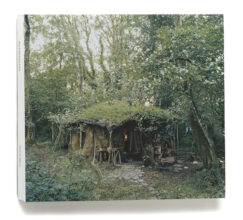
At an inch and a half thick, hard back, 12″ x 10″ proper BOOK, Settlements by David Spero is heavy. It’s not exactly a tome, but it’s close. It is most definitely a ‘work’. And the work depicted in its pages is also a labour. Working is at the very heart of Settlements. Hard, back-breaking work over time; building, digging, planting, cracked nails, splinters and sore feet. As we humans contemplate the end of our time on earth thanks to the global climate change of our own making, groups of environmentally-conscious people are looking to build a sustainable way of life, and Settlements shows us what that might actually look and feel like.
Spero began the project as a topographic exploration, following his interest in cultural relationships to the environment, expressed through building structures in the landscape. Through a visit to a nascent low-impact community in Devon, his interest grew to include a fascination with the societal infrastructure and the ebb and flow of the individuals who make up these ‘intentional communities’. The history of farming, land ownership and enclosure, followed by the preservation of ‘natural places’ forbidding settlement is a long one, riddled with inconsistencies and fluctuating ideals.
Settlements addresses the evolution of small, low-impact communities across mostly the south of England. The images are full page, large-format, relatively formal photographs of the homes, land and families living in rural places with storybook names like ‘Tinkers’ Bubble, ‘Fivepenny Farm’ and ‘The Roundhouse’. The text is small, and the writing is dense, factual, and almost exhaustive in its telling of the idealism and struggles of the vanguard of a small and quiet revolution. It is also exhausting to read; in some ways Settlements is a manifesto, and much as politics or philosophy can be fascinating and inspiring, their texts are often too wordy and earnest to be enjoyable reads. So it is here, and the underlying narrative of battles with local authorities and planning departments is rather dispiriting. That said, it is important that it is included – simply displaying a collection of beautiful photographs purporting to show Utopia would be disingenuous in the extreme. Creating an idyllic life is not idyllic when you are trying to live separately from mainstream society while in fact only a short distance from it.
Settlements attempts to answer the question “Is it possible to create a sustainable, low-impact, collective and mutually supportive way of living?” by showing some of those who have tried to do it. Their homes are mostly made by hand; there are yurts, turf roofs, trodden earth floors, rag-rugs, wood-fired stoves, workshops, chickens and goats and vegetable beds. Some are more ‘house-like’ than others, others barely more than tents, some appear to be simply tarpaulin rigged over wooden structures. Interiors are colourful, filled with rough-hewn furniture, throws, reclaimed fixtures, ceramics and art. It feels as if each home should be dripping with dreamcatchers and every kitchen cupboard filled with mismatched jars of homemade preserves. The friends and families who live under these canvas roofs are shown as thoughtful freedom fighters with woollen beanies and scuffed jeans, women in long skirts, a scattering of dreadlocks and beards, occasional barefoot children in bright t-shirts. Spero’s ‘community portraits’ (while carefully noting the names of those members not present at the time) show groups of happy friends, and many of the photographs of the land do promise a halcyon way of life. Indeed, the stand-out photograph for me in this book is one where in low afternoon sun, a white shire horse called Samson pulls a laden haycart on a sloping field.
But is it really like that? There are fewer photographs in rain, or snow, and the inevitable conflicts and petty jealousies which must arise in discrete communities such as these are not hinted at in the images, although conflict resolution in the communities is described in the text. The idealism of the proponents of a low-impact life is echoed in Spero’s book; perhaps an element of visual criticality would have given his exploration more weight.
We seem now to be at a place where environmental concerns are beginning to have an impact on the interests of the wider world, and although these communities might inspire, most readers will admire their tenacity while having no desire to join the ‘Peasant Evolution Producers’ Co-operative’; it’s just too politically charged, and we may be too lazy. Settlements shows us what one version of a different way of life might look like, but creating Utopia might just be, for some, too much like hard work.
– Reviewed for Photomonitor by Lottie Davies
__________
Settlements is available for £35 plus P&P from davidspero.co.uk
An exhibition of prints from Settlements will be held at Kestle Barton, Cornwall from 20 July – 8 September 2019. More details can be found here and here.