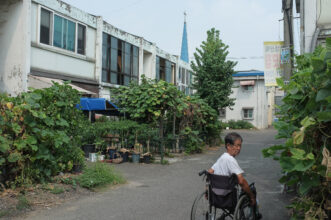
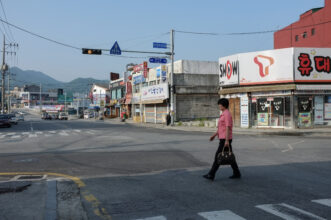
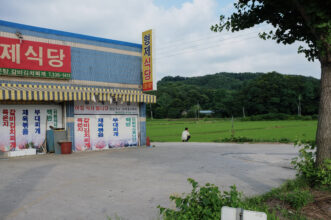
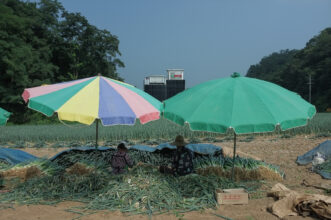
The thought of South Korea lacking poverty is beyond absurd, although the scarcity of photographs in the media depicting their disadvantaged classes is equally astonishing (fiction films are a different ball game, as The Wailing, Parasite and others demonstrate). Independently of the reason for this absence, the result is a national image that compounds technological advancement with cultural sophistication. Photographs usually show a vibrant Seoul as the wellspring of films, beats, and fashion trends that have fascinated the world for decades. Rather than capturing the alienation of people living in that dense metropolis, Jong Won Rhee’s Solitudes of Human Places concentrates on the inhabitants of smaller cities, many of whom live on the fringes of society. The locations of the photographs are undisclosed, making it difficult to know if they were made in one region or across the country.
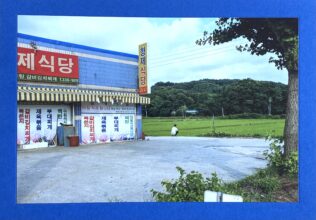
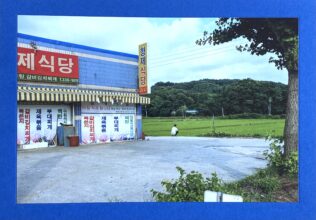
The cover image sets the tone for what’s to come. A man crouching with his hands on his face next to a roadside restaurant, looking absently into the hillside. The saturated greenery makes his gesture more agonising as if he were contemplating a painful decision. The cause for the man’s burden is unclear, but the picture skilfully presents a scenario that links emotions with places. What is subtly suggested here – given that situations always happen in a social context – is that politics plays a role in the conundrum described by the title. Why else focus on the solitude of man-made places and not on that of people? Won Rhee’s pictures amount to more than a representation of his subjectivity, delineating a grim profile of a nation whose economic growth after the ‘625 War’ is frequently described in supernatural terms. In this sense, his site selection evidences his desire to deviate from the standard narrative of his country’s success.
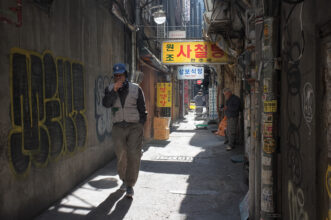
The pictures are made in the (widely defined) tradition of street photography that arrests the choreography of passersby, although these people are more likely on their way to work than strolling around looking for aesthetic experiences. These are not portraits, yet Won Rhee is not merely using these strangers as compositional elements. They come across as individuals, rendered in some cases with enough detail to imagine their story. The same can be said of the photographer’s use of colour, which adds layers of information to his depiction of social strata. The dullness of weathered shop signs, falling tiles and peeling paint describe the painful economic disparity between the places depicted and the capital’s rich neighbourhoods.
Back alleys and side streets allow us to see how people live and display the complex patterns into which residential areas are divided. There are a few instances where we can peer into windows, storefronts, and gateways. Yet, Won Rhee doesn’t belabour the point that space is the ultimate luxury in Asian cities. While this is undoubtedly true of bigger cities, the book offers glimpses of properties with gardens and front yards. These precious meters of real estate are mostly neglected, with overgrown weeds and hoarded stuff taking up that space. The houses are built with cheap or repurposed materials, not that different from the informal settlements of the Global South. Their style is the flipside of the minimalist architectural designs found in Busan and Gwangju. Nevertheless, there’s something very endearing about looking at everyday scenes that capture the local flavour but are common enough to happen elsewhere, such as the clotheslines that appear repeatedly, and in different guises, as markers of economic status and a communal style of living.
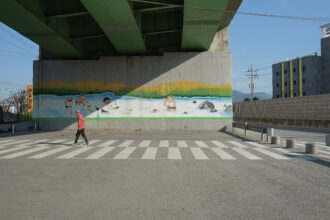
In the colophon, Won Rhee states that he tried to capture a sense of “mutual understanding, fleeting beauty and enduring hope.” However, despite the title’s connotations, most pictures address socioeconomic issues rather than existential ones. Take, for instance, the photograph of a cartoony mural on an underpass depicting a group of children fishing. The mural represents their innocence and joy towards nature. However, the image can also be seen as an attempt to make traditional values seem laudable. When we encounter an image of actual fishermen towards the end of the sequence, their neatly stacked nets and ropes speak only of hard labour and hardship, bringing into focus the book’s main subject. Won Rhee’s Solitudes of Human Places visualises rising income inequality in South Korea while also revealing how normative representations can occlude those showing social stagnation. This accomplished collection of images hits hard precisely because it’s easy to disguise poverty with Samsung ads and robust growth predictions from the OECD while dancing to the synthesised harmonies of “Dynamite.”
__________
Jong Won Rhee’s Solitudes of Human Places was published by Edition Patrick Frey.
Reviewed for Photomonitor by Arturo Soto