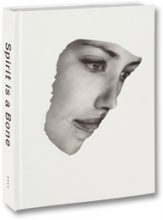

It’s a strange title but familiar if you know a little philosophy – taken from Hegel’s 1807 book The Phenomenology of Spirit, the phrase “the spirit is a bone” sums up his thinking on how the spirit is expressed in the physical world. Heaping scorn on the contemporary ‘science’ of phrenology, which measured the lumps and bumps of a skull to find out something about its owner, Hegel nonetheless believed that “the spirit, forever elusive, can thus only be captured in the inertia of a rigid, dead, debased kind of object”. Or at least that’s how Eyal Weizman puts it in Adam Broomberg and Oliver Chanarin’s latest book, in a text recording a conversation the three had on 27 September 2015.
Tackling difficult concepts in an approachable way, this text touches on Hegel, contemporary facial profiling, and classic photographic projects such as August Sander’s Citizens of the Twentieth Century or Sir Benjamin Stone’s anthropological archive, to explore how images of flesh and bone have been taken as indicators of character.
In albums such as “Album number 50, Types and Races of Mankind”, Stone classified images of individuals in terms of their ethnicity and social standing, for example, while in Citizens of the Twentieth Century, Sander labelled portraits in terms of the sitter’s position in society – starting with farmers and bakers then moving through more marginalised individuals to a final chapter on “Idiots, the Sick, the Insane and Matter”. Creepy, subtly totalitarian, this systematic labelling and categorisation might put you in mind of the Nazis and their murderous take on eugenics – and Weizman’s best-known work is a book called Mengele’s Skull: The Advent of a Forensic Aesthetics, co-authored with Thomas Keenan, which traces how Mengele’s cadaver was identified by literally fleshing out his skull, marking the start a new ‘era of forensics’ in images.
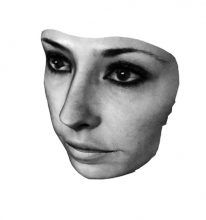
In Spirit as a Bone it’s contemporary facial profiling that’s foregrounded though, in particular the use of 3D images by the Russian government, which are assembled from multiple photographs to allow individuals to be identified no matter what the angle, expression or disguise they assume. Using the same technique, Broomberg and Chanarin have made a series of 3D ‘portraits’, labelling them, like Sander, in terms of the individuals’ jobs: ‘Industrialist’s Wife’, ‘Public Prosecutor’, or ‘Railway Official’, for example. Reducing individuals to their employment, they’re weirdly impersonal names – as weirdly impersonal as the images themselves, in fact, which Broomberg and Chanarin argue are not portraits as we traditionally understand them.
“There is never a moment in the capturing of the ‘image’ when human contact is registered; the subject’s gaze, or any connection between photographer and sitter that we would ordinarily rely on in looking at a portrait, is a complete fiction in this space,” they state. “What we’re seeing is the negation of that humanity: the digital equivalent of a death mask.”
As such, Spirit is a Bone is, in its understated way, deeply unsettling – a palpable insight into how each and every one of us can be recorded, classified and filed without our consent, or even our knowledge, be it visually, as in this example, or in terms of our online habits, our shopping preferences or our journeys around town. Recorded and tucked away into algorithms we become data, stripped of spirit and therefore capable of being processed as such. “Schtick Fleis Mit Tzvei Eigen” ends the book, a Yiddish insult rendering the recipient a “piece of meat with two eyes”; if not understood in terms of our individual personalities, that what our bodies become – and, all too easily, we as well.
– reviewed by Diane Smyth
The Shipyard Worker © Broomberg & Chanarin The Member of the Rural Gymnastics Club © Broomberg & Chanarin
__________
Spirit is a Bone by Adam Broomberg & Oliver Chanarin was published by MACK in January 2016