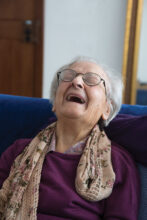
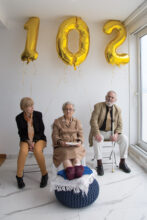
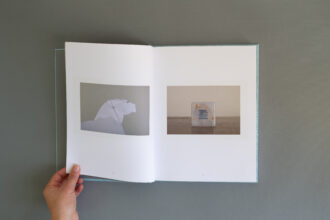
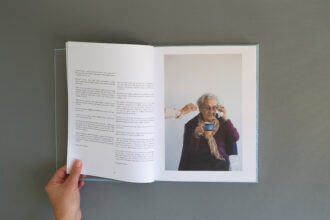



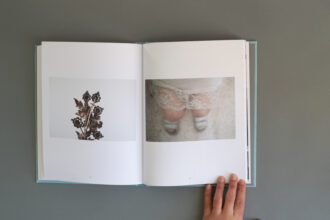
The protagonist of Giola Cassar’s photo book Tessie is her centenarian relative, the 102-year-old Tessie Scerri, known affectionately to her family as Auntie Tessie. The project is fitting for the Maltese photographer Cassar, who often focuses on the relationship between identity and memory in her practice, exploring how objects can be used as a springboard to consider interpersonal relationships. The images in the book form a loose visual story and they are accompanied by a bilingual text, written by the book artist and writer Glen Calleja. Cassar and Calleja co-run the creative workspace Studio Solipsis in the town of Rabat in Northern Malta.
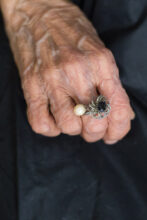
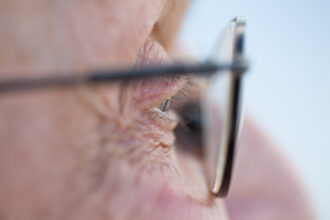
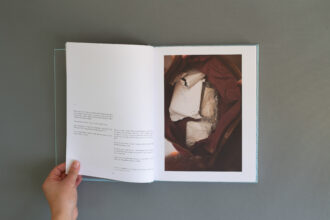
In her foreword to Tessie, Joanna Lowry writes how “jewellery threads it way through this book of stories” and the “ways in which these objects signify the transactions that we all continually make with the world”. Objects can become placeholders for memorable moments in one’s life, or are representative of one’s identity, offering an alternative biography that can be read through possessions. There are four specific items of Tessie’s which are central to Cassar’s book. They are photographed at close range and are detailed with short descriptive captions: brooch, gold and mother of pearl, a gift, 1948; spectacles with case, made in 1920; ring, yellow gold, 24-carat, lost 1942, found 1943; earrings with small imitation pearls, a gift, probably Maltese craftmanship, 1935-8.
Cassar has expressed in a press interview that she wanted the narrative to both “explore who [Tessie] is and who she might have been”. Calleja’s text subtly picks up on the four family heirlooms in his fragmentary narrative, in which he tells the imagined life story of Tessie. He writes, “For instance, she avoids wearing pearls because, she says, pearls are tears”. And later, switching into the first person, in her (fictionalised) words, “Lately I’ve thrown away so many odds and ends I’ve nearly dismantled the house … I’ve kept the potted plants. They were my mother’s. The ancient specs in their brown case. They were my father’s. – Their wedding rings, some family gold – I won’t touch those, ever.”
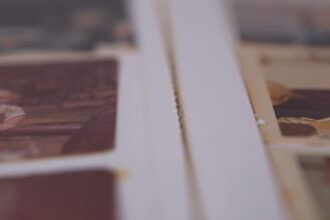
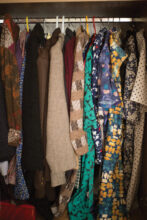
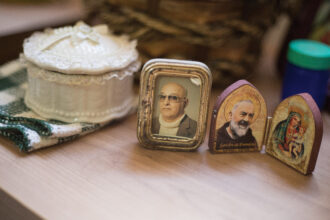
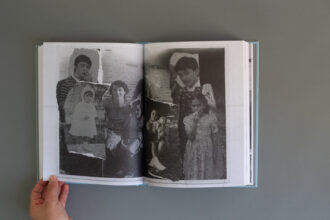
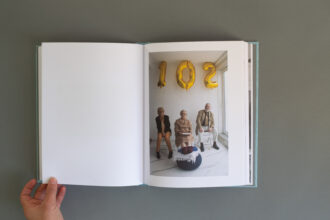
The majority of the book is dedicated to different sequences of photographs of Tessie and her belongings, occasionally interspersed with double page spreads filled with collaged black and white photographs drawn from Cassar’s old family albums. We see Tessie studying these albums with a magnifying glass, in addition to reading the newspaper, drinking tea, celebrating her birthday, searching through her handbag, having her hair cut, gesticulating while she talks. Cassar also captures Tessie’s body at close range, photographing her fingernails, the creases of her palm, the white lace trim of her nightdress bunched over knees, her arms folded in her lap. The documentation of Tessie’s possessions is treated with the same intimacy, and there is a palpable physical presence felt in viewing these inanimate items. Her slippers, the pin of a brooch, her glasses, the open weave of knitted textile, her clothes hanging in the wardrobe, the framed photographs she keeps next to her bed, alongside stacks of books and papers, her rosary beads and crucifix. Tessie and her objects are intuitively conflated, such as the photographs of a stitched textile, cropped to focus on a constellation of multicoloured threads, which lead before a series of images of the delicate veins and wrinkles on her clasped hands, a poetic testament to the passage of time.
Reviewed for Photomonitor by Philomena Epps
__________
Tessie by Giola Cassar was published in a limited edition of 150, more details here