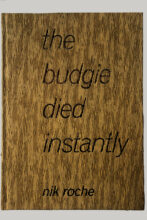
Nik Roche’s unforgettable essay, reporting from the waste lands of “austerity” fuses a photographic and a moral vision. The narrative implies difficult questions and, perhaps, a recognition of complicity.
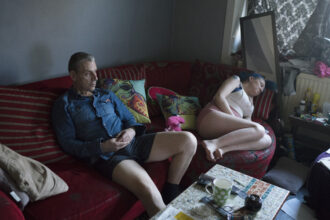
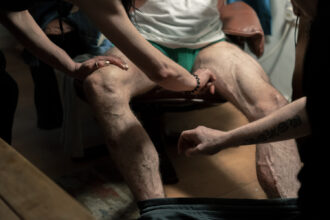
Over years, Roche gained enough trust to take these intimate, often shocking, photographs of an alienated community, linking their private spaces and self-destruction to a wider economic destruction. An opening photograph shows the fringe of a run-down estate; his subjects are, literally, marginalised. In banal rooms, with net curtains, pound-shop sweet jars and rumpled sofas, the addicts’ paraphernalia is equally banal, a syringe by a bottle of nail varnish, a tangerine on a glass dish beside the user’s foil. Their sparse rooms are bleakly lit, with few personal touches, few comforts. At their most peaceful, his subjects doze, with narcotics and alcohol, sprawling on sofas or sun loungers in a cramped concrete yard, yet their lives are far from peaceful.
Roche gazes unflinchingly at the squalid violence, including over-heard conversations devoid of any empathy, any ethical or civic values. Yet, among pictures of scars and wounds, these aggressive anecdotes of brutal mischief and revenge have a performative cheekiness, suggesting quick wits and high spirits.
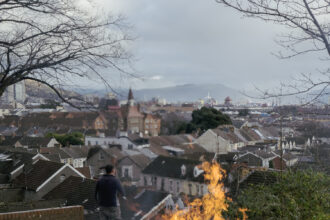
Roche’s photographic vision is undramatic, insistent. Often the light is low, the characters blurred, barely distinguishable; Roche seems as silently unobtrusive as wall-paper. Sometimes he gives an enlarged detail; then, pages on, the full image. So, the first shot of the central character is an obliquely-angled close-up of his eyes; later comes the whole portrait. Roche circles his subjects, reflecting their limited horizons. Repetition structures the narrative: halfway through is a shot of bonfires and a tree-felling on a hill overlooking spires and rooftops. At the end, an enlargement of that same vista is licked by tips of flames, potentially consuming the town. In another example, again from the end, a boy gazes from a caravan window; two pages on comes the child’s unsettling stare in close-up, and we are forced to wonder how he sees the world he looks upon, what future it holds.
Roche travels beyond the shabby interiors, but the world beyond is equally claustrophobic. From these closed and shuttered faces, we extrapolate the cheerless pub, the insultingly mismatched chairs in a bureaucratic corridor, the fruit machine and perfunctory balloons at some venue, a hopeless corner in a medical unit. A wonderful double spread in the centre, a road zigzagging a rainy night hillside, gives the poetry of bad weather, yet remains forlorn, disconsolate.
Another narrative strand hints at something hidden, suppressed tenderness, unfulfilled yearnings. Photographs of animals, especially birds, weave throughout the essay. Mostly, these animals are confined – a dog leaps in darkness behind wire netting, a gaudy parakeet is caged in a yard, or perches on a door frame, pigeons flutter in dark lofts and sheds. Just once birds fly freely beneath the sky, just once five horses gather by a hay rack, just once we see dogs outside, following their master along a farm track. Other photographs remind us that the people are no less confined: iron railings tower above goal-posts on a foggy sports pitch and, after the shot of dogs along the farm track comes a picture of an asphalt yard, with brick walls high enough for a prison. A blurred photograph of white doves in a shadowy loft is the final bird image, separating the two shots of the boy at the end of the book, a poignant juxtaposition. The beating wings of caged birds express something hidden, something inward, in their owners’ lives.
And through these images of birds and animals, Roche leads us to consider the nature of imprisonment. The caged bird returns to its cage; people’s days revolve around airless rooms and addictions. As this century transports us towards bright opportunities promised by technology, some are excluded. The decay of older industries damages ordinary lives in ordinary places; every under-funded Health Centre, every leaky school roof signals contempt for the vulnerable. Though the people Roche photographed are difficult, and dangerous, there is no “deserving/ undeserving poor” debate; his images show the personal destruction that follows economic decline – the parents of the child staring out of the caravan window were children themselves when Governments in the 1970s attempted to cancel free school milk. Roche offers no answers, makes no excuses, but shows a world blighted by inequality as much as by poverty.
An ironic footnote: The publication of The Budgie Died Instantly coincided with press reports (The Times 19th Sept) of our current Prime Minister struggling financially, on his Prime Ministerial salary (165K). That toxic inequality is one end of the seamless spectrum of distress and crime: this we know, and Roche vividly reminds us.
__________
The Budgie Died Instantly by Nik Roche was published in an edition of 500 by Setanta Books and reviewed for Photomonitor by Patricia Baker-Cassidy
For further viewing: Nik Roche website