“…running away from photography.”
– Stephen Gill (at MPF Bristol, 19th October 2019)
__________
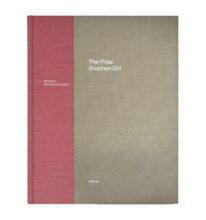
One of the outstanding photo-books of 2019 was Stephen Gill’s The Pillar (Nobody, 2019), the deserved recipient of the Prix d’Arles, and many enthusiastic reviews. Readers were moved and amazed; this essay will live on.
In The Pillar, Gill’s basic photographic strategy is to “step back as an author”, a purpose declared years ago when he published Buried (Nobody Books, 2006). Gill set a wooden pole at a field edge in the flat vastness of Skane in southern Sweden. On a second pole about 4 foot away, he fixed a camera, triggered by a motion sensor. This is even less human intervention than with Night Procession (2017) where an infra-red flash captured the nocturnal kingdom. He said about Night Procession that wilderness creatures “would perform and take on the role of author,” and The Pillar has certainly achieved that “stepping back” – there is no trace of “authorial intention” nor is there any sense of performance, neither from Gill nor the birds. Gill hoped to “pull the birds from the sky;” his years of considering the perspective of wild creatures, and how they occupy their environments, led to such a successful realisation of his hopes.
So, an astonishing photo-essay. But I would like to propose that The Pillar is not so much a photo-book as a philosophy text, expressed through photographs, not syllogisms. Gill’s photography invites us to rethink the way we position ourselves in the world. The landscaping of our earth, through painting and through physical design and engineering, creates avenues, panoramas, vistas, viewing points, all implying a single-point perspective. The human observer is both privileged and necessarily separated; organising the world visually through perspective creates a gap between the viewed and the viewer. And that anthropocentric gaze is reinforced by the ancient concept of The Great Chain of Being, still potent centuries after Aristotle, informing science and literature – as seen in Alexander Pope’s Essay On Man (1734). Population drift from the countryside into Europe’s burgeoning cities increased a sense of nature as something to be “looked at,” part of the nascent tourist industry, and thriving still in these Instagram days. The poets, later labelled as The Romantics came as challengers, insisting on the transformative effects of looking at Nature, that the the natural world “interfused” the spectator; yet the viewer’s reactions, the poet and the poet’s responses, remained unshakeably central. Gill’s work asks us to do something almost beyond the reach of the human mind: to dismantle the thought-scaffold that places human consciousness at the heart of all seeing, all experiencing.
As we read through this handsome book, the power of the photographs over-rides our human displacement. Birds are made visible in ways that we have never seen. Wings slice the sky, birds twist, move out of focus, blur and sharpen, dive into our vision, sometimes truncated, sometimes distant. They swivel on the post struggling to balance, take off to spiral through the Skane skies. And we see a backdrop of changing seasons – winter snow and summer grasses. Not quite a colour book, not quite black and white – subdued tones in a subdued landscape. Sometimes they are too close to decipher, and sometime completely gone, leaving empty fields under snow or a flying moon. Such surprise, such joys.
Through Gill’s ingeniously placed camera, bird life in a field in Skane has been made visible. And he shows us, by receding from “authorship,” that we coexist with many life forms, in our planet’s interactive eco-system. There is no need to position ourselves on any notional ladder; Gill’s essay frees us from the Chain Of Being. Behold, we are here! Along with the birds, the grasses by the ditch, along with all other life, blown by the winds of the universe, we too are here.
– reviewed for Photomonitor by Patricia Baker-Cassidy
__________
The Pillar by Stephen Gill, with words by Karl Ove Knausgård won the 2019 Les Rencontres de la Photographie author book award. Published and available from Nobody Books.