Reviewed by Mark Durden
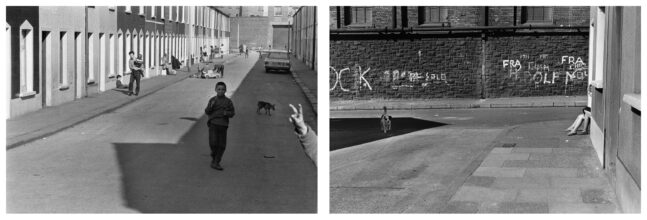
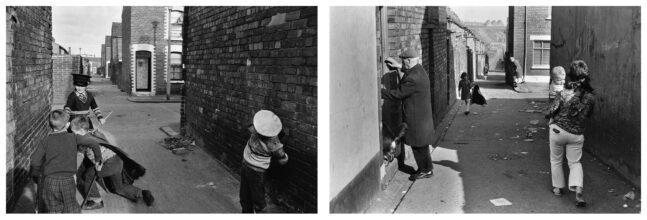
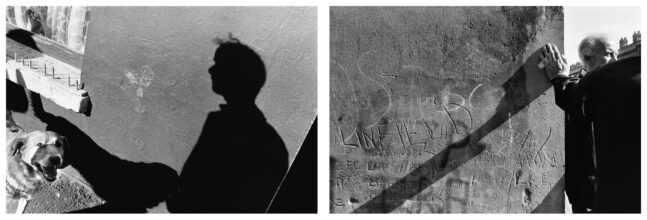
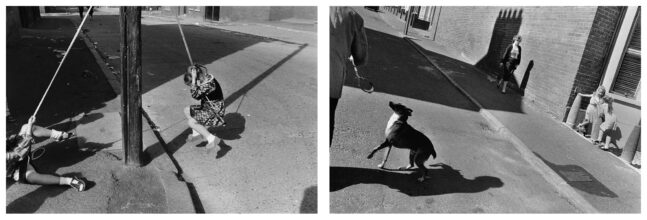
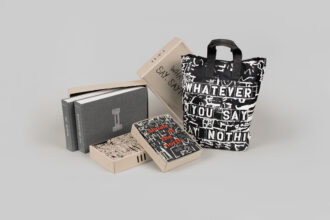
As photobooks go this is extraordinary— two big, weighty grey oblong slabs with a thousand pages of over a thousand black and white photographs, giving us a vivid and detailed portrait of life during the conflict in the North of Ireland. (1) And there are another nine hundred pages with over three hundred images in an accompanying softcover publication, Annals of the North, which serves as a reader and guide to the photobook with lyrical stream-of-consciousness notes to its photographs and essays, stories, documents, testimonies that illuminate the complex history of the conflict in the North of Ireland.
While it has taken a very long time to be published, Gilles Peress points out how “the bulk of the book” was made in a few specific years in the 1980s and “was essentially finished in 1990.”
It is a monument to the ordinary people caught in cycles of violence at such a savage time in Irish history and a powerful exposé and indictment of British imperialism. In structuring the work into twenty-two chapters, “semi-fictional days”, Peress said that he has attempted to describe time in its “helicoidal structure, where today is not only today but all the days like today”: the days of the chapters recur and repeat around rituals of protest, parades, violence, riots, mourning and also days of ‘craic’, of partying and drinking, where people try and forget. There are also many more ordinary and eventless pictures, of days when nothing happens.
The drama, violence and spectacle of the conflict take place amidst the ordinary and the everyday, and pictures sometimes play upon the absurd collisions this sets up— one man reading his newspaper on his doorstep while there are troops in his garden, the detail of the smiling face of a young soldier through the little window in the back of an armoured car as it travels down a sunny street, where kids are playing, including one with his own toy gun raised and pointed to the military vehicle.
The book has its origins in Peress’s harrowing experience as a photographer during what became known as Bloody Sunday. He was 26 years old and working as a Magnum photographer on the occasion of a civil-rights demonstration held in the city of Derry on 30th January 1972 when the British Army shot and killed 13 unarmed Irish nationalist civilians and seriously wounded 15 others (one of whom subsequently died). His shocking pictures of the injured, dead and grieving play a dominant role in volume one and he returns to them in volume two, when he undertakes his own forensic investigation into his photographs by enlarging them through high resolution scanning.
Peress was called to give testimony during both the Widgery and Saville Inquiries into the massacre and includes scanned transcripts of his testimony for the first inquiry in the second volume, in which we learn he was shot at by a young paratrooper. For the second inquiry they wanted his negatives and refusing this request he decided to enlarge them, “[a]nd do what the Brits wanted to do to my negatives.” British Justice’s interest in his pictures was to see if there was an IRA gunman in the crowd. But all Peress can find in the grain, as he puts it in his notes to the blown-up pictures (included in the Annals):
Are feet and the hands
Of the living
And of the dying
And of the dead.
Another central event concerns Peress’s close friendship with Denis Donaldson, a key figure in the Republican movement, friend to Bobby Sands and Gerry Adams, and the impact of the subsequent revelation and confession in 2005 that he had been under the pay of British Intelligence since the mid 1980s. In response to the shock of his friend’s betrayal and his subsequent murder a few months after his confession, Peress produces a closing chapter to volume one that combines different appropriated and scanned images, portraits of Donaldson, from pages from his family album, from contact sheets, and enlargements of his image in news reports about his murder as well as close ups of such conspiracy headlines— “British outed Donaldson to show Provos they had another spy in leadership”. There are also a series of stills from films, John Ford’s 1935 The Informer, for example, with its story of a Republican’s act of betrayal during the Irish War of Independence. The chapter and volume one end with the image of the memorial funeral card for Denis Donaldson, spread over two pages. Breaking from the more familiar pictorial conventions of much of the rest of this volume, such fractured, appropriated and blown-up imagery is in keeping with the emotional crisis and turmoil of the impact of this betrayal. In one of the chapter notes to this series of pictures, Peress succinctly relays his conflictual feelings towards Donaldson:
Denis, I love you, still do
Fucking traitor
During the Troubles anyone could be an informer, a tout. The climate of paranoia and schizophrenia, of suspicion and fear, as well as Donaldson’s betrayal, is perfectly captured in the book’s title Whatever You Say, Say Nothing. The words occur on one of the IRA’s wall murals Peress photographed. The expressive force of language is an important element running throughout this book, with Peress often drawn to the messages painted on walls— threats, taunts, abuse, acronyms, slogans, recruitment calls, as well as brilliant reflections on the bleak absurdities of the conflict: “When those who make the law and break the law in the name of the law there is no law.”
Peress says in making his book, “my intent was to describe a totality in all its simultaneities: not just to represent what was happening on each side of the divide between Nationalists and Loyalists, or on either side of the class divide between the rich and the poor, but to represent life in all its incarnations.” Driven by a desire to be as comprehensive as possible, his photography comes from an impassioned and powerfully subjective response to the violent history of the North of Ireland, and at the same time involves working through the trauma of his experience of Bloody Sunday and the repercussions of his close friend Denis Donaldson’s betrayal and murder. There are no tidy narratives here to contain and frame things. And the unresolvable contradictions are exemplified by the figure of Donaldson. The mystery of the man both haunts the book and pulls it away from more conventional and familiar documentary pictorial modes.
Towards the book’s close there is a series of hard-hitting pictures that take us close to the impact of the violence. He shows us the injured, the blinded and the scarred. Then pictures of boys in their coffins during wakes in their homes, boys who have been killed by plastic bullets, and the agonies of the grieving. The next chapter shifts perspective by opening up a deeper sense of time and history through what Peress refers to as “the enduring continuity” of the ancient pilgrimage on Croagh Patrick, the holy mountain in County Mayo, with people shown barefoot in penance on its harsh rocky terrain. Peress’s notes to the pictures during these final chapters shift from anger and rage over the violence and senseless killings to questions about the pilgrims’ ritualised penance:
Does it redeem all the Irish suffering?
Is there a revelation at the end?
Can you see paradise down there in the mud with your bleeding feet?
Peress offers no answers or redemption in his photobook. The pictures of the pilgrimage, like an earlier idea for a title for the book Power in the Blood, imply deep-set passions of faith and belief, that are not seen as separable from the violence of the conflict he photographs. The final chapter of the book shifts to nature and the Irish landscape, including the Giant’s Causeway, framed in terms of elegy and memorial to the country’s bloody history as ‘The Land of the Dead’. In their romantic tone and aesthetic they are however pictorially distinct from much of the rest of the pictures – abrasive, raw and visceral – in this book.
In a text written in 1980, included in the Annals, Peress refers to the photobook as a form and how “[i]t speaks as an object whose ubiquity eliminates the preciousness of the museum presentation, establishing communication on a private plane.” But a book of such size and quality comes at a price and this limits its circulation and access. The photobook and reader are currently priced at 650 euros. Who is it for? Well-off book collectors? Specialist libraries? Museums? The presentational aesthetic of the two volumes and the reader packaged in a tote bag patterned with graffiti only adds to this schism: the privileged world in which this book circulates is far from the realities of the world it immerses us in.
__________
(1) I am adopting Peress’s use of the term North of Ireland as opposed to Northern Ireland throughout this review. In a note in the accompanying book Annals of the North Peress clarifies his use: “Many Nationalists and Republicans prefer the term the North of Ireland, which connotes a united Ireland and denies the legitimacy of the partition of the island.”
Whatever You Say, Say Nothing by Gilles Peress, was published by Steidl and reviewed for Photomonitor by Mark Durden.