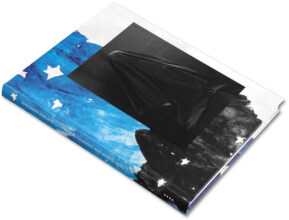
‘During labor, every woman touches death, if only for a second,’ writes Ahndraya Parlato in her recent photobook Who is Changed and Who is Dead (2021). She also observes that this preface to physical death, ‘marks the beginning of the death of the autonomous self as we know it’. Throughout the book, this intertwining of birth and death is presented through repeating motifs, while photographs of Parlato’s daughters and her frank anecdotes on motherhood explore the complicated identity shifts brought about by becoming a parent. The resulting depiction of parenthood is neither idealised nor an evocation of the pram-in-the-hallway stymieing creativity, but rather an elusive and pensive reflection on the ambivalence of motherhood.
The photographs and texts in the book are given equal footing to explore these themes. Written in two parts – the first addressed to her children, the second to her mother – the texts combine reflections on her mother’s suicide and grandmother’s murder, alluding to an intergenerational trauma associated not just with her personal experience but also more broadly with being female. Occasionally, the diary-like texts refer directly to the photographs, providing a starting point for what to see in them, or what to pay attention to. However, the images – which include photograms, double exposures, drawings, constructed scenes and more candid documentary photographs – are left ample room to intimate on their own terms and the book becomes a space to hold seemingly contradictory ideas together.
Flowers and fruit – some in full bloom and ripeness, others starting to wilt or decay – are a recurring motif. Alongside these images Parlato mentions a connection to her maternal grandmother through an interest in nature and a desire to watch things grow. Yet here, as in the tradition of vanitas still life painting, death is ever present in the fecundity of nature. One still life of red flowers against a red backdrop reappears a few pages later with her daughter in the frame, intervening and dismantling the arrangement. Her presence transforms the scale creating a subtle shift to see things differently – evoking the reorientation of self that motherhood demands, the navigating of a new identity in constant flux. Also recurring are ceramic jugs and vases arranged on their sides or inverted, spilling imaginary contents, or rendered unable to successfully hold anything. These images are both carefully constructed aesthetic studies of light, form and colour, and emblematic. Parlato explains that these vessels appeal to her because ‘they are clunky but will suffice’, like her experience of motherhood.
In one anecdote Parlato recalls driving alone and glimpsing her children’s empty seats in her rear-view mirror and experiencing their ‘relentless presence despite physical absence’. This succinct summary of parenthood also captures the potency of photography – the insistent there-ness of the photographic image that gains its power from the subject’s absence. Throughout, the book plays with what, or who, is absent, or cannot be seen, and must be brought forth by other means. One such present absence is her mother. Eschewing archival images, Parlato conjures her mother’s presence through the inclusion of photograms made with her ashes, although these abstract white splotches over bright hues are not immediately identifiable as such. The photograms are reproduced in the same dimensions as the original prints, a direct imprint of what physically remains of her mother.
Another absent presence is Parlato herself. Despite the presence of her voice as the omnipresent narrator, Parlato’s image is absent, or almost absent; she is present but has obscured herself in the tradition of Victorian ‘hidden mother’ portraits. In these photographs, mothers or nannies required to hold a child still for a long exposure would cover themselves in dark fabric in an attempt to blend into the backdrop. A portrait of Parlato covered in black fabric, shot against a black backdrop, striving but failing for invisibility, appears on the book’s cover. The image is funereal, linking to the idea of the death of the self that is experienced in motherhood, and also slightly absurd. Although her identity may be effaced, Parlato still remains a solid presence. In another ‘hidden mother’ image she is a visibly orchestrating presence: crouching behind a chair, her hands, with some force it seems, hold her daughter’s head towards the camera.
The title of the book is adapted from Barbara Comyns’ 1954 novel, Who Was Changed and Who Was Dead, about a village that is first flooded and then plagued by a madness that makes everyone want to commit suicide. There are parallels with this narrative and the suicide and violent deaths within Parlato’s immediate family – and her subsequent fears for her daughters. But the title also hints at the idea of what we might inherit, what will alter and what continues, of being a vessel and what we might unwittingly carry or contain.
__________
Who is Changed and Who is Dead by Ahndraya Parlato was published by MACK and reviewed for Photomonitor by Jessie Bond.