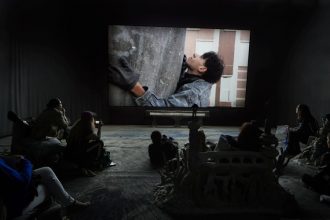
The queue for Laure Prouvost’s Deep See Blue Surrounding You/Vois Ce Bleu Profond Te Fondre stretches down the long avenue from the French Pavilion to the entrance of Venice’s Giardini della Biennale. Prouvost, who is this year’s national representative for France, has created an installation that so far has proved to be one of the most popular offerings at this international showcase, which is both the benchmark for artistic innovation and excellence as well as a conspicuous display of wealth from the art world elite. In an energetic and immersive Pavilion, the Turner Prize winner plunges audiences into a rich, part-fact, part-fiction universe, charting the artist’s conceptual journey from France to Venice in a vastly original homage to the sea.
Across the 58th Biennale, artists in the Central Exhibition, the International Pavilions and Collateral Events contend with a series of contemporary challenges seen through the lens of the eponymous ‘interesting’. The title, chosen by curator of the Central Art Exhibition, Hayward Gallery’s Ralph Rugoff, speaks to both the doubtful authenticity of much of today’s rhetoric and the collective circumstances faced by our species as we struggle with increasingly uncertain futures.[1] The climate crisis, continued displacement of peoples, and daunting technological futures are primary concerns across the city, in a showcase that sees artists prophesying, offering resolution and sometimes resisting with unmitigated expressions of joy and pain.
I begin my visit at the Central Exhibition, where Rugoff has chosen to scale down participants from over 100 to 78 as well as making the unusual decision to invite artists to show two pieces across two sites – seeking to reflect both our “neither single nor homogenous” reality, and in parallel, demonstrate the complex nature of each artist’s oeuvre.[2] Despite Rugoff’s decision to lessen the visual load, the Central Exhibitions remain at times a long slog, punctuated by moments of complete brilliance in menacing installations by Sun Yuan and Peng Yu, moving image works by Kahlil Joseph, Jon Rafman and Hito Steyerl, and photography by Rula Halawani and Zanele Muholi. However, the multiplicity sought by Rugoff is perhaps best illustrated in the works of Christian Marclay and Ryoji Ikeda, both of which warrant a more detailed explanation.
Marclay’s 48 War Movies, 2019, (Arsenale) and Scream, 2018 (Giardini) both offer unsettling viewing experiences. 48 War Movies, a visually and acoustically dizzying onslaught of fractured sound and footage from incalculable conflicts leaves the audience with an abiding image of mass bloodshed crystallised through the cacophony. In Scream, 2018 a series of large-scale woodcuts spliced from comics and manga evoke the most primeval sound in a Munch-esque expression of pure angst.
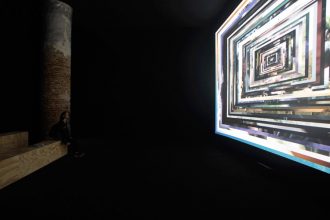
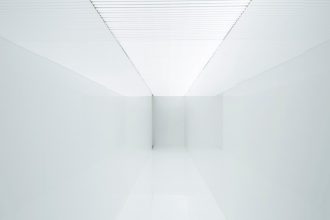
Ryoji Ikeda’s data-verse and spectra III offer two vastly different takes on data overload with data-verse being a monumental and hypnotic digital projection that coalesces the digital sum of our physical reality via the process of re-programming raw data from institutions such as CERN and NASA. Spectra III provides the polar opposite aesthetic experience, taking the viewer through a narrow corridor of blindingly bright fluorescent tubes, invoking what the artist sees as an experience of the sublime.
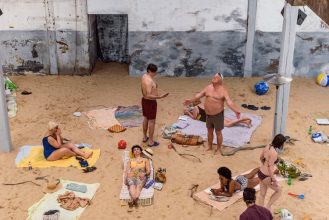
Progressing through the International Pavilions, it’s clear that participants representing their countries have similarly embraced Rugoff’s interpretation of ‘interesting’, with the climate crisis being one of the most widely examined themes this year, referenced in the aforementioned French Pavilion through human ephemera sunk into a blue resin floor, in the organic forms of Ane Graff in the Nordic Pavilion which question human exceptionalism linked to ecological disaster, and by Denmark’s Larissa Sansour in her fictional installation In Vitro, which imagines a future subterranean world in which the surface has been lost to climate breakdown. The subject is addressed most originally by Lithuania, winner of this year’s Golden Lion. Represented by theatre director Rugilė Barzdžiukaitė, playwright Vaiva Grainytė, and composer Lina Lapelytė, the pavilion contains a subtly perturbing climate change themed opera that resists the usual fearmongering and instead reveals a glimpse of the laziness that may well lead to the end of the world.
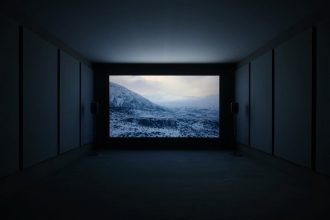
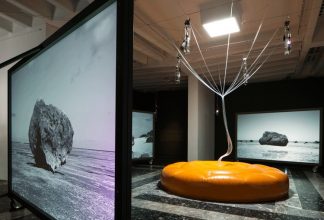
As in the Central Exhibition there are some outstanding moving image installations, by Charlotte Prodger for Scotland and Motoyuki Shitamichi, Taro Yasuno, Toshiaki Ishikura and Fuminori Nousaku for Japan. 2018 Turner Prize winner Prodger recalls her years spent as a queer teenager in Aberdeenshire in parallel with the story of a lioness who grew a mane, in an exploration of queerness and essential human/ animal behaviour in visually lush film SaF05. The Japanese Pavilion, Cosmo-Eggs, created by Shitamichi, Yasuno, Ishikura and Nousaku investigates issues around humanity’s relationship with our surrounding environments. The Pavilion has been designed to create a platform considering the ecology in which humans and non-humans co-exist, questioning how and where we can survive, a topic especially relevant to recent Japanese history which has been marred by man-made and natural disasters.
The Biennale is a highly respected showcase of contemporaneous artwork acting as a mirror for current events and not immune to real world politics, as in the case of the usually highly anticipated Venezuelan Pavilion which, like the country’s borders, has remained closed as the ongoing power struggle between government and opposition continues. [3]
Despite the efforts of artists and organisers to reflect these innumerable social challenges in engaging and provocative ways there is, as always, a margin of error – this year arising in the form of a large fishing boat, installed in the historical naval grounds of the Arsenale by Swiss artist Christoph Büchel. The piece, Barca Nostra, is a ship which sank in 2015 off Lampedusa killing between 700 and 1,100 migrants in an event which became the Mediterranean’s most tragic shipwreck in living memory. Raised from the seabed in 2016, the ship-turned-mass-grave is currently casting a shadow over an Illy outdoor café, lacking any accompanying information and flanked by Polizia. A sobering sight but also a highly tone-deaf spectacle – both a monument to our collective failure and a short-sighted, shallow lapse of judgement on behalf of the organisers. An unfortunate reflection on these ‘interesting times’.
– reviewed for Photomonitor by Madeleine Shanks
__________
Notes:
[1] ‘May You Live in Interesting Times’ is a fictitious yet persistent proverb, thought to have been first used by Sir Austen Chamberlain in 1936, during a speech in response to the advancement of German troops before the onset of the Second World War. The phrase has been used repeatedly since, including a mention by Robert F. Kennedy, in Cape Town, during a 1966 speech, and also invoked by Hillary Rodham Clinton, in her 2003 autobiography, as a running joke in the Clinton family.
[2] In his essay ‘May You Live in Interesting Times’, Rugoff uses this quote from The Life of Forms in Art by Henri Focillon.
[3] At time of publication rumours of a late opening have yet to have been met.
__________
Full credits for images at right:
1. Pavilion of FRANCE, Laure Prouvost
Deep see blue surrounding you / Vois ce bleu profond te fondre
58th International Art Exhibition – La Biennale di Venezia, MayYou Live In Interesting Times
Photo by: Francesco Galli Courtesy: La Biennale di Venezia
2. Christian Marclay
48 War Movies, 2019
Single channel video installation, colour, stereo sound
58th International Art Exhibition – La Biennale di Venezia, May You Live In Interesting Times
Photo by: Francesco Galli, Courtesy: La Biennale di Venezia
3.Ryoji Ikeda
spectra III, 2008
LED lighting tubes, laminated white wooden panels
58th International Art Exhibition – La Biennale di Venezia, May You Live In Interesting Times
Photo by: Italo Rondinella Courtesy: La Biennale di Venezia
4. Charlotte Prodger
SaF05
Installation view Venice Biennale 2019, courtesy of the Artist; Koppe Astner, Glasgow and Hollybush Gardens, London.
Photography: Cristiano Corte
5. Pavilion of JAPAN, Motoyuki Shitamichi, Taro Yasuno, Toshiaki Ishikura and Fuminori Nousaku
Cosmo-Eggs
58th International Art Exhibition – La Biennale di Venezia, MayYou Live In Interesting Times
Photo by: Francesco Galli Courtesy: La Biennale di Venezia
6. Pavilion of LITHUANIA, Rugilė Barzdžiukaitė, Vaiva Grainytė, and Lina Lapelytė
Sun & Sea (Marina)
58th International Art Exhibition – La Biennale di Venezia, MayYou Live In Interesting Times
Photo by: Andrea Avezzù Courtesy: La Biennale di Venezia