
Adam Jeppesen’s work challenges the boundaries between documentary and fiction. His photographs inhabit a blurred territory where the real and the tale become interchangeable. Even if the Danish artist seems to remain faithful to what is already in front of his camera, he doesn’t seem to be too concerned about objectivity.
His first monograph, Wake, was published by Steidl in 2008, and brings together a selection of photographs that Jeppesen took over the course of seven years, while traveling on assignment.
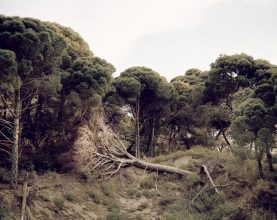
The book Wake opens with an air of restlessness. In the first page we see a dead, fallen tree in the middle of a pine forest. Second page, a cupboard with china cups, red drops spilt all over. Then we come across a letter: two people who love each other are apart. Presumably one of them is away, travelling; the other one is waiting at home. One wrote something about a plant dying. The other replied, “I wanna hear yr voice on the phone, maybe t’morrow?” Who knows?
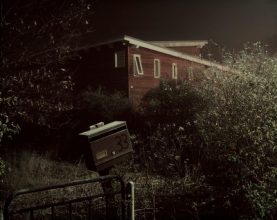
An atmosphere of uncertainty traverses the pages; an expectation in every image, a sense of something happening and yet everything appears so quiet and calm. The quietness is pregnant with discomfort, like an untold story. A mixture of heavy darkness, foggy lights and wet air floats over places, things and living beings. Insignificant objects and situations are invested with a secret narrative that the imagination of the viewer is encouraged to unfold. A plastic chair next to a staircase outside a balcony; an unoccupied table in a restaurant; a crooked letterbox behind a fence in the middle of the night.
Most of the images are pervaded by a sense of loneliness: the loneliness of the traveller. Empty landscapes, empty rooms and empty streets. Only a few living beings are present across the book: the person who writes the letter at the beginning of the book, a dog, a thoughtful woman sat on a table, another woman (or maybe the same, we really can’t tell as her face is turned away from us) standing in front of a mirror and a person lying in the shadows. However, these presences only emphasise the sense of absence. None of them are interacting with the photographer, either because they are ignorant of his presence or just because they are too immersed in their own thoughts to realize that they have company. However it is, their appearance seems to leave with us a stronger feeling of loneliness and distance. It becomes clear from the scarce portraits scattered throughout the narrative that this traveller is an observer, an outsider, a curious soul.
Adam Jepessen’s most recent and ongoing project is called Flatlands Camp Project, and it is essentially the documentation of a solitary journey through the Americas that started in the Arctic and ended in Antarctica over a period of 487 days.
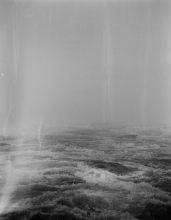
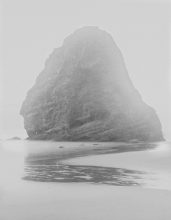
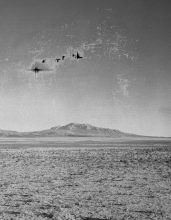
Most of the images within this project are landscapes: the vast land lying at the feet of the adventurer. Horizons, kilometres of deserted earth and sea. Traces of the journey are present in the photographs: scratches, stains and dust that remained on the surface of the negative as the traveller carried them all the way through his expedition. Traces that invest the photographs with a sense of physicality and tell us about the journey as much as the images themselves do. Through them, we feel the tiredness and the struggle of the traveller making his way through foreign territory.
The narrative is serene and slow; as with his previous work, what we see is filled with an uncanny atmosphere. There is always the same sense of absence hovering over the desolated landscapes, the empty territories and the incommensurable and secretive nature. In fact, this work could make us think of those Romantic figures in Friedrich’s paintings, with their backs to us, contemplating in a sort of ecstasy the sublime beauty of nature. However, this time we don’t see the back of the traveller but we are instead allowed straight into his eyes, staring into the raw eternity of an agitated sea.
In Flatlands Camp Project the only human presence is the one of the photographer himself, the lonely witness of his own journey. Usually blurred and undefined, his presence is diffused and ghostly or half concealed, as though about to vanish. It seems as if that diluted figure that he offers as a self-portrait serves as a metaphor to represent the fluid character of his work, sharing with us a flowing and open narrative free from the burdens of truth and objectivity.
But Flatlands Camp Project is much more than a mere group of documentary images about a trip. Because of the way the artist conceives his work, the way he produces it and the way he chooses to show it and install it (deconstructing the image into different pieces, then assembling them back together with pins), his art reaches out from the boundaries of photography and makes an incursion into those of performance and sculpture. The photographs in Jeppesen’s project became an artistic object that can’t be isolated from the way the artist produces them, constructs them and displays them.
Going through Adam Jeppesen’s work is like embarking in a mental journey. It doesn’t teach us anything, but encourages us to feel. His photographs don’t give us any facts. Even if they are the product of a trip, they don’t tell us about people, places or foreign cultures and traditions the way we expect travel photography to. In fact, we are unable to tell where each photograph was taken, as the artist doesn’t give us any information about it. However, looking at these images, we still feel the power of the journey, the amazement of the traveller, the nostalgia and the mystery while staring into never ending horizons. And this is where the magic of these photographs resides. This traveller is a dreamer, with the sensitivity of an artist engaged with beauty and adventure. And by going into his images, so are we.
———
Work by Adam Jeppesen is currently on view in the exhibition ‘Do You Remember the First Time?’ through 8 September 2012 at Atlas Gallery, London.