










Love Letters Straight from the English Heart
John Angerson’s English Journey is a project that retraces the steps J.B. Priestley took when he wrote his 1934 classic, a book which laid bare the inequalities of English society as Priestley travelled from Southampton to Newcastle.
The origins of the project began in Bradford in 2008, where Angerson was living at the time. “When I first left college I took a job at a picture agency photographing vicars and steam trains in the north of England. I spent quite a lot of time at the Photography Museum in Bradford. There’s a big sculpture outside of a man in a coat with a pipe. I wondered who it was so I looked at the plaque and it said J.B. Priestley. So I read his book English Journey and was transfixed by a) how beautifully written it was and b) it felt like I was reading something very contemporary. That’s when the nugget of the idea appeared.”
Angerson applied for and was given a grant, decided to move from 35mm to large format, bought a camper van and set off on his journey. It wasn’t a success. “I made the classic mistake of turning it into a local history project. I would find places where JB Priestley had been. Oh look, J.B. Priestley went here, J.B. Priestley went here, J.B. Priestley went here… I came back with all these pictures after four weeks, got the film processed, realised that I didn’t know what I was doing with a large format camera and realised that I had completely missed the point. I saved a bit more money and the following year I did it again.”
“I realised I had to make my own journey , so on the second trip the research changed to finding places that weren’t there when Priestley was around but that he, a man of a certain age and a certain political persuasion, would be interested in seeing. I wanted to open up a conversation visually and with this imaginary friend about how England had changed.”
Where Priestley looked at the economic injustices within England, Angerson places the country within a more globalised economic framework. Call centres have replaced heavy industry, hotel chains are owned by transnational companies, and the china-making industries of the Potteries have been outsourced to Eastern Europe and Southeast Asia.
This non-nostalgic view of England was deliberate on Angerson’s part. “I made a promise to myself that I wouldn’t slip into cliché and go down that Downton Abbey vision of England. I had post it notes on the steering wheel of my car that said ‘no post boxes, no phone boxes, no mad dogs and Englishmen’ because it’s so easy to do.”
As a result, the book that is relatively free of the symbols of what Michael Billig calls ‘banal nationalism’. These are symbols that are everywhere and constantly remind us of nationalist imperatives. The problem for us is that we forget that we are being reminded. In Angerson’s book, there are instead constant reminders of what might be called ‘banal transnationalism’, a record of England as a deskilled country where transnational ownership, service stations, fast food chains, delivery services and zero hour contracts dominate the cultural and economic landscape.
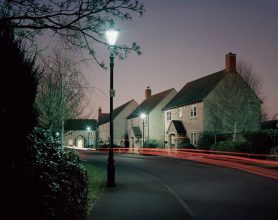
There are reminders of an idealised Britain; new-build homes in the Cotswolds, the lady master of a hunt, the hotel where travellers on the Titanic stayed before their fated journey. But the idealisation is thin and the nostalgia becomes frayed around the edges in the face of captions that de-romanticise any idealised vision of England one might hold.
Nostalgia is there, but it comes in the form of a mass psychosis, something that appears in the image from Royal Wooten Bassett. “I was just driving along to Bristol and you know when you accidentally knock the radio and it goes to Radio Swindon or something. I did that and it said, “this morning there is going to be another repatriation in Wooten Bassett at 11 o’clock and we’re going there live”. So I literally just randomly turned up there and the whole town turned out to see these dead soldiers coming home. It was quite moving, but very strange as well. It almost felt like I’d been transported back to the First World War.”
Angerson also went to lengths to photograph what he identified as specifically English, such as the grass at Liverpool’s football stadium, grass that fits into English ideas of the idealised beautiful landscape, but also the idea of turf and grass as hallowed ground in military, class-based and sporting contexts.
“I got access to Anfield via a friend who’s a sports photographer. I arrived and the marketing team were completely perplexed by me. “What players do you want to meet?” they asked. And I said, “I don’t want to photograph any players.”’
‘”How about the changing rooms? Do you want to see the changing rooms?” And I said “No, I don’t want to see the changing rooms, I want to see the grass, it’s all about the grass. I just want to photograph the grass.”’
The nod to J.B. Priestley’s original book is carried through in the design of Angerson’s book. Here surrendering the design was a key to its success. “I think a lot of photographers think they are designers. I’m a sucker for that but I think occasionally we need to say I’m not a designer, I’m not a writer, I’m not a marketer.”
“I did the journey three times and then I sat on it for a few years and then I showed Lee Bradley at B and W Studio in Leeds and he said, “give it to me, this will look great, just give me free range on how to design it”.’
Bradley coupled Angerson’s images with pictures of ephemera collected along the way, and tied these together to reinforce key points. “Look at page 10 which is the newbuild cotswold houses and if you go to number 5 of the stamps – all the houses in the Cotswolds have to be built to be keeping in the surrounding area. There are lots of connections between the images and the ephemera. It’s the same with the Concorde stamps and Filton airfield.”
These visual elements are reinforced by captions that accompany the tipped in images (they are pasted in by hand to mirror the design of 1930s books). These captions are factual in tone, but have an underlying message that builds as the book progresses. Again, this is a result of a design process where image, text and paper all serve the message of Angerson’s English Journey.
The underlying message is one of an England of disappointment. This comes through in the low-rent economies and the marginal landscapes that Angerson photographs. These are landscapes of box architecture and CCTV cameras. They are planned spaces that are unlived in and unloved, that are hard to access photographically and even harder to photograph, that look and feel the same wherever you are in the world.
At the same time however, there is an unsentimental affection in the pictures, whether it be of the woman who wants to be a glamour model and was once on Nuts TV, or the horse grazing on the former site of the Easington Colliery, now England’s worst obesity blackspot, or the successive waves of migration that have powered mining, farming and leisure industries since the 19th century. Here the narrative of the journey oscillates between the grander narratives of what once was, and the micro-narratives of the people and places he photographs. There’s a warmth that comes through the matter-of fact nature of both the pictures and the captions.
It’s an affection that is born both of bleakness and the resilience of these people and places, a resilience he also sees in Bradford, the town where he used to live and work.
“I was looking at this book the other day and I’ve decided it’s almost a love letter to Bradford. There’s something about Bradford that is quite unique, it’s like it’s its own little country within the county. It’s almost like a love letter to Bradford. Now that I’ve left and I look at the book it reminds me of Bradford.”
Bradford’s always known as the underdog to Leeds. If you say you live in Bradford, people say ooh, Bradford and there’s always a not especially nice comment about Bradford. I always felt Bradford was a really united, special community. It had its own arts scene, it always felt like it was 5 or 10 years behind the rest of the country but it had its own identity. And J.B. Priestley endorsed the city, it’s uniquely English.”
“At the moment because we see it every day – we see the UPS driver every day, we see this Deliveroo world we are living in – we don’t see anything unusual. But it will become more relevant with time. Maybe in 30 years’ time, my book will make more sense.”
– essay by Colin Pantall for Photomonitor
__________
For further viewing:
English Journey by John Angerson was published by B&W Studio.