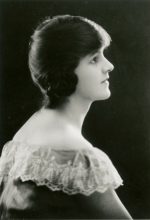
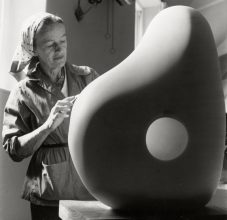
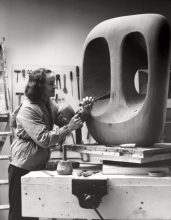

Much as I love looking at the sculptural work of Barbara Hepworth (1903-75), I also love looking at photographs and film footage of the sculptor herself, both at rest and, even more so, at work. Perhaps this quote, from the mouth of the artist herself in 1961, goes some way towards explaining this predeliction: “I, the sculptor, am the landscape. I am the form and I am the hollow, the thrust and the contour.”
This summer sees three shows dedicated to the sculptor: Penelope Curtis’s final offering at Tate Britain and two smaller, but equally rigorous and delightful, exhibitions at the Hepworth Wakefield, home to the Hepworth Family Gift, a collection of 44 of the artist’s surviving working models for her bronze sculptures.
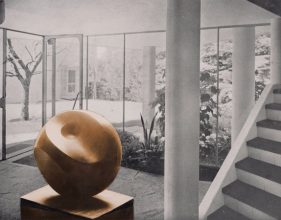
While Tate’s exhibition unsurprisingly largely comprises sculpture, it dedicates one worthy section – Staging Sculpture – to photographs taken by both Hepworth and others, showing her work in the landscape. Many of these, including a series of photo-collages, cutting out photographs of existing sculptures and pasting them on to new backdrops, including a house designed by Richard Neutra in Los Angeles and the interior of flats designed by Alfred and Emil Roth and Marcel Breuer in Zurich, have never been shown before, except for when published in Architectural Review in April 1939. Fired by her ambition to work on a larger scale, Hepworth made these composite images to show how her work might enrich an architectural or natural setting. Photography enabled her to explore such sculptural ideas and only partly came out of economic necessity.
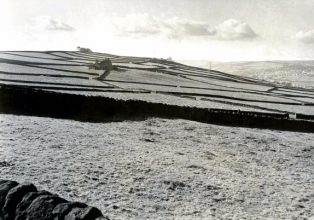
Hepworth liked to keep a photographic record of the context in which her sculptures were situated after their purchase, firmly believing in the unity of sculpture and landscape. “I’m sick of sculptures in galleries and photos with flat backgrounds,” she wrote to the critic EH Ramsden in 1943. “No sculpture really lives until it goes back to the landscape, the trees, air and clouds.” The short (18-minute-long) film, Figures in a Landscape (1953, directed by Dudley Shaw Ashton, 16mm), one of the first films to be commissioned by the newly established British Film Institute’s Experimental Film Fund, is shown at Tate alongside an annotated storyboard, siting Hepworth’s work within the Cornish landscape. The moving image is accompanied by a score by Priaulx Rainier and the words of the archaeologist and writer Jacquetta Hawkes, spoken by the poet Cecil Day-Lewis. Although the director’s vision comes across more strongly in this first film, Hepworth’s was to dominate in later portrayals. Archive correspondence evidences Hepworth’s prescriptive nature when it comes to the locations and times of day for filming her works.
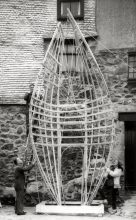
Throughout her career, Hepworth took a keen interest in the particular surroundings in which her sculpture might be seen. Having collaborated with established photographers, such as Paul Laib (1869-1958), she went on to photograph her own sculptures between 1934-44, learning how to select appropriate backgrounds and how to light and angle her sculpture to convey its 3D presence. As with the films, she maintained a high level of control over how her works were depicted and how the images were to be used in publication. Her notes on the back of numerous prints demonstrate her awareness of the impact of cropping and other such technical aspects. “It is terribly important that the photography should not be cut in any way at all,” she wrote to Bryan Robertson, director of the Whitechapel Gallery, about her 1954 exhibition. “If even a fraction of the bottom or top is removed, it prevents one feeling that the carving is large and merely looks about six inches long.” Hepworth always remained in control of how the media – and artworld of the time – managed the presentation of her work. An annotated offprint of World Review (Christmas 1943, pp56-7), for example, shows Hepworth’s criticisms of others’ photographic reproductions of her sculpture.
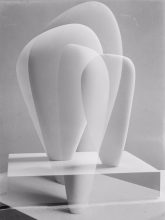
Hepworth was very aware of the burgeoning image culture in which she lived and worked and, alongside collage, she employed innovative techniques, such as double exposure, to convey a sense of her sculptures to colleagues and potential collectors. Thus, while some of the photographs on display are simple documentary photographs of her sculpture, some are experimental works in their own right – especially Double Exposure of Two Forms (1937).
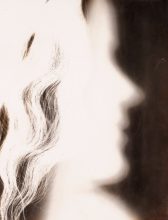
Hepworth was great friends with the Hungarian avant-garde artist, László Moholy-Nagy (1895-1946). He was a pioneer of the photogram and clearly an influence of Hepworth, who also undertook to experiment with this technique. Only two of her photograms survive, both of which are profiles, made by placing her head against photographic paper and exposing it to light. One of these little-known treasures, Self-Photogram (1933), is enough reason in itself to make the trip to Millbank.
Another gem is the pair of personal photograph albums – one compiled by Hepworth, one by her second husband Ben Nicholson (1894-1982) – from the 1930s, which emerged from the family archives during the research for this exhibition. Unfortunately visitors are only able to see the pages chosen for display in the vitrine, but the photographs capture a fertile period of Hepworth and Nicholson’s relationship and the interplay of the two artists’ lives and works in their shared Hampstead studio. Having met in Norfolk in 1931, and married shortly afterwards, once Hepworth had divorced her first husband, John Skeaping (1901-80), the couple’s studio became a living artwork in its own right, with each artist’s work in direct dialogue with the other’s. The albums, which open with holiday snapshots from that Norfolk trip, show myriad staged scenarios, with each artist posing with his or her own work, or the works posing with one another, concluding with the birth of their triplets in 1934. Although these books give something of a more personal insight, emphasis is still placed on the importance of the sculptural form in space.
As she became more famous, Hepworth herself became a subject of interest for filmmakers and professional photographers alike, but she always remained careful to manage her own image, just as that of her works. In 1970, she published her own Pictorial Autobiography. The two exhibitions in Wakefield complement this photographic approach to the sculptor’s life, presenting family photographs and images of Hepworth’s formative years, including some from the autobiography, as well as later photographs of the artist at work in her studio.
– essay by Anna McNay
__________
Barbara Hepworth: Sculpture for a Modern World
Tate Britain
24 June – 25 October 2015
Hepworth in Yorkshire
The Hepworth Wakefield
16 May – 6 September 2015
A Greater Freedom: Hepworth 1965-1975
The Hepworth Wakefield
18 April 2015 – April 2016