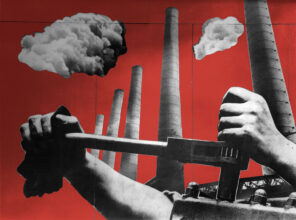


Charlotte Perriand has long been considered one of the most influential and celebrated designers of the mid-20th century, but her talent in one field has at times eclipsed her work in others. Several retrospectives have cropped up in recent years. But the latest exhibition of her work at Les Rencontres d’Arles is dedicated to exploring a short-lived, but critical aspect of her working method. The exhibition ‘How do we Want to Live? Politics of Photomontage’ studies the open politics of the medium and contextualises Perriand’s photomurals, both within her architectural practice and the wider modernist period.
Perriand first took up photography in the late 1920s. One portrait displayed shows her with a tight finger wave curl, backlit by a wall of windows (she moved into a photographer’s attic studio), smiling downwards at her camera. From this apartment in Saint-Sulpice, since immortalised as the birthplace of the Bar sous le Toît, she began shooting out a window. Inspired by the language of The New Vision, her early photographs are typified by the extreme angles and shadows of the modern 20th-century city. But from her vantage point, it would have been impossible to ignore the economic downturn and the rising fascism impacting the streets below. “You have to keep your eyes as open as fans,” she once said. For her, the architect’s role was to stay alert and sensitive to the world.
The needs of others concerned Perriand throughout her life, but her political stance sharpened acutely during this period. A committed member of the Association des Écrivains et Artistes Révolutionnaires (AEAR), she was deeply involved with the Leftist Popular Front. Perhaps inevitably, due to her political inclination, Perriand soon visited the USSR. But while her trips left her doubtful over the Soviet Revolution, she returned inspired by the collaborative emphasis and bold graphics of agit-prop, from which she would draw inspiration over the next coming years.
One of the exhibition’s great strengths is in charting Perriand’s trajectory in a short period, from amateur experiments to vast photomurals. Despite the original photomontages being lost, curator Damarice Amao has brought Perriand’s process to life. In the concrete hall of the Monoprix centre, vitrines hold re-touched negatives and glass plates show the different stages and variations of murals. Looming large, reproduced photomontages are blown up to the intended monumental size. These insights allow us to see how Perriand started thinking in imagery, returning to selected motifs and textures repeatedly.
Her first two public commissions were designed for the Exposition Internationale in Brussels, a reproduction of which has been reproduced in the last chapter of the exhibition. It lays out the history of the development of human societies, and it is as visually dense and complex as it sounds. But two ideas central to Perriand’s political agenda and design ethos can be teased out.
Perriand was working at the intersection of several unfolding movements—from the intellectual to the social and artistic. Photomontage could account for these varying ideas and synthesize them in a communicable format. The scale and speed at which the urban city was transforming due to industrialisation impacted the human visual apparatus as outlined by Martino Stierli. It needed to be viewed in motion; its buildings required “a sequentialised perception”(1) as its vastness could not be evaluated within a single frame. Her use of aerial views as a recurring motif shows how Perriand was using photomontage as a speculative form of urban planning, a pre-photoshop testing ground where she could ask questions and generate answers.
Photomontage also communicated and educated the public on the project of social transformation. As Dawn Ades has written, photomontage was particularly well suited to the Left as it could express the Marxist dialectic process and reveal how progress could be made. Hence, her first photomontages are brimming with photographs, both found and collected, but accompanied by large amounts of data. There is an underlying order and agenda to them, as graphics, statistics, quotes and figures all greet the eye. “For Perriand, it was important to convince people rather than visually seduce them,” Amao explains.
These dual ideas came into force within the next two years, a critical period between 1936-7. And the exhibition hinges on Perriand’s three projects which followed in close succession. Her most comprehensive work was commissioned by the Minister of Agriculture Georges Monnet, who initially invited her to design the ministerial building in 1936. The wall-to-wall photomontages promoted the economic and social justice program that the Popular Front intended to roll out. One mural presents a sombre sight (without the Left’s political intervention) where unequal land ownership and natural disasters plague the countryside. It’s opposed by another monumental fresco presenting an idealized projection of fields of bountiful wheat and larger-than-life epic agricultural figures. “Perriand was advocating for the rural world and encouraging respect for their traditions and values,” Amao says, “but at the same time she doesn’t want to be nostalgic—she isn’t a traditionalist.”
The same visual tensions unfold within ‘La Grande Misère de Paris’ (Paris’ Great Poverty, 1936). At sixteen meters wide, the mural rejects a focal point. Empathetic close-ups of faces alternate with wide expanses of landscape, but Perriand and her collaborators leave absent space for visual digestion. We read it horizontally. It begins dismally with a dead-eyed child staring from behind infant mortality rates; plumes of pollutant smoke rising underfoot; a sprawling map of Paris with desolate shots of interwar housing conditions. Next, signs of progress: modern production techniques, and trade union organisations promising health, well-being, and equality. Eventually, we reach a solution: clean modern living spaces overlooking a rural idyll, within which a couple embrace. From left to right, the eye dictates a visual and actual progression.
Public reception was mixed. “She faced a lot of criticism for their lack of visual power and their so-called ‘easiness’,” Amao explains, “but with the pavilion, she found a nice balance between information and its organisation. Fernand Leger helped her do that.” A prolific collaborator, she had written in her memoir that she wished to visually clarify her technique and thought her friend might assist her.
With Leger, Perriand’s photomontage seemingly found its compositional rhythm. For the second commission by Georges Monnet, 18 photomontage panels were constructed in a circular structure for the department’s pavilion at the International Exposition of Art and Technology in Paris, 1937. Each revealed a transformation of the rural world through social policy. While Leger added colour, Perriand drew upon her own collected imagery, cropping, arranging and enlarging aspects of the French countryside. Women in Breton dress figure, at rest or with armfuls of flowers. Modern agriculture was at the heart of the Popular Front’s vision and would prove vital to economic recovery. Through cut and paste, Perriand fused the modern and the tradition of the rural, bringing forth a vision that married tradition, economic development and technical mechanization in one fluid sweep.
While Perriand was not specifically a photographer, she was photographically radical. She understood the world of images. David Campany refers to this as “both to what the imagery depicts and to the ever-growing world of imagery itself.” The photomontages not only showcase her humanist perspective but address the shifts in mass cultural imagery of the 1920s-30s. One way in which she achieved this was through buying from agencies and fellow photographers, whether fellow political activists or not. For example, she often used François Kollar’s portraits of clerks, farmers, workers and artisans. Although Kollar’s work lacked criticality, Perriand recontextualised his photographs, lending them to a larger project.
For Perriand, photomontage was a collaborative means to improve modern society and encourage a more expansive view of it. “Living means moving forward” Perriand once quipped, “You have to give voice to your era.”
__________
(1) Montage and the Metropolis: Architecture, Modernity, and the Representation of Space (2018), pg. 2
Charlotte Perriand: How do we Want to Live? Politics of Photomontage is exhibited as part of Les Rencontres de la Photographie d’Arles (4 July – 26 Sept 2021) and curated by Damarice Amao with Sébastien Gokalp and the Charlotte Perriand Archives.
For further viewing: Les Rencontres d’Arles
With thanks to Ellie Howard for this essay.