The idea of an idyllic, primeval utopia seems to have always captivated artists, writers and philosophers. Within Western culture, Arcadia is the most common iteration of such a place, and in Greek mythology it was the home of the god Pan who was worshipped by the shepherds and farmers of the Peloponnese peninsula. Arcadia has since become shorthand for an unspoiled, idealized place, within which ecologies rotate in perfect balance. The legend of Pan’s Arcadia evolved into the Christian Garden of Eden through the writing of Virgil in the first century BC and Ovid slightly later.1 However, these Latin works were closely based upon Hesiod’s epic Works and Days, from the eighth century BC. Written from the perspective of a disillusioned farm boy, Hesiod’s protagonist laments the passing of the previous ‘ages’ of man: the Golden Age, Silver Age, Bronze Age, the Age of Heroes and finally, the Age of Iron. In Hesiod’s narrative the deteriorating mineral quality parallels a decline in man’s moral purity. The changing conditions which came with each new age brought greater challenges, which were imposed by the gods as castigation for man’s moral shortcomings as his innocence faded. The Golden Age concluded when Prometheus gave man knowledge of fire, which marked the beginning of his undoing. Subsequent ages came with the advent of conflicts, wars and the ensuing hardships associated with it, which is the climate that Hesiod’s farm boy finds himself in.
Virgil and Ovid located the people of the Golden Age in Arcadia, and their existence was defined by peace and plenty: where man did not need to be concerned with having enough to eat; enjoyed sexual freedom; was not cursed with sickness or disease and only ever died peacefully; was not troubled with conflict with other men or competition from other creatures, and finally; where he could exist without the need for governance or any hierarchical system. In Arcadia, nature and culture existed in perfect harmony. Lucas Cranach the Elder’s painting from the 1530s,2 made in the wake of Jacopo Sannazaro’s poem Arcadia (1502) that invigorated a surge of interest in the Golden Age during the Renaissance, presents an image of blissful, frolicking naivety and an impression of complete emancipation.
The idea that an earthly utopian paradise could ever have existed may well seem fanciful. However, anthropological analysis has linked a collective longing for a Golden Age to the reality of the Mesolithic era, when our nomadic hunter-gatherer ancestors benefitted from a greater abundance of food due to smaller populations. As communities expanded, it became necessary to establish social hierarchies and develop agriculture.3 The ubiquity of the Golden Age myth may indeed overlap with our tendency to reject our present circumstances in favour of nostalgia for a simpler existence. Whether carried within our collective unconscious since the days of primitive man or transmitted culturally through mythologies, a belief persists that an earthly Arcadian paradise is not beyond our grasp. The idea that the land has the potential to offer refuge and emotional sanctuary is also ingrained. Not only is physical immersion in the land generally considered a healthy pursuit, but it would seem that such revitalization can even be achieved through representations of it alone. The popularity of idealized landscapes, free of apparent traces of people (most commonly found on postcards, calendars and mass-produced canvases), evidences our need to surround ourselves with images of ‘unspoiled’ nature.4
Many representations of Arcadia throughout the history of art have, however, amounted to documents of far greater criticality than simply aesthetically soothing objects. Most cited is Nicolas Poussin’s The Arcadian Shepherds, 5 in which three men appear to have come across a tomb and anxiously reflect upon its inscription, ‘Et in Arcadia Ego.’ Like the identity and significance of the statuesque woman who presides over the shepherds, Poussin’s intended meaning of the inscription is contested: does it mean ‘also in Arcadia I [death] exist’? Is the message a straightforward memento mori, in keeping with the popularity of the theme of the period,6 or is it something more controversial; an anagram of I! Tego arcana Dei [‘Begone, I keep God’s secrets!’]? To whom does the ‘I’ refer – Virgil perhaps? 7
Paul Gauguin’s far less ambiguously titled exploration of the Arcadian theme took the form of the giant canvas painted in Tahiti, Where Do We Come From? What Are We? Where Are We Going? 8 The painting’s title helpfully summarizes the suite of questions with which representations of Arcadia and the Golden Age are entwined. Gauguin’s catechism addresses spiritual and theological debates around man’s genesis and eschatology. However, he also poses profound questions about man’s true ‘natural’ state.
During the Enlightenment, discussion of Arcadia could be found in treatises on aesthetics,9 yet additionally – and perhaps surprisingly – rather than taking a nostalgic look backwards, the Arcadian vision of the Enlightenment period manifests itself within progressive outlooks for economic, judicial and social change.10 The political dimension of Arcadia and its representations is especially pertinent when we consider Christopher Down’s military personnel: as deactivated servants of their state who have willingly engaged in a covenant between themselves, the state and the civilian population.
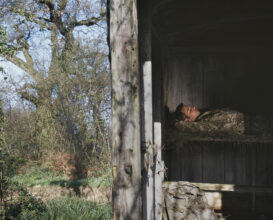
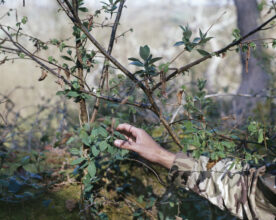
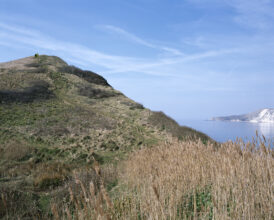
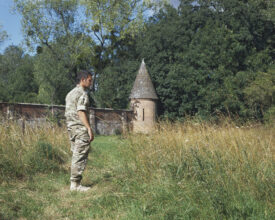
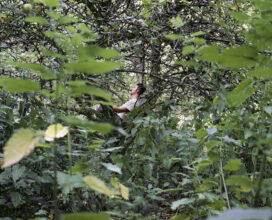
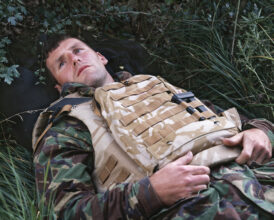
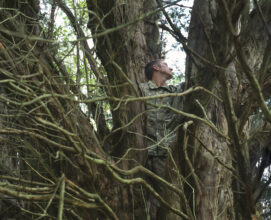
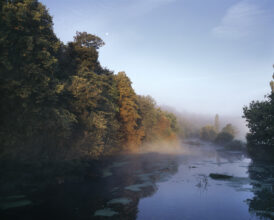
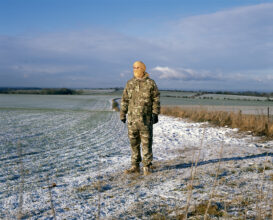
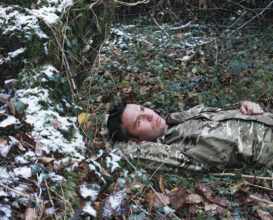
Down’s images are of course free of typical pastoral motifs, such as the naked figures that can be found relaxing and frolicking in works such as Thomas Eakin’s Arcadia, as well as Modernist representations by Gauguin, Cézanne and Matisse.11 However, Visions from Arcadia engages with and extends the philosophical and political concerns of the Arcadian theme. Dressed in military fatigues, the soldiers are indexical of recent and ongoing conflicts, and deliver an immediate sobriety to these serene places. Engrossed in a state of contemplation, these placid landscapes seem to offer the soldiers sanctuary and space for peaceful reflection. Like the kneeling shepherd in Poussin’s painting tracing the inscription on the tomb (that his own shadow obscures) Down’s soldiers invite us to reflect on the fact of our own mortality, as well of course as the death and carnage that they have witnessed.
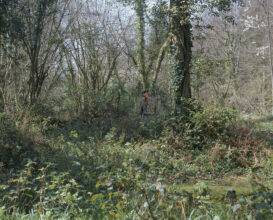
The ‘multi-terrain pattern’ uniforms worn by the soldiers (developed in 2009 primarily for forces in Afghanistan) have a peculiar relationship to the bare skin found in classical depictions of Arcadia. Contrasting with the nakedness of such figures, which suggests purity and synergy with nature, the camouflage material alludes to a more problematic relationship with the environment. Visually, we can observe a very literal and immediate immersion within the landscape. In Keeper’s Pool, the uniform is so effective that the soldier’s presence in the landscape is only betrayed by his face, his body – barely a smudge on the canvas – dissolving into the forest’s undergrowth.
Camouflage material is used in the service of subterfuge, disruption and disorientation, and is designed not to be seen. We might therefore regard these soldiers as hiding within rather than ‘being at one’ with these environments. We may well imagine these individuals would feel ‘at home’ in these outdoor spaces,12 yet their clothing implies a laboured effort to connect with and blend into their immediate surroundings. The incongruity of the soldiers’ presence in these rural English landscapes alludes towards the psychological challenges that soldiers face returning periodically from tours of duty, forced to navigate a civilian existence with the burden of their recent experiences in theatre. The soldiers’ spectral appearance in the photographs underscores their presence as only a temporary arrangement.
The cyclical nature of military deployment, and the disruptive lifestyles that this can lead to for service personnel and their families, is also referenced within the linear narrative of Down’s series, which follows the four seasons. Down’s camera patiently captures the phenology and nuances of the environmental changes that affect these spaces over the course of a year. It is worth noting that the seasons have particular relevance in relation to various ‘ages of man’ narratives. 13 For instance, according to Ovid’s description in Metamorphoses (which proposes four ages as opposed to Hesiod’s five), the introduction of the seasons is imposed upon man during the Silver Age, meaning he was no longer able to enjoy perpetual harvests and had instead to develop agriculture. Ironically, the labour that agriculture and animal husbandry requires has been celebrated in romanticized representations of the land: workers harvesting crops; shepherds and cow herders leading their stock to fresh pastures or drinking water… In Visions from Arcadia, however, the seasonal theme resonates with something far graver – the perpetual cycles of war and peace – and as Down describes; reflects how ‘mankind seems bound by a chain of conflict that cannot be broken’.
Interestingly however, the soldiers appear to be oblivious to and unaffected by the seasons that exert themselves on the immediate surroundings: this ‘green and pleasant land’ is somewhat underwhelming. The soldiers’ expressions remain stoically fixed, the climate orbiting around them and their thoughts as they stand to attention. This disconnection with their environment can be related to broader discussions around photography, memory and in particular trauma studies. The soldiers’ ambivalence towards their current location – their thoughts seeming to be far from their actual experience of being within the land – contradicts the linear continuum of day-to-day consciousness and memory function. As Ulrich Bayer explains, ‘Traumatic events … exert their troubling grip on memory and on the imagination because they were not consciously experienced at the time of their occurrence.’ 14 Within such a model, the trauma experienced by the soldiers can be mapped against any point in time, and indeed any place, making it inevitable that the spatially distant conflicts and atrocities will be brought back to the soldiers’ home soil.
There is a strategic similarity in Down’s use of the immediate landscape as a rhetorical device in Peter Kennard’s Haywain with Cruise Missiles.15 This Cold War era photomontage, reminiscent of anti-fascist dadaist imagery, 16 violates the hallowed ground of the English picturesque to deliver the artist’s uncompromising polemic. With British soldiers and personnel deployed in Afghanistan now for almost two decades, numerous photographers and artists have examined myriad aspects of the conflict.17 Down’s incorporation of a distinctly north European landscape into the discourse is a poignant tactic,18 which literally ‘brings home’ a facet of the UK’s ongoing military commitments in less temperate climates.19
Visions from Arcadia is riddled with paradox and contradiction: beautiful, distinctive scenery is rendered sinister; uniformed, duty-bound soldiers are presented as thoughtful, vulnerable and individual; we attempt to empathize with them but their apparent failure to immerse themselves in the landscape authentically prevents us from fully connecting with them, perhaps prompting a sense of our own helplessness in the face of seemingly endless conflicts and atrocities. This demands the attention and reflection of others, especially those of us who are fortunate enough to only be able to speculate the trauma and barbarism of war.
__________
1 Virgil’s Georgics was written around 37 – 29 BC, and Ovid’s Metamorphoses in 8 AD.
2 Lucas Cranach the Elder, The Golden Age, c.1530. Alte Pinakothek, Munich. Oil on wood. 74 x 105cm.
3 Merlin Coverley. Utopia. Harpenden: Pocket Essentials, 2010: 20.
4 See David Bate’s essay which proposes the social usefulness of picturesque imagery: ‘Notes on Beauty and Landscape’ in Liz Wells et al. Shifting Horizons: Women’s Landscape Photography Now. London: IB Taurus, 2000.
5 Nicolas Poussin. Les Bergers d’Arcadie or Et in Arcadia Ego, 1639. Musée du Louvre, Paris. Oil on canvas. 121 x 185cm.
6 Poussin’s painting was inspired thematically by Guercino’s painting Et in Arcadia Ego, c.1623. In this work two shepherds reflect upon a skull (an explicit ‘vanitas’ motif) that sits on top of a tomb.
7 This hypothesis is discussed in Michael Baigent et al. Holy Blood Holy Grail. London: Jonathan Cape, 1982.
8 Paul Gauguin. Where Do We Come From? What Are We? Where Are We Going? 1898. Museum of Fine Arts, Boston. Oil on canvas. 139 x 375cm.
9 Such as Edmund Burke’s A Philosophical Enquiry into the Origin of Our Ideas of the Sublime and Beautiful, 1757.
10 Liz Wells. Land Matters: Landscape Photography, Culture and Identity. London: IB Taurus, 2011: 46.
11 Thomas Eakins. Arcadia, 1883. Metropolitan Museum of Art. Oil on canvas. 98 x 114 cm. Paul Cézanne. The Large Bathers, 1905. Philadelphia Museum of Art. Oil on canvas. 210 x 250 cm. Henri Matisse. Bathers by a River, 1917. Art Institute Chicago. Oil on canvas. 260 x 392 cm.
12 Some of Down’s locations are M.O.D. training ranges, such as the village of Tyneham in Dorset, which was commandeered during the Second World War.
13 Hesiod’s Works and Days was meant as a farmer’s almanac, to instruct his brother in practical aspects of agriculture.
14 See Ulrich Baer. Spectral Evidence: The Photography of Trauma. Cambridge, MT: MIT Press, 2002: 8
15 Peter Kennard. Haywain with Cruise Missiles. First published in Camerawork, July 1980.
16 John Heartfield is the most celebrated practitioner. See David Evans, John Heartfield: AIZ/VI, 1930-38. New York: Kent Fine Art, 1992.
17 Of particular note is Steve McQueen’s cabinet of postage stamps of soldiers killed in action, Queen and Country, 2007. Imperial War Museum, London.
18 During the Second World War, images of the southern English landscape were used to instill support for the war effort, such as Frank Newbould’s series of posters bearing the strapline, Your Britain. Fight for it now. (See Imperial War Museum archive.)
19 See Martha Rosler’s photomontages: House Beautiful: Bringing the War Home, 1967-72. Museum of Modern Art, New York.
__________
With thanks to Jesse Alexander for this essay.
For further viewing: christopherdown.com