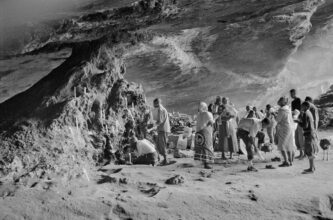
Picture a highveld landscape in a remote corner of South Africa’s Free State province, in the foothills of the mountainous region bordering Lesotho. Now picture a cavern hidden amongst sprawling white-owned farms, where outcrops of sandstone reveal evidence of prehistoric gatherings in the form of San rock art. Often referred to as a fertility cave, the site is a monumental crescent-shaped rock shelter – one of the largest in the Southern Hemisphere. Rockfall from the overhanging roof has created a barrier of boulders at its mouth. So that, even from the river flowing directly below, it is impossible to see the extent of the chamber. Let alone what might be transpiring inside there. Burnt candles by the water’s edge, some improbably placed on protruding rocks in the deep channel, speak of this being a sacred place – an active site. Once inside, the light begins to behave strangely. It funnels through the chasm and coalesces with smoke, seeming to materialise as physical matter.
More markings of candle wax and manifestations of prayer rituals greet the visitor. Near the entrance, in a manner that appears designed, the natural bedrock rises in a column to meet the ceiling, and a stream flows around it like a river would a mountain. As the Grand Altar, it is the focal point of a cave complex that includes numerous church factions, Sangoma healing sites and dwellings – all demarcated by simple stone enclosures and handmade flags. More than just a place of religious worship for a few passing through, this is home to an entire community that performs initiations, sacrifices animals and communes with ancestors all year round. Cultural and religious activities overlap with the daily duties of collecting firewood, preparing community meals and laundry. On significant days like Easter Sunday, spiritual leaders and pilgrims merge in spiritual actions, representing a powerful image of togetherness under the roof of indigenous belief systems. [1]
Santu Mofokeng was here once, camera in hand, working on a series he would later anthologise as Chasing Shadows. In a supporting statement, he describes its predominant theme as “people in moments of contemplation, performance, confrontation and perhaps celebration. My exploration and participation in the fictions we call relationship and community.” [2] Importantly, Mofokeng’s mission to the caves was twofold. Accompanying him was his brother Ishmael, who was seeking traditional healing for complications related to HIV. Sadly, he would later succumb to his illness. Around this time, from the late 1990s through the 2000s, Southern Africa had reached peak infection and mortality rates from the virus. Still today, the region continues to be the worst affected in the world. A mutation in nature that Mofokeng believed to have brought about a “crisis of spiritual insecurity” following the end of apartheid, which for all its horrors was, in his words, “a roof”. [3] A roof under which Black consciousness, though curbed and diminished, had nevertheless found a cohesiveness in the struggle it faced.
__________
Galvanised most famously through protest and political uprising, though other cultural groups and activities have also helped define South African society and identity. Photography is no different. One could even argue that it holds a unique position by not only creating a space for collectivity, but also the ability to direct a lens reflectively on the society that gave rise to it. In other words, photography holds up a mirror. Moreover, the kinship between photo collectives and photography of sociocultural groups, whether linked to social movements, education platforms, leisure activities or spiritual gatherings, is so ingrained that collective agency can be seen as much more than a device to amplify the voice of individuals. We can see it as a defining characteristic or an emblematic paradigm that underscores both the means and outputs of creative photographic production.
In almost any discussion around South African photography, especially socially or politically engaged photography – of which it’s nearly impossible not to be in a context like South Africa, we must consider its roots as a tool of resistance. From 1948 to 1994, a period dominated by the legalised racism of apartheid and the resulting liberation struggle, ‘resistance photography’ became a vital means of reporting atrocities, inequalities and the abuse of power. Running parallel with frontline photojournalism, other less confrontational forms of photography were subverting the official, often wrong-headed narrative of the time – even at times pushing against the inherent dilemmas of the documentary genre itself. Arguably, no one was as conceptually groundbreaking as Santu Mofokeng in that regard – though he didn’t exist in a vacuum.
Drum Magazine, established in 1950, was instrumental in bringing investigative journalism to the fore whilst fostering a community of like-minded, predominantly Black photographers and writers at a time of limited prospects. Afrapix, a prominent photography collective and agency established in 1980, was composed of photographers from diverse backgrounds, and was a key proponent of resistance photography. Its principal goal was to use photography as a political tool in the liberation struggle, simultaneously promoting a new generation of Black photographers. As well as what M. Neelika Jayawardane describes as “a desire to re-shape their own, and others’ subjectivities and political self-formation”. [4] Afrapix member David Goldblatt founded the Market Photo Workshop (hereafter MPW) in Johannesburg in 1989 with the ethos of furthering education in visual literacy amongst disadvantaged communities. Although its grounding is in social documentary, MPW embraces a range of visual cultures, with graduates going on to have celebrated careers in the art world.
Possibly the most extreme group, active in the 1990s during the violent final phase of the struggles, was known as the Bang-Bang Club. Though described as a club, this was less a collective and more like a cohort of comrades drawn together by the newsworthy spectacle of conflict. For some, the glorification of violence by the all-white male group – further glorified when a Hollywood-style movie retold their story in 2010 – was tantamount to weaponizing the medium. While this might sound strong, to quote Greg Marinovich, one of Bang-Bang photographers, “In South Africa, the violence of the photographs had an explosive effect.” [5] At the very least, they were partaking in the visual economies of conflict based on the international appetite for apartheid and its gruesome representation. Even now, the overseas perception of South Africa as a place plagued by violence is frustratingly one that perpetuates. No doubt statistics show that it has earned its reputation, but to be solely described via discourses of criminality is not helpful or progressive.
__________
As problematic as the violent portrayal of Black communities may have been, such archives nevertheless represent a slice of history we would do well to remember. If for no other reason than to see how far this nation – and its visual representation – has come. Heritage sites such as the Constitution Hill Human Rights Precinct and the Apartheid Museum provide an appropriate context for displaying such hard-hitting journalistic images. This transition from the highly politicised media spaces of the 1980s and 90s to the arguably more reflective spaces of museums and galleries represents a shift across the wider photographic scene. Where, amongst other developments, the emergence of long-form photographic essay approaches replacing intermittent single images can be observed. Worth mentioning is the heightened censorship around overtly political imagery by the apartheid government, which must have partly informed these shifts. However, it’s the work of photographers who were eschewing the tropes of mainstream photojournalism – even from the early days – that is most pertinent here.
Santu Mofokeng (1956–2020) and David Goldblatt (1930–2018), while distinct photographic voices in their own rights, also provide a foundational point of reference when considered side-by-side. As documentarians with a propensity for the everyday, their broad approach to photography can be collectively defined by what some call the “refusal of the event”. [6] Goldblatt was engaged in the implicit conditions of South African society – the values by which people lived – rather than the climactic outcomes of those conditions. In his last interview, Goldblatt says: “I was drawn not to the events of the time but to the quiet and commonplace where nothing ‘happened’ and yet all was contained and immanent.” [7] Mofokeng, who was born in Soweto, was morally opposed to the tropes of mainstream news imagery. Resistant to what he considered “victimology”, Mofokeng was instead drawn to the social ideologies underpinning township life, later developing work tied to history, land, memory and trauma. As mentioned, a consistent thread throughout his work concerns the spiritual dimension of life in Southern Africa. In contrast to how Goldblatt viewed documentary photography as dealing with brutal facts, Mofokeng regarded his photographs as fictions. [8] Historian Patricia Hayes, in her essay ‘The Violence is in the Knowing’, notes that his fictions often “contain smoke, mist, and other matters and techniques that occlude rather than expose”.
Train Church, an early series by Mofokeng, depicts religious gatherings in the crowded confines of public train carriages between Soweto and the Johannesburg CBD. Notably, these train journeys were ones the photographer was already making to reach the city for work. Unlike his white counterparts seeking to gain access to townships, inevitably adopting questionable power dynamics, Mofokeng’s perspective was from the inside, from his own lived experience. With that came a sensitivity towards how people coped with daily life under segregationist rule. Through the appropriated spaces of trains and highway underpasses, his images of improvised ‘ibandla’ (congregations) reveal a resourcefulness within the harshness. For Mofokeng, the train churches combined, in his words, two of the most significant features of South African life: “the experience of commuting (migrancy) and the pervasiveness of spirituality.” [9] These two modes of being in the world, whilst seemingly disparate at first, have more in common than one might think. The word ‘commute’ has roots in the Latin ‘commutare’, which joins ‘com’ meaning come together, with ‘mutare’ meaning to change. In other words, to change together.
__________
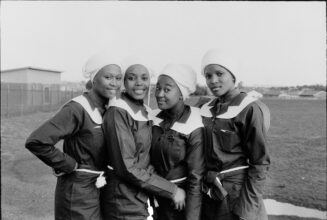
Framed by how Black life adapted and persevered under oppressive conditions, other photographers later picked up the thread of documenting underrepresented groups. Ruth Motau (b.1968), also from Soweto, trained at MPW in the early 1990s, was later mentored by Mofokeng and was the first Black woman photographer employed by a South African newspaper. Her intimate portrayals, showing the other side of Black South African and township life, are compiled under themes including Hostel Life, Religion and Rituals, Music and Culture. One theme, the subject of her first solo exhibition, is humbly titled Ordinary People. [10] Motau’s archive, through its compassion and respect for people, no matter their walk of life, pays particular tribute to womanhood.
It would be remiss in this approximate chronology, not to mention the now iconic Faces and Phases project by Zanele Muholi (b.1972). As a living archive representing over 500 individual lesbians and gender-nonconforming individuals, the aim of the work, as explained by Lerato Dumse – one of the long-term participants in the series – is to address “the dearth of visual history for Black LGBTQIA+ people [and draw] attention to the brutal hate crimes that continue to plague South Africa today.” [11] In its multiplicity of singular portraits, the work is often presented in a grid format, sometimes interrupted with empty spaces in place of pictures. Evoking an unfinished process whereby placeholders stand in for future members, this format alludes to a community with room to grow. Indeed, Faces and Phases began in 2006 and has been exhibited incrementally throughout its lifespan.
Of their work, Muholi says, “Collectively, the portraits are at once a visual statement and an archive, marking, mapping and preserving an often invisible community for posterity.” Less known about are their philanthropic activities to support members of what could be considered the Faces and Phases collective. Inkanyiso, a queer media platform established by Muholi, helps further individuals linked to the project through art advocacy and shared resources – including supplementary programming alongside international museum shows for the artist. [12] As a past graduate of MPW, Muholi also provides sponsorship and equipment for several aspiring photographers to attend the school. As Dumse notes, the ultimate goal of skills-sharing and knowledge distribution is to increase the number of visual activists documenting the Black LGBTQIA+ experience in South Africa. In a reciprocal feedback loop that goes way beyond a series of portraits, Faces and Phases represents an allegiance and respect to a community which, without their participation, would not exist.
__________
Jabulani Dhlamini (b.1983), whom I interviewed in Johannesburg recently to discuss his approach to photography and his role as educator, mentor and member of two artist collectives, typifies what this text seeks to engage with. He does so by embedding the themes of his work, together with an openness to collaboration, firmly within the framework of community. With that also comes an interest in photography as a conduit for collective memory across generations – both past and future. For instance, how a particular subject matter is treated in the present might give future generations a sense of what you thought about it. In the same way oral history works, by songs or stories being passed on, photography too can be inheritable.
Oral histories might not appear as an immediately obvious accompaniment for photography. The two seem opposed somehow: one has sound, and the other is mute. One is continuous, the other more fixed. But in a context like South Africa, where shared heritage for many people of colour are the stories that live in the collective imagination, the two have a strong synergy. As we all know, the best stories are the ones that conjure the most vivid images. Conversely, images can loosen over time depending on their arrangement in chorus or juxtaposition with other images.
iHubo, meaning hymn, is the title of a collaborative project by Dhlamini and Thembinkosi Hlatshwayo (b.1993). [13] As a concept, it refers to a form of praise poetry and how Black South Africans archive collective memories through song. In particular regarding ideas of generational trauma and the residue it leaves behind. Each artist made photographs independently: Dhlamini returned to the countryside of his childhood in the Free State, and Hlatshwayo to his family-run tavern in Johannesburg. As charged sites for the artists on a personal level, rural hometowns and taverns, or the journeys to reach them, can also be allegorical as places fraught with potential violence, suffering or anxiety. Via an experimental method similar to Exquisite Corpse, whereby an arrangement of words or images is collaboratively composed, typically where only the ending of the previous contribution is made visible, the two artists shared photographs, music or text to solicit a visual response. Or, as the artists describe it, like a game of photographic ping-pong. This dialogical exchange continues into the gallery space, meaning the work is an ever-evolving curation. And yet, the underlying substance and significance remain intact. Again, much like oral histories. Through the interplay between the tangible mark-making of Hlatshwayo’s tavern pictures alongside the intangible atmosphere of Dhlamini’s landscapes in particular, a tension arises that, especially for South African audiences, is palpable.
Like Mofokeng and Goldblatt before him, Dhlamini’s work resists the event. Even when delving into one of the most pivotal, consciousness-altering, politically explosive episodes – the Sharpeville Massacre of 1960 – he remains peripheral to the sociohistorical event itself. Opting instead to tell stories about those affected by its collateral impact. For Dhlamini, photography is about “starting conversations that are not easily confronted.” [14] The key to his process is dialogue and participation. Before creating a single photograph, he spent time with members of the Sharpeville community, including his own family (his aunt was one of those injured on the day), many of whom still live nearby. For them, the memory of the massacre became frozen in time, and despite their contiguity with such a nationally significant chapter, they continue to feel economically excluded and socially marginalised. Through dialogue and engaging individuals with their personal photographic archives before the incident, Dhlamini’s work begins to untangle the fixedness of the event. After all, “the event makes you powerless”, he said, echoing Mofokeng’s sentiment that if you overly centralise the event, you miss what is actually there. By locating a life pre-event, both within the contemporary context and the collective memory, the possibility for a broader perspective opens up. And by that virtue, the possibility of a healing process might unfold.
In his role as mentor, Dhlamini, who is also project manager for the Of Soul and Joy programme (hereafter OSJ) and member of the Umhlabathi Collective, says that collectives and mentorships are “enabling spaces”. It is one thing to pursue a photographic practice, to create space for yourself. But it is something else if someone holds that space for you – crucially without market-driven expectations. OSJ, established in 2012 by Rubis Mécénat endowment fund, is a training and mentorship programme based in Thokoza, a township south of Johannesburg. High school students are placed on the programme, enabling access to further education at university or MPW. Through its extended network, a photo collective has formed whilst an outdoor festival displays the work of its members. For many South Africans living in townships, the opportunity to visit galleries is not a reality they have access to, nor is it a priority. Especially concerning photographic works representing township life, a growing need for programmes like OSJ that reciprocate to these local audiences is invaluable.
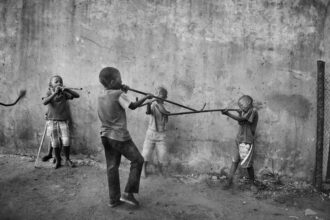
To illustrate the value of such a platform, let’s consider the trajectory of someone introduced to photography via OSJ. Lindokuhle Sobekwa (b.1995), who earned a scholarship to attend MPW, later became represented by Magnum Photos and won the inaugural John Kobal Foundation Fellowship. This year sees the release of his first monograph, I Carry Her Photo with Me, to be published by Mack. Nyaope, one of Sobekwa’s other projects, is the name given to a crudely produced ‘poor man’s heroine’ that is causing a drug crisis throughout South African communities. During the making of Nyaope, Sobekwa spent time photographing a group of addicts, including guys he knew growing up. In a sobering moment, he realised it could have easily been him on the flip side of his lens. Beyond the accolades, books and exhibitions, “photography saved me,” [15] he says. While Sobekwa’s work, in its portrayal of impoverished circumstances, might lean towards the tradition of issue-based reporting, it is far from one-dimensional. Deeply personal, at times diaristic, imbued with dignity, his work is a wake-up call to the realities of South Africa’s current predicament that many find so disheartening – especially in connection to the obstacles and lack of opportunity faced by its youth.
__________
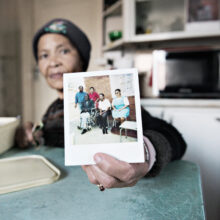
Against the backdrop of such conditions, the power of group solidarity and social cohesion feels as critical as ever. One possible lens through which to contemplate this is the most elemental of human sensibilities: love. More specifically, the union of marriage and the ceremonies we collectively conduct to symbolise it. Isivumelwano, meaning a contract, agreement or alliance, is a body of photographs by Sabelo Mlangeni (b.1980) spanning a 30-year period. Coinciding with Black majority rule in South Africa, in what Emmanuel Balogun calls a critical time for coexistence, the work draws together a mix of wedding traditions with modern interpretations across various Black communities in Southern Africa. Evoking the American cultural critic and feminist bell hooks, when she wrote, “ours is a shared struggle… we are each other’s fate”, Balogun elaborates that expressing love to one another is the ultimate practice of freedom. [16]
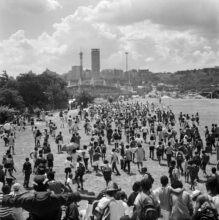
From his early exploratory images of migratory spaces in Johannesburg, such as taxi ranks, hostels and public parks, to his long-standing representation of LGBTQIA+ communities and church groups, Mlangeni’s work can be considered celebratory; we often see people enjoying each other’s company, even playfully posing for the camera. Yet it is tinged with melancholy. Perhaps a result of the beauty he observes in the mundane – or the darkroom techniques that serve to obfuscate – or the underlying desire for belonging that many of the groups he works with personify – or the mirroring of the artist’s journey when he migrated from rural Mpumalanga to the big city and his subsequent quest, which so many of us can relate to, of fitting in.
Writing about Umlindelo wamaKholwa (The Night Vigil of the Believers), Mlangeni’s homage to the South African Zionist faith communities, Athi Mongezeleli Joja places his work within a lineage he describes as a theology of photography in South Africa. Likening the anticipatory nature of religious worshippers in their pursuit of salvation to the ways photographers wait for “revelation of hidden truths of the everyday.” What binds this school of thought, in Joja’s view, is how photographers look through “the vapid and beguiling strife of everyday life, with lyrical and disorienting power.” [17] What distinguishes Mlangeni is the timespan and the degree of immersion his projects require to gain their level of intimacy.
__________
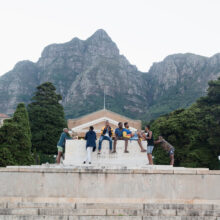
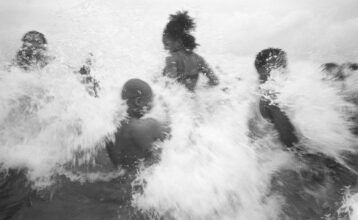
One of the principal goals that apartheid sought, via its dominion over social structures and spatial order, was to make Black life invisible. Hence, the forced removals, the establishment of townships and inner-city curfews, to name a few. One place where this surfaced in a particularly pronounced manner was the beach. Where the infamous ‘whites only’ signs, together with fenced areas, were racism manifest in full view. Arguably, from a Western perspective, restricting Black communities’ access to the beach denies them the right to leisure activities. However, as we will see, this misses something more deep-rooted and life-affirming within Black South African culture. It misses the spiritual aspect – not of the beach itself – but of connection to the ocean. Just as the caves are alongside a water source, beaches, with their proximity to the sea, can also be sites of healing and communion. Combined with the unstructured and liberated sense of play and relaxation, Black social life at the beach is culturally distinctive and ought to be celebrated.
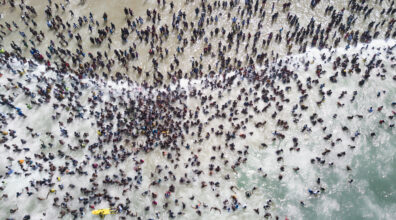
Taking this premise as their starting point, together with an impetus of overwriting the colonial bias of photographic beach archives, Luvuyo Equiano Nyawose (b.1994) has been documenting Black beachgoers at the eThekwini (Formerly Durban) beachfront. A previously exclusive domain for white holidaymakers. The resulting body of photographs and video, titled eBhish’ (at the beach), combines moments of tender human interactions with aerial views showing congregations on a massive scale. For Nyawose, this drawing back to a topographical perspective, whereby beachgoers are depicted as a singular mass, speaks to “cartographies of control, histories of mapping, aerial geography, taxonomy and separation.” [18]
Through its high-handed, Godlike vantage point, mapping by colonial entities had devastating implications across the wider African region. To repurpose such a device, formerly used as a method to claim ownership of land and subjugate more vulnerable cultural groups, makes for a subtle yet radical statement. Together with the shifting scale and viewpoints of the images, eBhish’ recalls Joja’s words in its disorienting power. To extend his theology of photography analogy, we can surely place Nyawose’s work in that canon despite the ostensible lack of strife on display. And yet, as with many of the photographers discussed here, the injustice is there – just below the surface. As Nyawase points out, the legacies of humiliation and insecurities associated with the correct (Eurocentric) beach etiquette continue to proliferate in the contemporary.
To quote Ernest Cole, when he described “the infectious spread of apartheid into the smallest detail of daily living” [19], or how, in the words of David Goldblatt, the almost imperceptible expressions of discrimination are “embedded deep, deep, deep in the grain of those photographs”, seems fitting. [20] If, as Santu Mofokeng once said: “the violence is in the knowing”, which Hayes explains “derives from the fact that there are knowledges attached to seeing”, then perhaps the healing is in the collective undoing. To that end, the joyous gatherings we see in eBhish’ and the celebrations of togetherness in Isivumelwano, represent rehabilitative possibilities alongside a collective refusal to be defined by historical conditions – as Nyawose puts it, “a certain kind of a transgression against white supremacist values and aesthetics.”
I leave you with this from Nyawase’s Master’s thesis eBhish’ – Articulations of Black Oceanic Presence eThekwini: “when we go ebhish’, it is spirituality in motion. When we congregate in groups (emanzini), there is an interplay of leisure and metaphysical reignition: Black people collectively traversing physical and spiritual terrain. This is a spatial-temporal dynamic force in action, enjoyment and fun underlaced by spiritual reconfiguration.”
__________
1. John Thabo Moephuli, A Survey of Sacred Sites and the Construction of Sacredness of Space in the Free State, (University of the Free State, 2016)
2. Santu Mofokeng, Chasing Shadows, (1997)
3. Sean O’Toole, Santu Mofokeng The Darkness and the Light, (Aperture, 2019)
4. M. Neelika Jayawardane, “‘Inside the artery of political consciousness’: Khotso House, the Afrapix Photographers’ Collective, and the Synergies, Confluences, and Practical Political Educations within ‘a small and embattled community’”, (Photography and Resistance, 2018)
5. Greg Marinovich and Joao Silva, The Bang Bang Club (Basic Books, 2000)
6. Patricia Hayes, Santu Mofokeng, Photographs: “The Violence is in the Knowing” (University of the Western Cape 2009)
7. Alexandra Dodd, David Goldblatt – The Last Interview (Steidl, 2019)
8. Nicola Brandt, Landscapes Between Then and Now (Routledge, 2020)
9. Santu Mofokeng, Stories1: Train Church (Steidl, 2015)
10. See Photography Legacy Project
11. Lerato Dumse, Faces and Phases 13 (Stevenson, 2019)
12. See The Stedelijk Museum Amsterdam exhibition: Zanele Muholi, 2017
13. Jabulani Dhlamini and Thembinkosi Hlatshwayo met as mentor and student via Of Soul and Joy. iHubo was exhibited at Photo Saint Germain, 2022 and Goodman Gallery, 2023
14. See video: Interview between Jabulani Dhlamini and Thembinkosi Hlatshwayo with curator Valérie Fougeirol (Rubis Mécénat, 2022)
15. See video: Lindokuhle Sobekwa ART(ist) series (Rubis Mécénat, 2020)
16. Emmanuel Balogun, Sabelo Mlangeni, Isivumelwano (Blank Projects, 2021)
17. Athi Mongezeleli Joja, Sabelo Mlangeni’s Umlindelo wamaKholwa (Africanah 2018)
18. Luvuyo Equiano Nyawose, eBhish’ – Articulations of Black Oceanic Presence eThekwini (University of Cape Town, 2021)
19. Ernest Cole, House of Bondage (Random House, 1967)
20. See video: David Goldblatt in Johannesburg (Art 21, 2018)
__________
Christopher Littlewood is a photographic artist and curator based in Johannesburg, South Africa.