


__________
At the close of 1066, the Conqueror took ownership of England. William occupied the country but did not know its people or their land. In 1085, he commissioned a survey of what he owned which resulted, one year later, in Domesday Book.[1] These ledgers transferred physical goods and property into the language of monetary value enabling the King and his successors to extract due taxes. This taxonomy served a simple purpose: to establish the legal rights of owners and their obligations to the sire.
Taxonomic methods are key to the organisation of museums and their belongings. The large national institutions have their beginnings with the private collections of the wealthy elite, whose carefully arranged ‘cabinets of curiosities’ could contain the valuable as well as the eccentric. Displays of objects, from the time of the Renaissance onwards, asserted social status demonstrating a collector’s taste and knowledge. Originally, the cabinets were rooms of wonder, but their size reduced to that of compact furniture and so the world was contained in a portable space.[2]
The artist David Ferry is a collector of things and books. In both his home and studio in Canterbury, the odd sits next to the precious. This arrangement is figured in his altered books—photomontaged period guides to the British Isles—that, like the Norman monarch’s ‘Great Survey’, provide an overview of the nation. The base materials for his artist books are outdated, second-hand pictorial guides that are part history, mirroring the educational function of the museum, and part tourism, appealing to people’s senses of well-spent leisure.
At Canterbury, on his route to London following his victory at Hastings, William the Conqueror built a wooden castle as part of his march to claim the throne.[3] The ancient town felt the presence of this invader. His progeny, Henry II would make his mark on the place with the murder of Thomas Becket, the Archbishop, in Canterbury Cathedral. As penance for this crime against the Church, Henry humbled himself before Becket’s tomb. The subsequent shrine to Becket was a popular site of pilgrimage and the journey’s end for the characters in Chaucer’s The Canterbury Tales (c.1345-1400) travelling from London.
In 2005, a device used by medieval travellers and pilgrims to determine time and location on which Chaucer was an expert, was unearthed beneath the grounds of a bed and breakfast hotel that neighbours David Ferry’s home. The Canterbury Astrolabe Quadrant (c.14th century), an accidentally discarded treasure, is on display in the British Museum, London.[4] Maps, guides and instruments aid pilgrim and tourist in their travels.
In the twentieth century, journeys were made for pleasure alone. The right to walk across open country, a freedom of way, was a privilege fought for by The Ramblers’ Association. The mass trespass of Kinder Scout in 1932 is a land-marking event that brings to the fore the struggle between a landless working class and a privileged landowning upper class.[5] Disobedience paved the way for new legislation and provision. By 1949 the landscape that could be viewed could also be walked upon;[6] mountains and moorland became national treasure to be shared by all, at an outdoor museum that could not be contained.
Guides to this collected experience were produced and widely consumed; notable examples are Alfred Wainwright’s pocket pictorial guides to the Lakeland Fells published between 1955 and 1966.[7] His books were originally designed for his own interest, practical notes for himself, but these became public property open to the use of all.
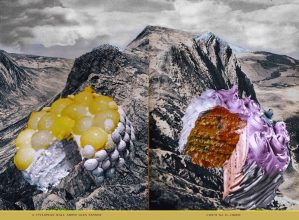
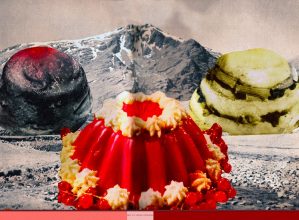
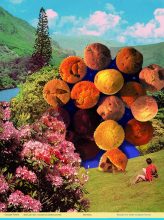
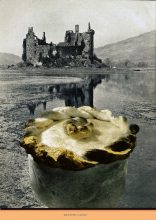
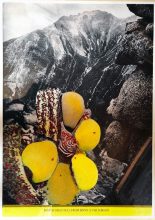
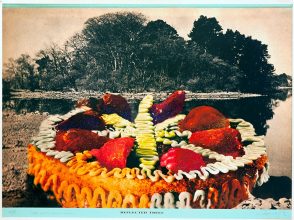
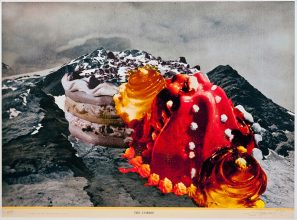
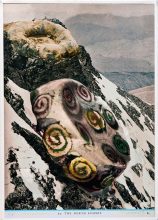
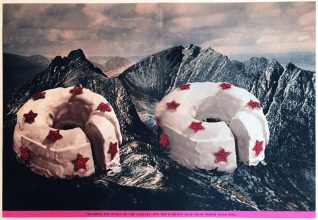
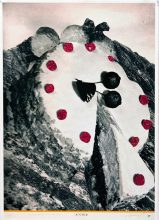
The photographs in David Ferry’s altered books started off, like Wainwright’s guides, as unspoilt views that promoted the natural heritage but which now bear marks of trespass. In Ferry’s series of photomontages, Belligerent Rock Intrusions, climbers scramble over monuments and the bucolic scene.[8] Worse still, for the Cakewalking series, mountains are pictorially hit in the face with the proverbial custard pie of slapstick.[9] Ferry’s employment of comedic insertion is territorial behaviour, laying claim to the representations of place. Po-faced tradition is tickled.
Wordplay has its role in this process of colonisation. The term ‘cakewalking’ has its lineage in the slave plantations of the southern United States. Dressed in the fineries of the white European, the enslaved performed the cakewalk dance as exaggerated movement to mock the refined attitudes of their owners.[10] Ferry’s cakewalking re-presents the beauty of Britain; this is served with the sweetness of digestible pastries, extra sugar-coating for the viewer’s delight. Along with changes to the photographs within the guidebook, Ferry adds to the accompanying written text. The original meaning is still evident but overlaid with new inflection. British place names have a long history of adaptation to invasion. The Romans left the earliest records of British place names, and added new names to the map. In turn, colonisers have left rich pickings for present-day toponymy.
King William’s Normans set to the task of making England a more pleasant land turning Snotingaham, the village of Snot’s people, into Nottingham.[11] The original meaning of the place name becomes lost, an orphaned label. For their humorous dictionary The Meaning of Liff (1983), the writers Douglas Adams and John Lloyd appropriated these labels that have obscured origins and applied them to ‘things there should be words for’. The pleasant seaside resort of Skegness, possibly meaning ‘beard-shaped headland’ from the Viking invasion, acquires the entry definition ‘nose excreta of a malleable consistency’. Reallocation of value constantly occurs as current worth either deteriorates or increases. Market fluctuations are reflected in coveted collections, valuable artworks can lose their prestige, and museum acquisitions can be reappraised. The result of these changes is that some things that entered the museum under one guise acquire updated identity. It is this process of cultural valuation that Ferry satires with his re-cycled pictorial guides. Words play their part in his cakewalk, as he exaggerates the treats on offer to the guidebook tourist.
Tearooms, cafes and inns, along with the mobile ice-cream man, cater for the culture fledglings that require their treats. The walker or climber cannot move far without a full stomach, but many fail to leave the comfort of the nest. A simple reading of Ferry’s Cakewalking images could be that combination of activity and sustenance. Tours of Britain can be motivated by the desire to literally taste the fruits of the land. Many British places have become linked to culinary produce: Cheddar has cheese, Cumberland boasts sausages and Bakewell has its tarts. European Union schemes have given some British foodstuffs protected status, so Melton Mowbray’s pork pies are re-digested as artefacts worthy of collection. The pies themselves cannot be retained in the museum but their image and the recipe can be recalled. Cookery books offer their ‘viewers’ a similar experience as the pictorial guides to land. Filled with saturated colour photographs, they give the housebound a taste of what is on offer to those able to sate their appetites. Television programmes offer the same menu of food and place to a gawping audience. A current attraction is The Great British Bake Off that seems to bring nation and pastry together on one plate.[12] The chef Paul Hollywood, who initially studied sculpture at art college before training as a baker, judges the offerings of competing amateurs. David Ferry encourages us to eat his visual concoction of scenic beauty and lavish cakes. In his photomontages two genres collide: the still life and landscape. The still life concentrates attention on the close up; landscape directs sight to the far away. A greedy eye is forced to gluttony as viewing leads to indigestion.
Opulence and art have been constant bedfellows. Thomas Gainsborough fully understood this relationship, amply demonstrating the allure of landscape and frills. He painted the ladies of eighteenth-century Britain as though they were elaborate cakes, so appealing that he was urgently compelled to quench his own needs. This urge to possession is visualised in his painting Mr and Mrs Andrews (c.1750). Robert Andrews casually stands with his estate, both the land he owns and the wife he possesses. Like Ferry, Gainsborough brings together two genres, in this case portraiture and landscape. While Gainsborough reinforces the rights of the landlord, Ferry’s interventions enact visual trespass. His additions do not belong, whether they are tropical fish, rock climbers or sugary cakes. These invaders come from the world of the suburban hobbyist, keen to enjoy their own pleasures. This change in propriety means that natural treasures of national importance are defiled by the lower orders. In response to increased democracy, public museums were created to educate the proletariat mixing those who had nothing with the possessions of those who had everything. All can now gaze on Mr Andrews’ private life in London’s National Gallery. Guides are produced to assist this intrusion allowing Ferry entrance without charge. In Britain a tension exists between the rulers and the ruled and this has its lineage in King William’s legacy. Occupied, surveyed, exploited and taxed—a delightful prospect for all inhabitants.
– text by Stephen Clarke
__________
[1] Domesday Book is believed to have been completed in 1086 by one calligrapher. William I (d. 1087) never saw the volumes that became frequently consulted public documents. Great and Little Domesday are held in the National Archives at Kew, Surrey. See www.nationalarchives.gov.uk/domesday
[2] Also known by the German name Wunderkammer.
[3] A motte-and-bailey castle with wooden tower and later made stone. Stone ruins of Canterbury castle remain. It was one of the three Royal castles of Kent. See the Canterbury Historical and Archaeological Society (CHAS), online at www.canterbury-archaeology.org.uk
[4] Made of brass and for use in England, it is one of only eight instruments of this type known to have survived from the Middle Ages. See Dekker, E. & Linklater, A. (2010) ‘The Discovery of a Quadrans Novus at the House of Agnes, Dunstan’s Street, Canterbury’, Archaeologia Cantiana, Kent Archaeological Society, (vol. 130), pp. 65-82.
[5] Kinder Scout is a moorland plateau in Derbyshire’s Peak District. Kinder Scout was used to keep grouse for rich landowners. Approximately 500 walkers from the Manchester area committee of the British Workers’ Sports Federation walked from Hayfield to Kinder Scout to secure access to the countryside. For full details see the Working Class Movement Library, Salford, online at www.wcml.org.uk
[6] The National Parks and Access to the Countryside Act was passed by a post-war Labour Government in 1949.
[7] Alfred Wainwright lived and worked in Kendal but was brought up in the Lancashire mill town of Blackburn. He began compiling his walks for printed volumes in 1948.
[8] The altered book, David Ferry’s Britain in Colour with Belligerent Rock Intrusions mainly in Black & White (2008), containing 40 original photomontage alterations plus dust jacket, was purchased by the Jack Ginsberg Artists’ Book Collection, Johannesburg in 2012. See Clarke, S. (2016) ‘The gentle flavours of Surrealist chewing gum’, in Clarke, S. & Ferry, D. The Invader’s Guide to the British Isles. Canterbury, unpaginated.
[9] The Cakewalking series includes the altered books Cakewalking Highland Holiday completed 2015 and Cakewalking Wales with colourmaster completed 2015.
[10] See: ‘Who takes the cake? The history of the cakewalk’ by Regan Shrumm on the Smithsonian National Museum of American History website at www.americanhistory.si.edu
[11] See Fields, J. (1984). Discovering Place-Names: their origins and meanings published in a revised edition by Shire Books, 2005.
[12] This programme first aired in 2010 on the BBC. Its highest viewing figures have been upward of 7 million.
__________
This article has been written to coincide with the exhibition of the artist books and print series Cakewalking by David Ferry.
The exhibition David Ferry: The Invader’s Guide to the Museum (and other places) is on show at the Grosvenor Museum, Chester, until 2 June 2019. Alongside a display of prints and artist books, David Ferry reinterprets the museum’s collections through interventions across the museum and Period House.
Guest curated by Stephen Clarke, Lecturer in Critical and Contextual Studies at the University of Chester.