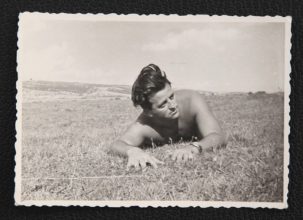
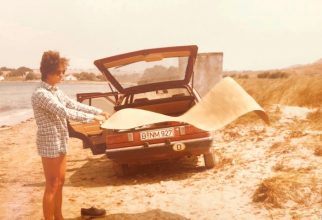

In her accompanying essay to ¿Déjà Vu?, the exhibition Susan Bright has curated for PHotoESPAÑA 2019, she makes it clear that she is not dealing with the paranormal, rather the literal translation ‘already seen’. Six artists have been selected whose work explore how the past may be understood in the present – how it shifts, expands, is open to re-interpretation as well as mis-interpretation. This is also necessarily an exhibition about process. The artists use all the tools of photography, analogue and digital, as well as practises which traverse painting, history, archive, and even performance.
Each venue had been carefully designated; Patrick Pound, who is really a curator and not actually a photographer at all, has been given the Museo Lázaro Galdiano. The museum houses an eclectic collection of artefacts from which Pound has taken several pictures and created his own display around them. The mainly vernacular pictures become art by association, and it is this dialogue that animates what formally resembles an exploded archive. Open suspension folders hang in vitrines, photographs tumbling out, scattered in piles, edges curling and overlapping. We are invited to make sense of a jumble of pictures depicting variously smoking, inhaling, candles, balloons, bubblegum, airplanes, breezes, butterflies, birds, wings, accordions, trumpets, flags, mouth-to-mouth resuscitation, sails. I did eventually figure out that it was all about air, all this material was actually trying to express the immaterial. I might have gotten there sooner if I had bothered to read the caption but the process was important, as well as utterly absorbing. Before the penny eventually dropped I was examining the pictures at face value, dwelling on individual images before appreciating their new temporal meaning within the collection. I had in a sense crossed time and space.
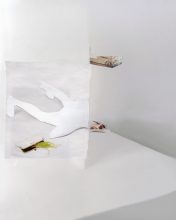
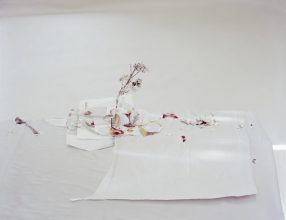
The Museo Nacional del Romanticismo is an equally appropriate venue for the work of Sharon Core and Laura Letinsky; exquisitely pink, it belies the intensely complex nature of their work. Letinsky’s previous works resembled elaborate stage sets, the aftermath of a delicate, delicious, shared experience of food. In these new pictures, the tableaux have been deconstructed, we can see the method in her process, everything has been flattened, folded. The beautiful table settings have fallen into disarray, collapsing like 19th century paintings of the fall of civilisations. They seem almost to fall out of the frame. And if her previous pictures left you feeling satiated, these seem to suggest our appetites are never satisfied, images taken from what could be advertising, are piled up, chopped up, taped up. The trompe l’oeil effect fools our eyes into seeing a depth that simply isn’t there; these are not so much nature morte as they are vanitas pictures, reminding us of the worthlessness of worldly goods, while utterly seducing us with their exquisiteness.
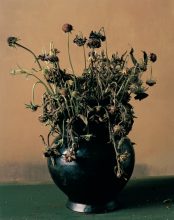
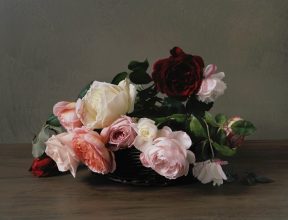
Sharon Core’s gorgeous still lives of flowers are just as deceptive. Still life was a genre of painting which desired to render its subject as realistically as possible, to convince the viewer of its veracity and so demonstrate the skill of the artist. Bright adds that flower painting was historically considered to be a lowly form of art, often created by women. All of this could equally be applied to early forms of photography. But where photography is generally perceived to be instantaneous, Core’s process is as labour-intensive as it could possibly be. Each image is painstakingly constructed using flowers she has grown herself, which obviously adds considerably to the length of time taken. These still lives are not just imitations of nature, but are copies of photographic representations of original paintings. Core not only challenges our preconceptions of photography versus painting, but forces us to reconsider the concept of representation. Instead of judging the photographs on their rendering of the subject we are comparing them to the paintings they imitate, as if it is the smell of oil paint rather than flowers which gives them their authenticity.
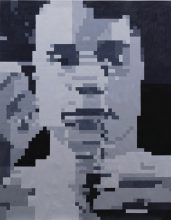
The work of the three remaining artists share a cavernous space at the Fernan Gomez Cultural Centre. On entering the space we are rather unexpectedly confronted with huge monochrome paintings that look like digital images that have become inexplicably fractured. This project by Clare Strand is explained by a row of small photographs with grids and numbers. These pictures were left with Strand’s husband while she traveled to France for a residency. While there, she made 10 canvases with the same grid; each square was allocated a tonal number from one to ten. Her husband, back at home, communicated a line of squares to be filled in. This could be straightforward painting by numbers, but in reality worked more like Chinese whispers. Strand did not actually know what she was painting, and it becomes clear that this can be a serious handicap, emotionally and creatively. Once again process is key, channels of communication are open to misinterpretation and error, and in a world where fake news is being propagated through so many channels, Strand’s work has a darker side beyond marital miscommunication.
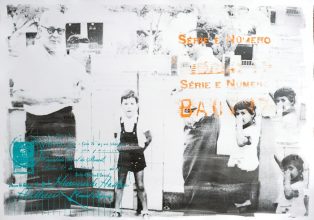
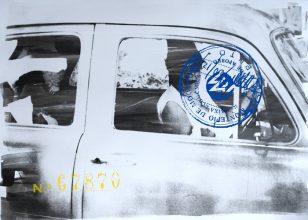
The photographic practise of Délio Jasse takes us back to the archive. This body of work evolved from the chance find of a box of documents at a flea market in Lisbon. Jasse infiltrates the memories of two families living in Mozambique whose lives are contained in this box. Bringing to bear his own experience and family history he pieces together stories about their lives. He cross references official documents, found photographs, re-examining them from his own viewpoint, and in so doing highlights the glaring anachronism of lives being lived in spite of their surroundings. Again it is the process that is revealing: photographs are re-photographed, the negatives reprinted onto paper, painted with photographic emulsion, and then screen printed. The visible brush marks lend an alchemical dimension to this process; Jasse is creating a new story out of the old, but also leads us to question what is being covered up. The stamps from the various photographic studios offer some proof of authenticity, but appearing as they do on the front of the print rather than the back, seem to imprison the image. The work is visually beautiful while revealing a world which feels confined, claustrophobic, even the slides stuck in the carousels of old projectors placed around the space feel ominous.
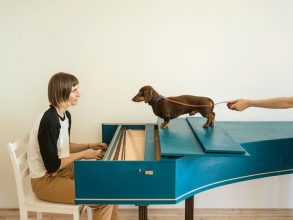
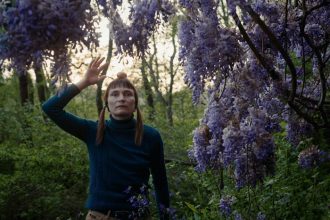
In contrast the work of Elina Brotherus feels full of infinite possibilities. She takes the Event Score of the Fluxus artists as her starting point, essentially an instruction manual for all things whimsical. They believed anyone could make art just as nowadays people believe anyone can take pictures. The Tate show ‘Performing for the Camera’ in 2016 demonstrated the difficulty of reproducing a happening; one couldn’t escape the feeling you were experiencing it all second hand, leaving the viewer primarily with a sense of disappointment. But Brotherus’s work feels so present, it feels as if we are watching her in real time, and the work is so free and so joyous, you immediately want to go out and ‘Disguise yourself as a Tree After John Baldessari’. Short films are hypnotic – who knew how soothing it would be to watch someone up a ladder pouring flour with a sieve onto someone else? The man next to me banging his programme angrily on the bench perhaps didn’t agree, but then that’s the beauty of Performance Art, it confronts us all in different ways, and what is so extraordinary about this work is that it gives the impression that it always feels fresh and startling. Even Valie Export makes an appearance closing the temporal gap, sitting as she did decades earlier, crotch covered.
If the term ‘déjà vu’ is usually used to describe a feeling of familiarity with the unfamiliar, these five exhibitions have exactly the opposite effect. ¿Déjà Vu? deconstructs, reconstructs, questions, challenges. The artists leap back and forth through time and process, re-focusing our image-weary senses with elegance, beauty and intelligence.
The practice of photography has a tendency to be backward looking, but Susan Bright shows us that sometimes looking backwards can actually lead us to appreciate the full potentiality of the medium.
– reviewed for Photomonitor by Susannah Baker-Smith
__________
¿Déjà Vu? curated by Susan Bright continues at PHotoESPAÑA 2019 through 1 September 2019. Full details of the exhibition and accompanying publication on this link.