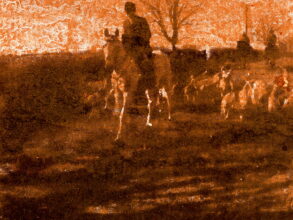

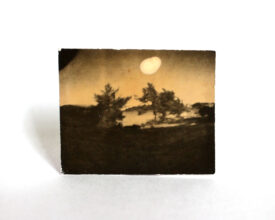

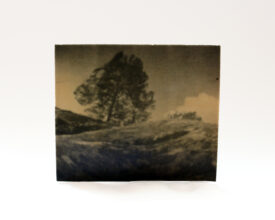

We were told to wear gloves at all times, but no one really did. There were tongs available, one for each tray, and yet we couldn’t resist slipping our fingers in to grab the print. The pungent smell could give you a headache at the end of a day in the darkroom, but most photography students came not only to love working under the red light, but to seek it obsessively as if under a spell. As an image would be conjured up in developer, the young photographer would feel a kinship across time with the medium’s inventors and greatest figures. Experiencing the ‘magic’ of analogue photography would trump all anxious questions about where all the chemicals came from and where they’re going when exhausted.
On one hand, the alchemical allure of photography resides in the appearance of an image seemingly out of nothing. After all, one of the foundational myths of the medium is that a photographic image is nature drawing itself . [1] On the other hand, it can refer to the mysterious chemistry that turns light into material image which can hardly be explained by practitioners today, an aspect of technology that historian of art and science John Tresch has called “black-boxing” [2]. What one needs to make an analogue photograph is boxed film and paper, packaged white powder and bottled liquids, provided by one’s local photographic lab of choice or global e-commerce corporation. Photography’s materiality has undergone a double obscuration – firstly, any material agency has been relegated solely to light, rendering metal and chemical components invisible; secondly, as an industrial product packaged for the consumer’s convenience, it has become utterly removed from its practical origins. Once metal plated with silver and coated with a varnish of bitumen of Judea and lavender oil (Niépce), paper coated in potassium iodide and silver nitrite (Talbot), or copper plated with silver and sensitised with iodine and bromine vapours (Daguerre), photography evolved in tandem with the proliferation of fossil fuels to essentially become plastic (the film’s base is cellulose triacetate[3] , acetate or polyester [4]) or paper, some coated in plastic (resin-coated) and some coated in barium sulfate (fibre-based [5]). This isn’t to say that photography was natural in its infancy, while now it is artificial, but to observe the amount of control over available materials the artist has exchanged for comfort, time efficiency, and the bliss of ignorance regarding waste.
However, in the context of the current climate emergency, the darkroom has become a place of environmental reckoning, where some artists are revisiting the magical process of photography and asking themselves the anxious question of what happens when they pour the photographic chemicals down the drain or dispose of the waste of their artistic practices in the bin. Some theorists have already responded with research that reframes the material history of photography and its impact on the environment: Siobhan Angus’s Camera Geologica. An Elemental History of Photography (2024) explores the ways in which both historical photographic processes and contemporary digital photography are inextricably linked to the earth’s geology; Michelle Henning’s Photography. The Unfettered Image (2018) situates photography within broader cultural and technological developments, connecting it to colonial ambitions and the processing of natural materials; Boaz Levin, Esther Ruelfs and Tulga Beyerle’s Mining Photography. The Ecological Footprint of Image Production (2022) discusses the history of photography’s raw materials and the ways in which their extraction and disposal have contributed to environmental degradation. In his article, ‘The pencil of cheap nature: Towards an environmental history of photography’, writer and curator Boaz Levin introduces a new genre of photography, which he names “metabolic realism”, in order to distinguish between photography that has an environmental subject matter and photography whose very making process reflects on the environmental relations embedded in it:
‘(…) the image’s metabolic process becomes intertwined with the work’s subject matter, and realism comes to encompass not just the documentation of an assumed outer world but also an attunement to the work’s very own (lower case) natural conditions. Metabolic realism is not a mere accounting of carbon emissions: it entails the acknowledgement of the entwinement of power, labour and materials – not as disparate substances, but as dialectically bound – and documents the creation of images through such relations.’
However, artists who make photographs with an acute awareness of the wider metabolism of nature they and their images are a part of aren’t simply artists. In fact, they operate at the junction between creative expression, chemical and technological innovation, environmental and historical research, and community organisation.
The Sustainable Darkroom, for example, is an initiative born out of the London Alternative Photography Collective, whose Director, Hannah Fletcher, teamed up with artists and researchers Edd Carr and Alice Cazenave, who has a background in molecular biology, to found a charity that promotes eco-photography. The Sustainable Darkroom investigates the ecological impact of photography, researches, teaches and disseminates recipes for low-toxicity, biodegradable photo-chemistries, as well as develops methods to minimize and repurpose darkroom waste.
Their first Tina (This Is Not A Solution) publication, appeared in 2019 as the result of a residency at XYZ Books in Lisbon, where Fletcher taught anthotype, cyanotype, chemigram and caffenol-c workshops and discussed bioplastic as a potential replacement for celluloid. The publication contains a caffenol-c developer recipe from artist and curator Melanie King, instructions to make bioplastic by artist Ivan da Silva, and the reflections of four other contributors. The second Tina (This is (Still) Not A Solution) resulted from a month of self-initiated micro-residencies where twenty-four artists met every day during one of the 2020 lockdowns. Much richer in recipes, examples of works, and instructions, including a guide for the recovery of silver from used fixer by jeweller Charlotte E Padgham, the publication also features the first iteration of a more structured framework for The Sustainable Darkroom in the form of two essays by Cazenave and Carr.
The following publication, re·source, came out in 2022, featuring forty-three contributors and marking a firm shift in tone. If the two Tinas still bore a connection to LAPC, re·source appeared entirely under the umbrella of The Sustainable Darkroom. The Tinas were also embracing a journey of experiments and trial-and-error processes, the title itself pointing to an unease to assume a guiding role within the photography community.[6] Carr’s introduction to re·source, entitled ‘Alternative ends here’, read almost as a call to arms: ‘Let this publication act as a blueprint for those wishing to depart from the violence of the past, and into a better future. To ecologise – decentralise – collectivise’ (p.5). Comprised mainly of thorough research summaries, eco-friendly recipes, tips and instructions, re·source departed from the realm of the speculative and entered that of practical discourse. The publication, sustainably produced by Folium Publishing, was proof of an empowered international community committed to completely transform how they make art.
Fletcher, Cazenave and Carr also maintain their own artistic practices, which, by bringing together the care for both the history and the future of the land and a concern for making responsible images, subscribe to the ethos of Levin’s metabolic realism. In 2022, Fletcher collaborated with Cazenave for Land.Seas.Sun., a series made on the Finnish Örö fortress island, which opened to the public in 2015, after being closed for one hundred years. A former military site, the island is today home to unique natural habitats, that the artists chose to photograph on direct positive paper developed in leftover tea leaves and fixed with salt evaporated from the Baltic Sea. By orienting themselves using the sun and the sea and incorporating the natural resources of the place, they make not only a visual, but a material statement about the human body and the photographic image being interconnected within the same ecosystem. The same year, Carr developed the moving image work, Yorkshire Dirt, whose every frame was printed on soil from the North Yorkshire moorland. The red hues of the film speak of the iron mining history of the region, but also of the exhaustion of the land, which has been perceived as a resource to be taken advantage of. In this light, the Sustainable Darkroom coordinators are more than artists – their research and innovation have gathered a growing community around their values, which in turn contribute their own experimentation and advice to the expansion of knowledge on eco-photography.
Following The Sustainable Darkroom develop over the last few years, along other practitioners around the Globe, such as Andrés Pardo, Almudena Romero, and Melanie King, to name a few, has reminded me of a similar period of fervent experimentation in the history of photography. Just as 19th-century photographers grappled with the technical and material aspects of their craft, today’s eco-conscious artists are reimagining these processes to align with environmental values. By revisiting these historical developments, we have a chance of better understanding the foundational practices that shaped photography and how those early methods might inform today’s efforts to create a more sustainable medium.
Around 1850, photography had been around for a decade, yet the daguerreotype was already starting to lose popularity due to its high production cost, while the calotype was still a slow and unreliable process, due to its restriction by patent in Great Britain. In 1847, Abel Niépce de Saint-Victor, Nicéphore Niépce’s cousin, started to test glass sensitised with silver nitrate and coated in albumen as another support for photography. Though even slower than calotype, the remarkable quality of the images sent the photographic inventors of the time into a frenzy – Talbot tried to patent it as his own idea twice, in 1849 and 1851, Gustave Le Gray suggested using collodion and published a paper on the subject in 1850, while Louis Désiré Blanquart-Evrard developed the albumen print in 1850, then published a paper on the albumen-on-glass process the following year. In 1849, Scott Archer began to experiment with collodion on glass, successfully reducing exposure time to one second, which opened the doors to commercial portraiture. The play of light and shade was captured more accurately, while detail was considerably improved compared to paper negatives. Talbot believed his patent should restrict Archer’s use of the process on the basis of making use of the negative / positive principle and sued him, yet the judge ruled in favour of the latter. Unpatented, the wet collodion spread, was reworked in the form of the ambrotype[7] and the tintype[8] , and remained unchallenged as a process for thirty years. Blanquart-Evrard’s albumen print, with its glossy surface, was often used as a complement for the wet collodion negative’s fine detail.
At the same time, salt prints were considered far from perfect, yet there was hope that with perseverance in experimentation they could reach the sharpness and the rich tonality of the daguerreotype. Since the calotype hadn’t been confined by a patent in France, both Blanquart-Evrard and Le Gray could improve on it freely. The former, not in contact with Talbot, first changed the application of the sensitising solution to the paper from brushing to soaking, which enhanced the negative’s stability, then separated the procedure in different steps. The exposure remained long, of 10-20 seconds, but the simplified instructions meant that the process could be replicated by other users. Having trained in chemistry, he envisioned pre-preparing the paper for ‘people less accomplished in manipulating chemicals’[9] and producing the positive prints at a later time than the negative, thus anticipating the industrialisation of the medium.
Le Gray instead departed from the calotype to perfect the waxed paper negative, which entailed soaking the paper in melted beeswax before sensitising it. The wax affected the paper’s refractive qualities, creating a more translucent negative, that could, in turn, produce a sharper positive. The treatment also improved the strength of the paper, as well as its longevity, allowing photographers to prepare their paper and store it for longer before exposing it on their travels. The atmospheric photographs produced with Le Gray’s method were breathtaking and propelled him to popularity in France.
It is important to note though, that despite history’s inclination to single out the personalities of the time, these men didn’t work and innovate in a vacuum, but were building on and responding to each other’s ideas. In January 1851 a Heliographic Society appeared in France with the aim to perfect and promote photographic methods. Le Gray and Niépce de Saint-Victor were members from the start. The society launched the journal La Lumière and later, after they reorganised into the French Photographic Society, they regularly published a bulletin and organised exhibitions. In Britain, the calotype coalesced many practitioners around it, with the Calotype Club being formed in 1847, where members exchanged prints, albums and information. The Photographic Society of London appeared in 1853 and later became the Royal Photographic Society, whose first honorary secretary, Roger Fenton, travelled to Paris to understand how the Heliographic Society worked.
What can looking at Victorian inventors tell us about the ways in which photography can be changed? Firstly, that in spite of a selection of individual names making it into the history books, communal work, collaboration, and sharing knowledge are the invaluable processes needed to advance towards a society that we envision. Secondly, that the medium of photography doesn’t have a will of its own, but it reflects society’s values at specific times in history. The 19th century British and French societies were eager to know and collect the world through images, to see themselves reflected in cheap portraits, and to have something new to do[10] . The 21st century global society is rapidly moving away from these goals, recognising at last the negative impact colonialism and extractivism have on the planet. Can our photographs reflect this new ethos solely through a rethinking of photographic processes?
Let’s imagine that photographic image-making is fully sustainable. No more plastic, no more silver, no more hazards. A practice deeply intertwined with the natural world. We don’t really have a problem anymore with the photograph not bearing the semblance to reality that we’re used to or with it not being properly fixed and gradually fading. We don’t digitise it either. We lose interest in collecting photography. We can’t rely on it to prove or to remind us of anything. We share it within our local circles. We make it regularly, ritualistically. To make a photograph we have to know the land. We have to remember the photographs we made last year and are no more with us. How do we teach photography? How do we document life? How do we record history? On the journey to make photography sustainable, it might help to revisit where the medium started. From our point in time, looking back, we might discover that the magic of photography has never been about getting the perfect, sharp, good contrast, freeze-the-moment picture.
___________
[1] ‘It may suffice, then, to say, that the plates of this work have been obtained by the mere action of Light upon sensitive paper. (…) They are impressed by Nature’s hand’, writes Talbot in his introductory remarks to The Pencil of Nature (p.1) and ‘In conclusion, the DAGUERREOTYPE is not merely an instrument which serves to draw Nature; on the contrary it is a chemical and physical process which gives her power to reproduce itself’ (Daguerre cited in Trachtenberg (1980), p.13).
[2] Photography and media theorist Michelle Henning discusses the implications of technology becoming so routine that we no longer consider its inner workings, noting that the process from input to output appears ‘rapid, automatic and completely predictable’ (Tresch cited in Henning (2018), p. 42).
[3] Technically a fully recyclable bioplastic, but in practice the recycling guidance in the UK is to dispose of negatives in the waste bin: https://www.recyclenow.com/recycle-an-item/photographs
[4] Made from petroleum and therefore a by-product of the fossil fuel industry.
[5] Technically bio-degradable, but it will release silver particles, just like resin-coated paper or film. Silver is a biocide, harmful to aquatic life.
[6] ‘this is not a user’s guide | this is not an instructions manual’ reads the introduction to the first Tina.
[7] An underexposed collodion negative mounted on a black background to render the picture as a positive. Similar to a daguerreotype in appearance.
[8] Similar to an ambrotype, an underexposed collodion negative on a blackened tin plate.
[9] Anonymous cited in Frizot, p.68.
[10] ‘The leisured class will find it a most attractive occupation, and although the result is obtained by chemical means, the little work it entails will greatly please ladies.’ (Daguerre cited in Trachtenberg (1980), p.12-13).
__________
Bibliography
Angus, S. (2024). Camera Geologica. An Elemental History of Photography. Duke University Press.
Beetles+Huxley (2016). Seizing the Light. Photography in The Age of Invention. London: Beetles+Huxley.
Chevalier, C. (1847) Recueil de mémoires et de procédés nouveaux concernant la photographie sur plaques métalliques et sur papier. Paris.
Daguerre, L.J.M. ‘Daguerreotype’, in Trachtenberg, A. (1980) Classic Essays on Photography. New Haven: Leete’s Island Books, pp. [11-13].
Frizot, M. (1998). A new history of photography. Köln: Könemann.
Hannavy, J. (2008). Encyclopedia of nineteenth-century photography. New York: Taylor & Francis Group.
Henning, M. (2018). Photography: The Unfettered Image. London: Routledge, Taylor & Francis Group.
Levin, B. (2023). The pencil of cheap nature: Towards an environmental history of photography. Philosophy of Photography, 14(1), pp.19–47. doi:https://doi.org/10.1386/pop_00069_1 (accessed 12/06/2024).
Levin, B., Ruelfs, E. and Beyerle, T. (2022). Mining Photography. The Ecological Footprint of Image Production. Leipzig: Spector Books.
Niépce, J.N. ‘Memoire on the Heliograph’, in Trachtenberg, A. (1980) Classic Essays on Photography. New Haven: Leete’s Island Books, pp. [5-10].
Talbot, H.F. (1844/2010) The Pencil of Nature. London: Longman, Brown, Green and Longmans. Available at: https://www.gutenberg.org/files/33447/33447-pdf.pdf (accessed 30/08/2024).
The Sustainable Darkroom and London Alternative Photography Collective (2019) This Is Not A Solution. Lisbon: XYZ Books, 2nd edition.
The Sustainable Darkroom and London Alternative Photography Collective (2020) This Is (Still) Not A Solution. London: self-published.
The Sustainable Darkroom (2022) re·source. London: self-published.
__________
Laura Bivolaru is a writer, educator and visual artist. She has written for Archivo (Portugal), Art Monthly (UK), C4 Journal (UK), and Photography Influx (Romania), and her essay, In Defence of the Small Screen, was the winner of the Michael O’Pray prize in 2022. Her interests concern expanded approaches to photography, with a focus on the relationship between photographs, text, and moving image. She is a member of the artistic collective Revolv, who facilitates professional and educational opportunities for early-career artists in the UK. As an artist, Bivolaru has exhibited in Romania, Moldova, and the UK. Curatorial projects include Separation and Belonging (2015) at 5th Base Gallery, UK, Statement of Being (2019) at Deptford Does Art, UK, Semantics of the Shell (2023) at The Balcony, The Netherlands, and Grafting: The Land and the Artist (2024) at the London Art Fair, UK. Bivolaru was also a Guest Lecturer on the Photography courses at UCA Farnham (2020), London College of Communication (2023, 2024), and University of Westminster (2023, 2024), and on BA Graphic Design at Kingston University (2022), as well as a workshop facilitator for East Meets West Masterclasses in 2021 and 2022. She is currently part of The Expanded Librarian at the Centre for Research in the Arts, Social Sciences and Humanities, University of Cambridge, a research project which investigates contemporary modes of collaborative image-text production. Bivolaru has a BA in Photographic Arts from the University of Westminster, London and an MA in Photography from the Royal College of Art, London.