




Essay by Stephan Schmid
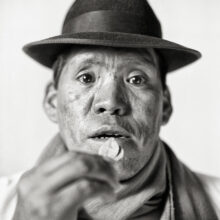
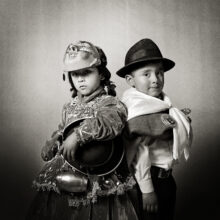
The Cocani are the Aymara coca merchants, who settled in the Bolivian city Oruro at the time when the region thrived on silver and tin mining. The region, its people and local mining industry gave rise to a rich carnival tradition – symbolic of the local culture – still celebrated today. Bolivian photographer Diego Echevers Torrez has been documenting these traditions since 2015, creating a series of analogue portraits celebrating the Cocani’s intergenerational heritage which is very much alive, yet under threat.
In recent years the popularity of the local carnival tradition has been increasingly appropriated and exploited by non-indigenous, economically powerful segments of Bolivian society realising its potential for the commercial tourist industry. This risks hollowing out and trivialising meaningful traditional practices like the Morenada (a satirical dance representing Black workers in the silver mines back in colonial times) rendering it a superficial folklore extravagance.
In the ‘Cocani’ project Diego Echevers Torrez pays tribute to the culture and traditions of the Cocani by capturing their cultural memory, their voice and their faces projecting the struggle of people anchored in the history of the mines of a city that little by little is forgetting its origins.
Diego Echevers Torrez’s chosen medium is analogue photography. Far from being a mere technical choice, this preference reflects a wider philosophical view of photography. He feels strongly about photography not being a literal transcription of reality. For him “photography is a poetic interpretation of life. Photography allows you to give visual meaning to your world. Perfection is something that does not exist as such. Therefore, that absurd and endless search for the perfect image has no place in my understanding of life – life which in its essence is imperfection.”
When once asked by a digital photography enthusiast “at what speed are the images recorded on your film?”, Diego’s laconic response was “at the speed of light”.
Diego Echevers Torrez was born in Chochabamba in 1979. He studied Architecture and Anthropology and has taught Anthropology at the Universidad Cathólica Boliviana. He currently teaches Photography at the Universidad Mayor de San Simón. Echevers Torrez first picked up a camera in 1997 as a student for research purposes in connection with architecture and anthropology study projects.
Entirely self taught and relying on his own visual and aesthetic instincts his photography developed without any formal guidance or genre reference points. Only years later with the advent of the internet, access to information relevant to his photography became easier. That led to his discovery of names like Edward Curtis, Josef Sudek, Karl Blossfeldt, Irving Penn and Sebastião Salgado – photographers he would now cite as influence on his own work.
Whilst Diego Echevers Torrez’ photography is informed to some extent by his background in anthropology, his work has artistically transcended its documentary origins. He pays homage to the people and culture of his country as well as addressing social concerns such as increasing inequality and industrialisation that endanger their traditional way of life.
Portraying his fellow Bolivians and their culture has become an important part of his work. Safeguarding their unique cultural identity for the future through his photography invariably involves exploring traditions reaching back in time. Commenting on his work he says ‘The decision to travel back in time – away from the current that can distract from what is really important – has allowed me to rediscover my love for photography. Enjoying the process, finding that simple, transcendent moment has changed my life. My gaze has become more reflective.’
He believes it is a mistake to dismiss the relevance of over 100 years of knowledge and understanding of the chemistry of photography. “My experience has taught me to appreciate a photography that is more respectful – going back in order to understand the present and imagine a meaningful future. We need to appreciate and enjoy the entire process – reflecting on subjects that move us, thoughtfully capturing the image and then discover in the lab how our perception – beyond the apparent – is shaped by the alchemy of creating the story on paper.”
By using mostly medium and large format cameras, the process driven nature of analogue photography has become an important part of the creative hand crafted way of how he works – even including some of the base materials and chemicals. Economic conditions and restrictions in Bolivia have forced him to produce some of the chemicals and material used in his work himself – something he now appreciates as an integral part of the overall creative process.
At times – as is the case with the Oruro silver mines, the historical context of the cocani tradition – the method and process of his photography tie in thematically with the story his pictures tell. This lends his work a compelling intensity.
Essay by Stephan Schmid
For his first exhibition with Albumen Gallery Bolivian Photographer Diego Echevers Torrez is presenting ‘Cocani’, until January 31st. For further viewing of the full series please visit this link: albumen-gallery.com