


By Annebella Pollen
As she greets me at the door to her flat in central London in early 2022, Carole Cutner tells me: ‘Don’t mind my face!’ A recent fall has produced a huge black eye, or in fact a black, green, purple and yellow eye. Is it agonising? ‘Not now’, she says brightly. ‘As a photographer, it’s been a gift. I’m documenting the changing colours daily through a series of selfies’.
I’m here to look through a lifetime of Cutner’s photo albums and prints. At 86, she’s been organising her archive of some 45 years of portraits, with a view to finding them a permanent home. The National Portrait Gallery already houses over a dozen of her highest profile sitters, from Charles and Diana before they were married, to depictions of famous figures as disparate as David Hockney and Enoch Powell. Her photographs have graced the cover of major international magazines, including Time. Her largest body of work, however, is unsung. Portraits of children and wedding photographs are two genres of practice overlooked in the photographic canon, but they’ve been staples of Cutner’s practice since she turned professional in 1968.
Cutner first began photography aged around 10, having inherited her mother’s old Kodak Box Brownie. She took her camera with her to boarding school where she honed her skills as a teenager in its photographic club. After school, she studied art at Leeds in the late 1950s in a period when Harry Thubron was revolutionising the subject with radical new approaches to teaching. Carole, however, dropped out to marry and start a family. As a new mother, Carole focused her photographic gaze on her daughter and began producing tender, and sometimes sombre, black-and-white portraits of her dark-haired and dark-eyed child. Friends would admire these depictions and ask if she’d ever considered developing a photographic career, but Carole only took steps towards this end when her marriage broke down. As a single mother, boosted by the encouragement of a graphic designer friend, and a new Yashica camera, she began to undertake paid photographs of other people’s children.
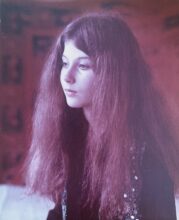
The colour portraits that Carole produced at the end of the 1960s and into the 1970s show children and young people as autonomous, self-possessed creatures. In natural light, at ease, but often caught up in their own thoughts, the portraits are contemplative and sometimes otherworldly. The tawny shades of the Kodak colour film result in soft and warm portfolio prints of long-haired sitters in floral fabrics, evocative of the pre-Raphaelite fashion revival of the time. We look at the portfolios together on Cutner’s kitchen counter over coffee and biscuits. ‘I used to sometimes say to the children, ‘Do you have a secret?”’ Cutner explains. ‘Their eyes would light up and their imaginations would be caught.’ She tells me who was who as we flick through. Some were passing encounters and others were long-lasting relationships that enabled Cutner to map the changing contours of children’s faces from toddlers to teens.
When Cutner was on the parents’ committee at her daughter’s school in the mid-1970s, Prince Charles was recruited to cut a ribbon at the opening of a new school building. Cutner gently suggested to a governor that a photographer would be needed, and she was put in place. On the day of the event, she made Charles’ private secretary laugh when she noted how many previous photographers had produced awkward portraits that emphasised his prominent ears. The secretary asked if she could do a better job and invited her to submit her portfolio to Buckingham Palace, leading to an opportunity to take Charles’ photograph.
For all her initial bravado, Cutner was terrified about the task. She worried about what to say and what to wear. She dressed in white trousers and wedges, which she recalled because Charles flirted with her, asking how she’d poured herself into her jeans. Using her favoured natural light and Buckingham Palace gardens as her requested setting, the rapport they shared showed through in the resulting photographs, which depict a twinkly eyed, grinning young man. The images appeared on front pages around the world, notably on Town and Country magazine in the US, where Prince Charles’ portrait led a 1978 cover story about ‘England’s eminent bachelors’.
Cutner had placed a bet with Charles, wagered on which of them would be next to marry. Each suspected the other. On the announcement of his engagement to Lady Diana Spencer, she called in her bet and asked to photograph his new fiancée. The 1981 portrait shows Diana as she turned 20, on the eve of her wedding, in a vulnerable image that is continuous with Cutner’s child portrait oeuvre.
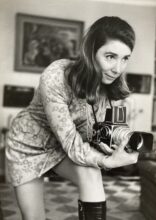
After being signed by Sygma photographic agency in Paris in the late 1970s, Cutner became a popular portraitist for wealthy, aristocratic and famous sitters. While some photographs are conventional in their poses and idealising messages, others offer surprises, putting a suited business magnate, for example, in a well-worn wicker chair. Some of her subjects are celebrated – a bleached blonde Hockney gesticulates characteristically in front of his California paintings in 1982, for example – and she produced a sensitive series of portraits of children’s authors for Walker Books, including the late Jan Pienkowski and Shirley Hughes. Other names are unrecorded. A particularly striking photograph resulted from a chance meeting with a newly-wed couple in Hyde Park. They saw Cutner with a Hasselblad around her neck and stopped their car to ask for a photograph. The young couple threw dynamic shapes on the edge of the Serpentine in gold spats and floor-length white fur.
Cutner’s own name is not commonly included in the photography pantheon, but she tirelessly built a career on both sides of the Atlantic over five decades in a time when it was hard for women to be taken seriously as photographers. National newspapers, for example, seemed as interested in her appearance as they were in her photographic skills when they featured her in articles in the 1970s. Fifty years on, Cutner is still remarkably sprightly and sparkly. It is easy to see how she built warm relationships with her young sitters, leading to extended invitations from families to photograph their children over many years, often becoming their wedding photographer (sometimes for first and second marriages) and even, in some sad cases, providing eulogies at their funerals.
As we talk, we leaf through Cutner’s own family albums. These include stiff turn-of-the-century studio portraits of her Russian émigré grandfather and tiny Polyfotos of her mother from the 1930s alongside images of Cutner and her young daughter in the 1960s, back-to-back in matching mini dresses. Although a large print of Prince Charles towers over the many pictures displayed on the shelves in Cutner’s flat, the largest quantity of photographs is made up of the kind of family and wedding portraits that Cutner dedicated her professional life to producing. These are, after all, the photographs that matter most to most people.
__________
Carole Cutner, portrait photographer, was professionally active from the 1960s to 2000s. She lives in London. Her National Portrait Gallery holdings can be viewed here.
Dr Annebella Pollen is Reader in History of Art and Design at the University of Brighton. Her books include Mass Photography: Collective Histories of Everyday Life (2015); The Kindred of the Kibbo Kift: Intellectual Barbarians (2015) and Nudism in a Cold Climate: The Visual Culture of Naturists in Mid-20th-Century Britain (2021). She is currently working on a new book and exhibition project about photography and children.