



__________
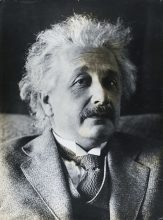
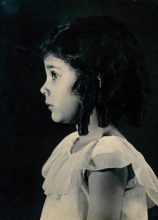
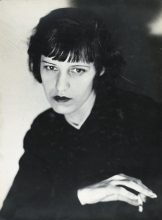
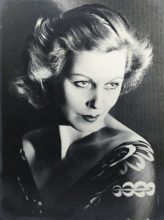
One side effect of the forced migration of so many thousands of Jews from Nazi Germany in the 1930s was the significant number of highly-trained and professionally-active women, including photographers, who arrived in the UK, bringing with them new techniques and approaches. Among them, and, at the time one of the best known, was Gertrude (Gerty) Simon (1888-1970). Born into a well-to-do Jewish family in Bremen, she had moved to Berlin in the aftermath of the First World War. Both her husband (Wilhelm) and her father were lawyers. Paving her own career path, however, and teaching herself how to handle a camera, Simon started out with editorial photography in 1922, getting a work published just one year after the birth of her son, Bernard (Bernd). She soon became a successful portrait photographer, attracting, by the end of the decade, such renowned sitters as the singer (and Simon’s friend) Lotte Lenya, the artists Max Liebermann and Käthe Kollwitz, the scientist Albert Einstein, and the French politician André Tardieu (who later became the French Prime Minister). The recently deceased, then six-year-old, Judith Kerr, who went on to write the Mog series and The Tiger Who Came to Tea, is also among those portrayed. Alongside these well-known personalities, Simon also captured the ‘new woman’ of Weimar Berlin, with her short hair, cigarettes, and frequently androgynous appearance.
Simon doesn’t appear to have kept a diary, and records of the shows she participated in, including the hugely significant touring exhibition ‘Fotographie der Gegenwart’ (‘Contemporary Photography’), held in Berlin in the spring of 1929, were lost during the war. Her work was, however, not just being exhibited, but published in illustrated periodicals, newspapers, and illustrated newspaper supplements. The critical response to another exhibition in Berlin in 1929 praised the ‘honesty’ of her portraits and their insight into the ‘essential character’ of the sitters – observations which were to recur concerning her later work as well. By the early 1930s, Simon had an enviable list of prominent sitters, and was being invited to show in prestigious international exhibitions, receiving positive reviews.
Things were not to continue so smoothly, however, with the escalation of Hitler’s regime. Simon left Germany relatively early on to escape burgeoning Nazism, writing: ‘Under the Nazi regime I found myself as a Jew in particular danger, because as a photographer, I had taken numerous photographs of Social Democratic and anti-fascist personalities and exhibited them in public.’ It is possible that another reason for her early departure was to follow her son, whose progressive school upped and relocated to Kent. Simon herself went to London, where she settled in Chelsea, and quickly picked up her photographic work. Her husband remained in Berlin, where, unable to practise as a lawyer, he found work as a notary.
Within just over a year of her arrival in the UK, Simon staged an exhibition of her work at the Storran Gallery in Chelsea, entitled ‘London Personalities’. Similarly to her work in Berlin, her British subjects comprised a mix of refugees, actors and politicians, including Aneurin Bevan, Sir Kenneth Clark, Lord Balniel, and actresses Peggy Ashcroft and Constance Cummings. The Sunday Times described her at this time as the ‘most brilliant and original of Berlin photographers’ and the Daily Sketch reported that her ‘unusual photographs’ were well known in Paris and Berlin.
Simon was reunited with her husband and son in 1939, but both men went on to be imprisoned as enemy aliens, with Bernd being sent to an internment camp in Australia until 1942. A little earlier, however – around 1937 it seems – Simon appears to have stopped taking photographs. It may well have been down to the impending war; others hypothesise that she suffered ill health (there is brief mention of illness in one of her letters), or that she turned from photography to oil painting; but no one really knows the answer to her sudden disappearance from the pinnacle of the photographic world.
Wilhelm Simon was restored to (West) German citizenship in 1955, and it seems he returned, at least for a while, to the country of his birth. Gerty Simon never returned to Germany and died in London in 1970. On her death, her 350 large-scale, probably silver gelatin prints passed into the hands of her son. When he died in 2015, they were inherited by his partner, who, the following year, having sought advice, passed the archive, comprising the (slightly mouldy) prints, along with accompanying documentation, on to the Wiener Library – Britain’s national archive on the Holocaust and genocide, founded in 1933, making it the world’s oldest collector of material on the Nazi era. Eighteen of the original prints from this archive, along with 50 reproductions, largely made up of portraits taken in Berlin in the 1920s and early 1930s, and 1930s London, are now on display in the Wiener Library until October. They are accompanied by further material from the archive, displayed in vitrines, including business cards, exhibition flyers, pamphlets and press coverage, personal documentation (Simon’s birth certificate and British citizenship naturalisation paperwork), and personal thank you letters from some of her prominent sitters.
This exhibition is interesting not only for its bringing Simon’s name back to light in the world of photography, but also for the concurrent campaign (begun in October 2018 and set to run until the exhibition closes) to identify some 70 of the unknown and unlabelled faces out of the 300 or so in her photographs overall. Although the archive contained a typed list of the names of sitters, and some were identified on the reverse of the prints, in catalogues, or in visitor books, not all were covered, and unfortunately Simon’s glass-plate negatives were destroyed after her death. The Wiener Library set up a Flickr page with the unlabelled images and any accompanying details it had and, as a result, some of the faces have successfully been identified. Suggestions have been received from people all over the world and the library has also been approached by family members who have recognised relatives in the collection. To date, around 12 people have successfully been recognised, including the Greek-American art collector, gallerist and dancer Alexander Iolas and German artist Elfriede (or Erich) Thum.
A donation like this is rare and meaningful and adds a lot to such an archive as that held by the Wiener Library, not only because Simon was such a powerful and innovative photographic artist, but also because she photographed so many important cultural figures from the lost world of Weimar Berlin. The library’s staff has been working hard to catalogue the documentary and photographic collection, as well as to undertake conservation work where necessary (largely to remove the mould). Digitisation of the archive has also been set in motion. Once the exhibition is over, the portraits will remain stored in the archives and members of the public will be able to access digital copies, by appointment, in the Reading Room. But now, while they are all on display together, is an exceptional opportunity to go and admire the work of this once so noted photographer – and perhaps even to help identify a further face and add to the still unravelling stories associated with the bequest.
As Ben Barkow, director of the Wiener Library, writes in his foreword to the accompanying catalogue: ‘We recognise the importance of Jewish self-representation as a counterweight to Nazi or other antisemitic presentation of Jews. Photographs complement and expand the understanding we gain from documents such as diaries, reports, telegrams and letters. […] A photo may not say more than words but can be the equal of words.’ What are some of the remaining stories that Simon’s portraits have to tell?
– essay by Anna McNay for Photomonitor
__________
Berlin/London: The Lost Photographs of Gerty Simon continues at The Wiener Library, London until 15 October 2019