“We all have a vision of the seaside that is uniquely our own. Memories, false and real, are aided and abetted by photography… and time changes everything.” (Shepherdson, Williams, 2019: 8).
__________
When thinking of the British seaside, a wave of nostalgia and novelty floods your thoughts. The bright colours, the sound of arcades and smell of salt and vinegar-drenched fish and chips are things that many will share memories of. Memories that are both collective to society and personal to each of us. This accessibility and vernacularity of the seaside is perhaps what draws photographers to document the many layers of the seaside escape, a British hyper reality. Seaside: Photographed currently exhibiting at Turner Contemporary, Margate, brings together different explorations of the seaside, creating moments of recollection of the glory days of the seaside, while providing a thought provoking look into the state of the seaside today. The exhibition shows that the ‘Great British Seaside’ is a theatre for photographers, a spectacular show, something which Grace Lau’s 2005 body of work 21st Century Types takes very literally.
One could argue that the theme of photographing the colourful, aging British seaside is getting repetitive, with too many photographers working within the vernacular. Lau’s work goes against this trend, breathing fresh life into seaside documentary photography by opting for formal, carefully composed studio portraits, based on classificatory photography of the late nineteenth century. Using techniques borrowed from the classificatory photographing of the Oriental “Other” from the late nineteenth century, Lau flips the roles and becomes the photographer of the West, putting Hastings holidaymakers in front of the camera with a contrasting theatrical, oriental backdrop.
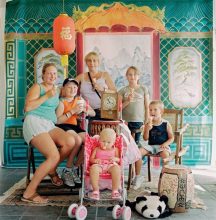
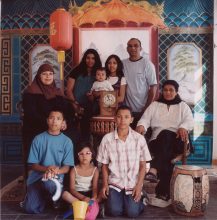
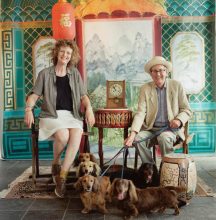
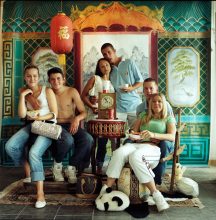
At first glance, due to the theatrical oriental setting not conforming to ideologies of the seaside, you would not notice these are exploring the popular resort town of Hastings, as well as reversing the West/East gaze. This invites you look deeper at the photographs’ layers. The Iceland carrier bag, the melting ice creams and beachwear – all of these contrast the carefully curated oriental backdrop. However, while this is markedly different to other bodies of work inspired by the allure of seaside, the portrayal of the sitters does hold some resemblance to the exposing nature of seaside documentary photography of artists such as Martin Parr, which is featured in the collective exhibition alongside Lau, creating interesting conversations. The portraits on the sitters’ behalf are unplanned, formal, and very much come as you are, removing the sitters’ choice to determine how they are seen, the same way the “Other” had no control over their portrayal.
While it may be initially hard to see the seaside element without having any context, 21st Century Types stands testimony to the fact that placement and relation is key. Directly across the exhibition room to Lau’s eye-catching framed portraits is a display cabinet full of anonymous beach portraits from 1850’s – 1920’s. While the eras are obviously different along with the scale and material used, they are strikingly similar. Both contain portraits of beachgoers posing in front of a camera out of choice, often with similar formal expressions. This similarity creates even more conversation around Lau’s work away from notions of Orientalism, reflecting how seaside visitors cling to the nostalgia of the beach, and see it as a time to memorialise with photography.
In reference to reductive, classificatory photography used in the nineteenth century, Pinney stated “Individuals who outside the studio might not inhabit the same terrain are here bought within a common epistemological space,” (2012: 13). The aim of Orientalist photography was to classify and categorise the “other”, listing traits, looks, and behaviours. If you take this gaze and apply it to the work the way Lau intended, you can create a strong profile, and get a small and privileged glimpse into the sitters lives.
For example, when looking at the image of two women and their children, you can see half eaten ice creams, flip flops, summer clothing, telling us they are at the beach and it is summertime. A bright pink stroller with a toddler all in pink suggesting the toddler is a little girl. They all look happy and relaxed with each other, indicating they are all family or at least very close friends. Due to wider knowledge and pre-imposed stereotypes you can assume they are British due to the style of their clothing. On the other hand, when looking at the image of an older couple and their dogs, you get a slightly different picture. They seem a lot more relaxed in front of the camera, while their clothes reflect their age and connote that perhaps they are middle class. The presence of their dogs not only indicates they see them as very important, but also raises the question to whether they are holiday makers or residents of Hastings.
Despite being portraits, traditional classificatory photography of the “Other” lacked a human element, therefore not representing culture. Lau seems to acknowledge this, and while these images follow the technique of classificatory photography and reverse the roles, bringing it into the 21st Century, there is a presence of humanity and culture. Whether it be through the way the sitters look relaxed and happy in front of the camera, the use of space indicating relationships and connections to one another, or inclusion of personal belongings.
What makes 21st Century Types so exciting and engaging is that after you are drawn in by the bright colours, crisp clean detail and sitters whose stances would not be out of place in a portrait from the early 1900’s, you unlock so many different layers. Of the projects aims, Lau said, “Through this project, I am making an oblique comment of Imperialist visions of the ‘exotic’ Chinese and by reversing roles, I have become the Imperialist photographer documenting my exotic subjects in the ‘Port’ of Hastings.” Lau achieves this role reversal of Orientalist photography, placing an anthropological, classificatory gaze onto the nostalgic dreamland of the British seaside. Flipping the stereotypical West/East gaze, and bringing the technique into the 21st century. Despite dismissing the popular vernacular approach, the images are still accessible and relatable to a wide audience.
Despite it not necessarily being Lau’s aim, a picture of the modern seaside is created, balancing the nostalgia that people desperately cling to whilst displaying the stark reality of its decline, and also celebrating the seaside, its diversity and the fact that it is an escape from the mundane everyday.
– text by Alice Sophie Turrell
__________
For further viewing:
Lau. G (2019) Portraits in a Chinese Studio [online] http://gracelau.co.uk/picturing-the-chinese-portraits-in-a-chinese-studio#portraits-in-a-chinese-studio
Seaside: Photographed (2019) [exhibition] Turner Contemporary, Margate, 25 May 2019 – 8 September 2019
Shepherdson. K,Williams. V (2019) Seaside Photographed, London, Thames & Hudson
Pinney. C (2011) Photography and Anthropology, London, Reaktion Books Ltd