





An essay by Mariasanta Tedesco
__________
“There’s a famous saying that life is more important than art. For me, art should be at the service of life. I would say it’s a form of activism. I have developed trust in the power of beauty and in the language of art, contributing to change by drawing people in and making them ask certain questions. It’s hard to make people engage with something; they need to feel something.” (2)
Like a spell, Hoda Afshar’s photography pulls us into a theatrical pièce reminiscent of Al-Halqa, a Moroccan storytelling tradition where the audience guides the narrative. With the cameras off and the curtain down, the collaborative performance begins. I watch as a captivating, stratified arrangement of images and ideas unfolds, disclosing a rare perspective that values complexity over simplicity. I am drawn in. Further investigation will multiply the questions surrounding public action and the civic poet’s responsibility. I cannot resist.
Through an innovative approach to documentary practice, photographer Hoda Afshar investigates the intersections of our hypernormalised (3) and oversimplified make-believe world and dissects its ramifications, focussing on the inequality divide. A love of poetry and stories and a strong sense of justice, recap her upbringing in post-revolutionary Tehran. Now based in Australia, her work is celebrated as uncompromising and luminous, fusing personal narrative with political engagement.
On a theoretical scale of accuracy, reportage images mirror reality, while theatre is the polar opposite, pure artifice. Afshar bonfires this axiom and its illusions. Documentary photography, masking its imperialistic record-making under the guise of impartiality and indulging colonialist fascination, has openly failed as a truth-teller. The artist challenges the power dynamic, where the camera is weaponised, the photographer’s gaze dictates the plot, muzzling the subject. Instead, Afsha embraces a staged approach with photographers and subjects allying towards a concerted project.
If the lens bends the facts, each photograph is a constructed piece of a larger story. Theatre, however, has a history of reshaping power structures, pinpointing Ionesco’s rhinoceros plagues of society, and promoting collective responsibility. The work’s nuanced interplay of reality-fiction rejects voyeurism, elevating her collaborators’ stories. Clearly, ethics is key to achieving a just redistribution of the visible and balance in image-making. Performance, above all, is a political choice, manifesting a commitment to care as an act of affirmation and revolution.
Mindful of the power of images in defining the world, Afshar’s meticulous research reaches for elasticity and potential for further meanings. Invisibility, visibility, and hyper-visibility serve as coordinates to explore themes of representation, displacement, and injustice, securing a platform for marginalised communities.
Despite discussing brutality, Afshar defies the prevailing glamorisation and normalisation of violence. Empathy became central to mid-twentieth-century humanist photography. However, this artist’s work transcends the candour of the latter, incorporating layers of intention and social action. Love, philosophical and political, imbues her journey, replacing mere compassion. Utter dedication to truth frames an eclectic process with style and message seamlessly integrated and the vocabulary shifting organically, driven by purpose, chance, and constraints. To disrupt inertia and elicit reflection, we desperately need an alternative language. Gentle and enlightened, Afshar’s practice addresses hate without reproducing it. Unafraid, she chooses beauty, emphasising the shock of the sublime and how ethical art can restore justice, empowering audiences and inspiring change. Her indispensable examination of the politics of visibility pushes the boundaries of dangerous assumptions, acting as a wake-up call and inviting dialogue. Impressed by Hannah Arendt’s concept of Amor Mundi, Afshar’s images are magnificent performances of love and hope.
“Hope is the thing with feathers” (4)
This line opens Emily Dickinson’s homonymous poem, a hymn to resilience. Afshar’s recent work, In Turn, was a privilege to view. A circular display of sorrow, purity, and strength, delicate as feathers, yet grand as memorials, enveloped me. Among them, I could hear the chanting. The project is an intimate and collective reaction to the 2022 Iranian protests sparked by Mahsa Amini’s death, a Kurdish woman arrested for not wearing the hijab. Like verses, painful and inspired, these images provide a glimpse of light amidst darkness and rage. Attended as a nenia and a battle anthem, the series is exceptionally evocative and sophisticated. Grace, in the language, while encountering loss, celebrates solidarity, surpassing ephemeral pity and promoting reaction.
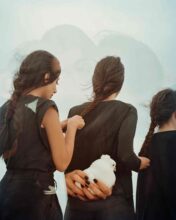
The photos in this work depict Iranian-Australian women who, similar to the artist, followed the protests from a distance and mourned the many deaths. Clad in black, they stand for their sisters, fighting for survival and sharing the same agony. A collective hug offers solace as they rehearse for the battlefield. “Women, life, freedom” reverberates in the chorus. Like the demonstrators, they braid their hair in protest, echoing the Kurdish female fighters’ tradition. Likewise, the pictured doves symbolise the birds released by families to honour the victims. “Hope is the thing with feathers”, “Grief Is the Thing with feathers” (5).
Beyond individuality, space, and time, these photographs achieve universality. Subverting the social media aesthetic, these splendid portraits, shot with a large format camera, employ an expanded documentary practice: cropped bodies, faces set against a familiar sky. Focus is on the gesture, rhythmic signal, and vigorous beat. Through calculated repetition, Afshar’s oeuvre belongs to a political statement on visibility, acknowledging privilege while crafting a counter-narrative and a coup.
The same moving embrace and sense of togetherness transpires in her earlier project Behold, where she offers a secure space for Iranian gay men to assert their voices. Raw and dark, the photographs are suggestive and tender, blurring the line between reality and performance. In a steamy bathhouse, the mutinous choreography evolves as condensation clouds the view, shielding identities. Afshar’s considerate approach is a departure from traditional reportage, with fictionality promoting collaboration, and concealment uncovering the obscured and the whispered.
Women, Life, Freedom! While the rallying cry for liberty resounded worldwide, society’s silence, even from the most progressive fringes, underscores an ongoing debate. Veiled women, objectified and commiserated, have long been at the mercy of the Western gaze and central to its political agenda.
The staged postcard of the Algerienne “is the fertiliser of the colonial vision” (6), argues poet Malek Alloula, and exacerbates its violence by eroticising the woman’s body. Exploitation and Orientalist reveries have endorsed the West’s prerogative to control and also possess the “non-white world”, continues Edward Said (7).
Afshar’s newest multimedia series, The Fold, bridging politics and psychology, explores the misrepresentation of Islamic women and the veil’s role in denying access and lurking information. As her aesthetic ambitions blend into a kaleidoscopic and hypnotic creation, the ethical image-maker avoids abusive depictions while investigating documentary photography’s place in Western propaganda. Priority is on love.
He shot himself. “He posed his death in front of the mirror” (8)
The video opens following the suicide of French psychiatrist Gaëtan Gatian de Clérambault. Fabrics, photographs, and mummy-esque figures set the scene. Like an altar, a large mirror sits in the middle, a gun lies on the floor nearby. The camera, zooming into the reflection, brings a shared angle for the photographer and viewer.
De Clérambault’s extensive early 1900s archive of the Maghreb area ticks all the boxes of an ethnographic inventory, showcasing staged pictures of veiled people. But unlike his fellow photographers, he does not undress his subjects. Instead, the photos tell of his long affair with drapery. De Clerambault’s work is not another crude catalogue. Compulsive and enigmatic, surely uncomfortable, it is a visual search across psycho-colonial manias on concealment and imagination, infused with an artistry of language and, perhaps, a shy awareness of the viewer’s gaze. Inspired by Orson Welles’ The Lady from Shanghai, the video includes interviews with experts filmed in a mirror maze, a fascinating style choice perusing notions of self-centredness and multiplicity in the labyrinthine image analysis.
Life-size reflective panels feature a sequence of de Clérambault’s photographs, revealing his fascination with collage to study the movement of fabric. The body is barely an object. As we observe our reflection in the veiled person, Afshar prompts us to confront our understanding of images. The mirror is a constant metaphorical appeal to the viewer to provide diverse translations, and also an oblique criticism of Western-centric readings and their ingrained cliche. People feel safe when looking back at themselves. Surrendering to predictive algorithms and overwhelmed by the world’s complexity, we retreat to familiar environments to avoid destabilising our carefully constructed bubbles.
900 miniature cropped images of the folds and fabric, downloaded and hand-printed in black and white, assemble the mosaic installation. Excess, repetition, and fragmentation capture the strange allure, almost addictiveness, of the psychiatrist’s archive. Neither piece discloses much. How to decipher the prodigious conundrum is left to the audience. The intent is not to unveil or reveal; this work nods to inaccessibility and reflects on how photography can slyly warp, overpower, and bury certain stories.
The Fold draws inspiration from her series, Under the Western Eyes, which emerged after Afshar migrated to Australia in 2007. Isolated, she addresses her crisis by researching multiculturalism, whose flag, self-serving and lacking, is proudly flown by the West. Exoticism, as proposed by professor Graham Huggan, oversimplifies cultures into predictability by wavering between strangeness and familiarity and replacing power with curiosity (9).
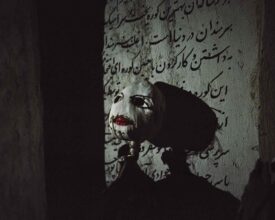
The visual satire is an inflamed pamphlet of art’s bigotry and Western stereotypes imposed on Iranian women. The Orient, unable to represent itself, as Edward W. Said suggests, has been consistently depicted as inferior and needing education. (10) ‘Veil Art is a White Thing’! claims the artist, referring to Richard Bell’s theory. In an act of personal and artistic rebellion, Afshar resists creating art about the veil and lack of emancipation. Provocative staged portraits juxtapose Shirin Neshat and Andy Warhol’s works, the distortion of Arabic script as a sarcastic example of fetishisation. In her self-portrait, she stares defiantly at the camera. Ruby lips, eccentric green makeup, and a can of Coke in hand, she wears the hijab fashioned with Oswald’s ears. A concoction of pop culture icons and Islamic vestiges, the piece speaks a Western language, sketching its capitalistic foundation. Although Afshar eschews a fixed style, this work stands out as one-of-a-kind, a hyperbolic medley of highly saturated photographs where ad hoc manipulation fails Oriental cliché and Western ideas of freedom. Through a vibrant mise en place of metaphors and metamorphoses, a complex exchange occurs between artwork and viewer, highlighting the medium’s artful nature.
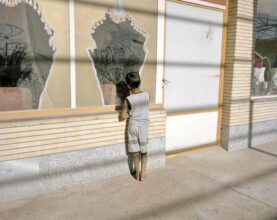
In her ongoing project, In the Exodus, I Love You More, displacement and artificiality of images gain a faintly exquisite style. Transcendence, staging, and concealment, often achieved through an intriguing use of fabrics, reappear and are decisive of the artist’s practice and radical impact on art and politics. Following her father’s death, the series is a touching visual travelogue of Iran, a love letter to her homeland. The work, a ballad of presences and absences, crosses the pleats of time, movement, and space, fluctuating between invisibility and visibility. In the liminal realm where memento and present collide, she delicately weaves a tapestry of fragments, summoning the past and the return. “I’m forever living between Aprils”, writes author Hala Alyan in her poem, Half-life in Exile. (11) As migrants, we exist between two worlds, endlessly begging for memories that might lessen the ache of distance. Time is elusive, and migration further transfigures our perception. Migrant life in a suspended state–this photo essay explores the anatomy of the diaspora.
In observing these images, time lengthens, holding onto every memory and emotion. Swinging between certainty and uncertainty, the artist’s journey is an ethereal spiral where dissimulation represents her limbo. The photographs are as cryptic as they get, interlaced like an alchemic tale: waves caress a silvery sea, and cloths wrap abandoned buildings. They remove, sometimes dress, and add. Banks of milky fog surround people and absorb landscapes. Ambiguous figures rise from the dusty ground, plastic sheets protect from the cold, and sacks are stored for survival. Alien constructions populate the series with open vaults displaying an ordinary sky, while faces and stories fade away with the passage of light and time. Poetry permeates the entire sequence, infiltrates every crack and crease, flowing through the patterns and draping along the folds.
In an escalation of illegibility, the project evokes nostalgia yet exposes its disconnect from reality. Memory and photography are but pieces. This mesmerising and nebulous journey into Iran’s obscured image, as the artist overlaps traditional and new representations, is an incisive commentary on the documentary genre and Western framing, focusing on the politics of images and inherent bias.
All locations have a path, and each person has a destination. Eyes on what lies ahead, they frequently elude our sight. Occasionally, they pause in contemplation. Where the sky meets the sea, disorientation battles with calm. My world might be fading, but it is still my world. Whether etched on a neglected window or woven into recollections, quietly mending her soul or boldly advocating a democracy of the visible, love is at the core of Afshar’s uprising, aiming to transform ourselves and the world.
Simultaneously calling the viewer and training herself, her project Speak the Wind underlines the importance of unselfing (12) in rendering justice, while also proving that neutrality is the most dangerous illusion of documentary photography and the handmaid of imperialistic violence. From the islands in the Strait of Hormuz in southern Iran, a personal healing journey becomes collective atonement. Cinéma vérité’s honest approach meets Tarkowsky’s rich cinematic style as Afshar appreciates the camera’s presence in the narrative, while the surreal aesthetic illustrates the beguiling and prismatic body of work.
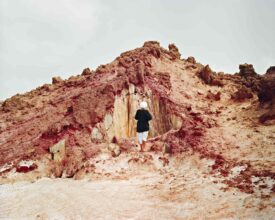
Speak the Wind quizzes the tangled network of gazes and the hazy border between matter and imagination in a glorious overlap of staged scenes where bodies, landscapes, dreams, and rituals alloy in a cyclical pattern. Vivid hues brush the enchanting rainbow island. Imagine crimson beaches where the sea reaches rusty sand while salt caves and anthropomorphic rocks shimmer like jewels with chromatic variety. Ancient and futuristic settings merge in a seductive, atemporal flow of black-and-white images. Mystical, windswept landscapes shape the people of this geopolitical and commercial hub where diverse cultures amalgam. But beneath the otherworldly beauty lie centuries of slave trade, with locals believing their echoes linger in the winds blowing from East Africa.
This ambitious piece displays the artist’s search for a new and respectful language to honour the community; Western labels of primitiveness are discarded, pushing photography’s boundaries to capture the supernatural as a dignified reality. Interviews and drawings enter the work, reinforcing the collaborative dimension and voicing the medium’s constraints. A suggestive language translates the impossibility of representation and the refusal to glorify violence, rejecting a definitive storyline. Throughout, political undertones and ethical considerations are woven into lyricism. The ghostly remnants of the slave trade are subtly depicted through a decomposing dog, cemetery views, and disturbing voodoo dolls. Although unseen, we witness the winds in the sculpted land, the rippling waves, undulating clothes, and the draining dance of those it haunts. Finally, the video delivers the magical encounter, portraying performances of the zār ritual and representing the camera as possessed. Mimicking the work of local shamans, these images offer a way to subvert photography’s skewed view of justice by cleansing its haunted history.
“Whenever domination is present, love is lacking”, writes visionary thinker Bell Hooks. For fairness to prevail, we must foster mutual respect and understand love’s essential place in our political lives. (13) She insists that self-preservation, not collective vision, often drives resistance to oppression, advocating for “an ethic of love” to counter self-interest and stagnation. (14) To photograph is to love entrusting subjects, calling for photographers to be mindful of their gaze and for viewers to be civic actors. Understanding the medium’s limitations, history, and potential is indispensable. In Afshar’s hands, what was once a tool of control becomes one of empowerment.
Projects like Remain and Agonistes signal a turn in the Iranian photographer’s work, presenting an overt study of Western democracies. In 2013, Australia’s strict asylum policy led to offshore refugee detention, officially for public safety. Remain details the distressing stories of a group of stateless men left behind after the Manus Island centre closed. The series’ epitome of the human rights struggle recognises yet resists the power of photography to distort popular opinion, creating both criminals and victims.
Afshar draws upon Jacques Rancière’s argument that the fight for visibility defines politics, with images shaping norms and their absence leading to discrimination (15). The photographer then retraces Giorgio Agamben’s idea of how sovereignty, bare life, and political life intersect in charting the state exception, legitimising violence. Invisible and with no rights, refugees are left to survive. They are numbers. Afshar reframes the refugee crisis as a racism crisis, exposing strategies of fabrication and erasure and the persistent East-West divide. Like in Kubrick’s satire, Doctor Strangelove, the West’s invention of the enemy breeds fear and paranoia. Similarly, migrants, when visible, become a problem.
To invert the collective act of disguise, the work celebrates individuality in twelve stunning portraits. Like the islanders of Speak the Wind, refugees can now choose how to represent themselves. Picking a natural element as a metaphor, they will perform their stories on camera. The stage is theirs, unadorned and unfiltered. The lens is focused on the body, while fire, water, sand, and all chosen totems complement the narrative. Shot in black and white against a plain backdrop, they emerge from the shadows, rejecting anonymity. We cannot deny their presence nor avoid their gaze. We can reach their flesh and listen to them. The film, a melange of acting, songs, and poetry, paints a heavenly sight with white sand and crystal-clear water. However, the unspoiled nature belies tragic recollections of stabbings, suicides, and mistreatment, which clash with the lush rainforest. The green hell, as refugees describe it, is both poetic and a set of painful emotions.
The world’s lack of response was rattling.
“Through the camera, people become customers or tourists of reality”, writes Susan Sontag in 1977. (16) Violence and apathy are commonplace for us. Refugee documentaries solely depict victimhood, crushing any sense of personality. As we look at them, hungry and miserable, their bodies emaciated and bruised, we dehumanise them.
This series exemplifies photography’s crucial role in representing minorities and challenging hegemonic records, converting its poisoned past into an act of love. Afshar’s artistic inquiry sits, generous and forceful, as critical art. Her work challenges the victim’s stereotype and reclaims humanity. Suffusing her images with beauty—a quality denied to refugees—she inspires awareness and mobilisation. If the project glorifies individuality, her lyrical language is broad and declines detachment. Only art and love Remain—an eternal defiance of oblivion uncovering a scandalous history otherwise lost to time.
Government employees on Manus Island who dared to speak out about the crimes they saw were silenced and faced severe repercussions. Related to Remain but extending further is the series Agonistes. “The survivor’s vocation is to remember” (17), writes Italian philosopher Agamben — witnessing inherently involves a personal struggle, as the series’ title suggests.
Shaped by tragic theatre and its impact on democracy, the series describes the struggle of whistleblowers torn between morality and law. Nevertheless, the artist refrains from portraying them as heroes. Diametrically in contrast to Remain, the work aims at the invisibility of the subjects. Peeling back layers advances the action and protects her collaborators. Whistleblowers hold, in fact, the unique position of being seen yet ignored and stifled. Their visibility is not a privilege. From Manus Island to the Afghan Files, and within Australian society, they expose systemic corruption. Afshar concentrates on the underbelly of Western democracies, whose actions are insidious. By controlling information and perception and manipulating public alienation, they permit defiance, thus upholding a sham democracy.
Whistleblowers share the plight of Manus Island asylum seekers, deprived of full citizenship rights but still bound by the law. The state of exception, earlier employed to defend the borders, now manifests as implementing gag orders.
Afshar’s thoughtful work is rooted in solidarity, allowing the mute chorus of the whistleblowers and the Iranian women of In Turn to sing out against political suppression. Disguise through carving acts as a protective screen while supporting the howl for justice.
In this series, theatre exceeds performance, infiltrating the laborious technique. 110 cameras scan all whistleblowers’ facial details, except the eyes. Afshar operates like a sculptor, her camera as a chisel, opting for rough modelling and waxy textures. Using 3D printing, she creates statue-like images reminiscent of Hellenistic busts and then photographs them to seize their expressions. Nine hours of interviews will compile a documentary-style video that focuses on the gestures and emotional trauma while maintaining anonymity.
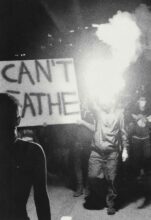
Afshar looks at the cancerous world with compassion and hope. The series Aura reflects on the horrific events of 2019 and 2020. Found photographs and intentional cuts mirror the grim reality dictated by death tolls and headlines of chaos. The images of US airstrikes on Iraq, Australian bushfires, and riots following the brutal police killing of George Floyd stay with us. “I can’t breathe”, Floyd says before dying. We cannot breathe. The raw, close-up images create a visceral, scarring experience for the viewer.
The artist’s elaborated approach extends past the emotional involvement as images evolve and interconnect in the viewers’ interpretation, surpassing fragmentation. The video Undone expands on the work by reshaping the common perception of war and bringing love to the forefront. In an underwater-like world the human heart-beat resounds. Rewinding video clips of bombings, Afshare captions how humanity can conquer death and overcome destruction.
Philosophy and politics have long overlooked love, reducing it to personal desire rather than commitment. Love is a taboo in the public sphere, and violence overweights beauty. We respond sceptically to goodness, searching for honesty within cruelty. Love, misread, belittled, corrupted, unspoken, and confined to the domestic, has enabled inequality and patriarchal systems’ growth. Through her redemptive practice, Afshar has paved the way for love to enter the public arena.
Camouflage, theatre, and celestial grammar are quintessential to the artist’s practice, converging ontologically and formally. With purpose and emotion, her constant exercise in addition and subtraction discloses and eclipses, improving visibility and providing a shelter. Shifting the tension from violence to beauty, death to hope, division to solidarity, observation to performance, and domination to participation, love drives Afshar’s work from start to finish. The artist adds to the lucid understanding of the unpredictability of photographs and the paradox of their completeness by rejecting a self-referential rule. Instead, steadily unpacking the image-making process, she liberates the viewer by forging the spectacle into a communal act, reaching out to Ariella Azoulay’s Civil Imagination. All participants in the photographic event share, in fact, the responsibility of reworking and negotiating the meaning of a photograph. (18)
Afshar’s art raises more questions than it answers, hence its strength. Her images agitate our souls, prompting discussion and action. Proof of trust and memory, they resist censorship and stand against forgetting and struggle. Neither naïve, easy, nor reassuring. Her glorious art is corrosive and revelatory as she refuses to retreat to a safe space but shatters it. By embracing complexity, she disrupts paralysis, demanding solidarity and critical thinking.
Love is an action, not just a feeling, declares Bell Hooks (19). Loving the world, Afshar is brave enough to defend it. Faced with injustice, she takes responsibility, loves, and acts. Her images of extraordinary humanity convey the political nature of love and its potential to feed a fairer society, suggesting care and accountability. Stemming from the heart and acting upon it, her artistic inquiry becomes civic service.
But how do we oppose violence without intensifying it? Poetry appears to be Afshar’s response, or at least her consolation and prayer.
“Why write love poetry in a burning world?
To train myself, in the midst of a burning world to offer poems of love to a burning world” (20)
The Artist escapes hopelessness, finding beauty in bleak places. The Witness recalls the events, while the Civic Poet advances inclusion and dissent. Afshar’s trenchant photographic exposé on truth and power urges a return to politics’ core mission: coordinating opposition rather than fearing it. Picturing what is possible and challenging what it is, her work is transformative and holds the future. Afshar’s labour of art and activism teaches us about love and rebellion. She masterfully composes a caustic melody, light in touch but vigorous and giving in motive, where care decants barbarity, restoring equality within the contentious territory of images.
Hoda Afshar “Offers Poems of Love to a Burning World”. Art and political change can coexist when emerging from love, she suggests. After all, “It is All about Love”. (21)
__________
For further viewing
Hoda Afshar’s artist website: www.hodaafshar.com
General references
Photoworks Masterclasses, On Making and Unmaking the World Through Images, led by Hoda Afshar 9 February 2022
Perspectives: Hoda Afshar, Unmaking Images: Image-Making And Representation. An initiative developed by The Bob Hawke Prime Ministerial Centre, ACE Open and Guildhouse. May 2019
Hoda Afshar & Taous Dahmani: disrupting documentary and picturing the invisible. MACK live, 8 July 2021
Isobel Parker Philip (editor), Hoda Afshar. Hoda Afshar, A curve is a broken line. The Art Gallery of New South Wales, 26 October 2023
Hoda Afshar, Speak The Wind. MACK, June 2021
Katharina Prugger, The fold. Essay published in NGV Triennial 2023, National Gallery of Victoria, Melbourne.
Bibliography
1. The quote in the essay’s title is taken from a poem by Katie Farris:”Why Write Love Poetry in a Burning World “, Standing in the Forest of Being Alive A Memoir in Poems- Pavilion Poetry, April 2023
2. Hoda Afshar, Exquisite dissonance, Interview by Anna Snoekstra https://www.kayburton.com.au/exquisite-dissonance/
3. Curtis A. HyperNormalisation. UK: Production company BBC; 2006
4. Emily Dickinson, “‘Hope’ is the Thing with Feathers” from Emily Dickinson The Complete Poems , edited by Thomas H. Johnson. Faber & Faber, 3 November 2016, page 116
5. Grief Is the Thing with feathers, Max Porter. Faber&Faber, August 2016
6. Malek Alloula, The colonial Harem, published in UK by Manchester University Press 1987, page 4 and 5.
7. Edward W. Said, Orientalism. Penguin Classics, 28 August 2003, page 108
8. Hoda Afshar, The Fold. One-channel animation and digital video, B&W, sound, 26 minutes, 2023
9. Graham Huggan – The Postcolonial Exotic, Marketing the Margins. Taylor & Francis 2001 – pages 13 – 14
10. Edward W. Said, Orientalism. Penguin Classics, 28 August 2003, page 283
11. Hala Alyan, Half Life in Exile. The Moon that Turns you Back, published by HarperCollins Publishers Inc, April 2024 page 28
12. Hoda Afshar & Taous Dahmani: disrupting documentary and picturing the invisible, 8 July 2021
13. Bell Hooks, Feminism is for everybody, Passionate Politics. Published by Pluto Press, October 2000 page 77
14. Bell Hooks, Outlaw Culture, Resisting Representations Routledge Classics. Published by Taylor & Francis, May 2006, pages 289–290
15. Blackout Jacques Rancière; Politics and Aesthetics, Interview with Peter Hallward 29 August 2002, published on Onscenes.com
16. Susan Sontag, On Photography. Penguin Classics. Published by Penguin Books, September 2008, page 110
17. Giorgio Agamben Remnants of Auschwitz: The Witness and the Archive, Zone Books, New York 1999. Page 26
18. Ariella Azoulay, The Civil Contract of Photography. Published by Zone Books, December 2012 page 14
19. Hooks B. All about love: New visions. William Morrow, 2001 Page 13
20. Katie Farris:”Why Write Love Poetry in a Burning World “, Standing in the Forest of Being Alive A Memoir in Poems- Pavilion Poetry, April 2023
21. Hooks B. All about love: New visions. William Morrow, 2001
__________
Contributor
Mariasanta Tedesco is a manager and buyer at Blackwell’s Bookshop in Oxford, with many years of experience in social media management and promotional strategies. She studied European politics between Italy and France and has always loved art to the bones. An emerging photographer and fascinated by the surreal imaginary and its vocabulary, her projects result from her intimate reality, which she translates by exploring with self portraiture. Mariasanta is keen to examine the fascinating link between images and words, photography and the book.
She is a contributor to various organisations, both as an artist and as a writer, she has been curating the Photo Oxford Instagram platform since 2020. She has also been collaborating with Hundred Heroines, an organisation raising the profile of women photographers. She was part of a theatrical company for several years, focussing on experimental performances and improvisation and has recently taken an interest in butoh, a form of avant garde Japanese dance theatre.