Contemporary Interpretations of the 19th Century Photographs of Hysterical Patients
by Ania Ready
The late 19th-century photographs of women diagnosed with hysteria have a haunting and ghostly quality. Some of the most renowned ones were taken in the Parisian Salpêtrière hospital which is still a large medical institution, now with a university affiliation. At the time when these images were taken in 1870s and 1880s, it was possibly the largest medical institution in Europe. [1] It had around five thousand patients, making it a ‘city within a city’ or as G. Didi- Huberman put it ‘a city of incurable women’ or ‘a mecca of female death’.[2] The photographs taken at the Salpêtrière depict women, some very young, in dramatic, perplexing and unsettling poses, accompanied by often eroticized or religiously inspired captions.
This curious combination of image and text, including patients’ medical history formed the basis of a three volume publication entitled Iconographie photographique de la Salpêtrière: service de M. Charcot / par Bourneville et P. Regnard. (Photographic Iconography of the Salpêtrière by D. Bourneville and P. Regnard) published between 1876 and 1880. [3] These books were commissioned by a charismatic medic – Dr Jean-Martin Charcot, a leading neurologist at the time who in 1872 became the professor of pathological anatomy at the Salpêtrière.[4]
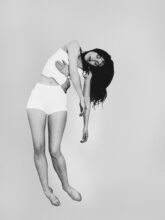
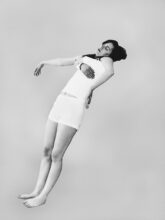
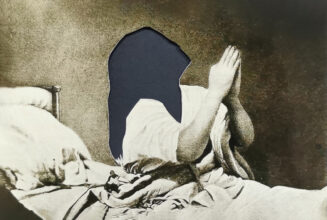
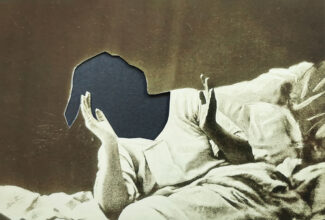
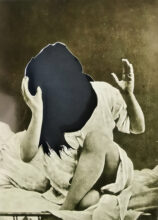
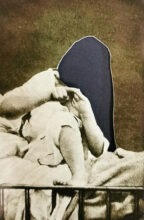
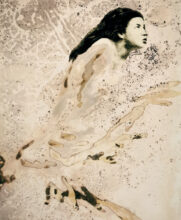
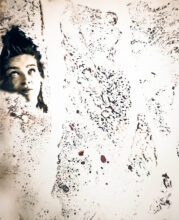
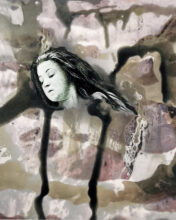
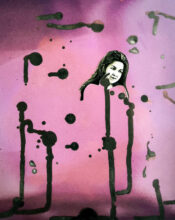
But who were the women featured in these photographs, and how were these images made? What were the consequences of employing photography in the medical setting? By answering these questions I will also explain why these photographs continue to captivate contemporary artists. Recent reinterpretations include Jessa Fairbrother’s The Rehearsal (Dedicated to Augustine) (2011), Valerie Schmidt’s attitudes passionelles (2014) and deleting babiński (2014), and my own works, Dispassionate Attitudes (2022) and Lunar Women (2023).
The discourse surrounding hysteria is extensive. My focus on a limited number of recent responses by photographic artists is deliberate and aims to show in more detail what provokes us to take creative action, and how these historical photographs have influenced modern artistic practices.
Photography came into the medical world not long after the invention of a fixed photographic image in 1826 by Niepce. It entered the premises of hospitals as early as 1840s, just a few years after Niepce’s business partner Daguerre popularized a new photographic process which allowed ‘nature to reproduce herself’.[5] Interestingly, the hospital ‘photographers’ were mostly doctors themselves. The French physician Alfred Donné photographed cells, bones and teeth with something called a microscope-dageurrotype as early as 1841. A decade later the superintendent of the state institution Surrey County Asylum, Dr Hugh Welch Diamond took images of his patients. [6] In the Salpêtrière Hospital it was the physician Paul Regnard who was appointed a photographer and who produced the visual work for The Photographic Iconography under the guidance of Dr Charcot.
Dr Charcot compared his professional role in medicine to that of a… photographer. During one of his famous Tuesday lectures, initially open to (male) medical staff, later also to the general public, and widely reported in the media, he said: “I am nothing more than a photographer. I inscribe what I see.”[7]
Charcot was definitely a visuel as Sigmund Freud, who did an internship under him, put it in his obituary. [8] His visual interests made him focus on hysteria which at that time was not a particularly attractive research topic for medics. [9] He also managed to turn it into a popular spectacle and the photographs taken at the Salpêtrière are definitely a testament to it.
In her brilliant publication Medical Muses [10] which reconstructs the lives of three most famous hysterical patients from the Salpêtrière, Asti Hustvedt explains the vulnerable positions these women occupied.
Blanche (in reality Marie Wittman), later nicknamed “The Queen of Hysterics” for her spectacular appearances as a hypnotised patient during Charcot’s Tuesday lectures and for featuring in The Photographic Iconography, came to the Salpêtrière at the age of eighteen, suffering from convulsions and fainting spells. As a teenager, she was compelled to work for an exploitative employer following her violent father’s institutionalization in a mental asylum and the death of her mother. She did very little schooling and couldn’t read or write well.
Another patient Augustine (Louise Augustine Gleizes), was a survivor of rape perpetrated by her mother’s lover who was also her employer. After her mother’s death she was forced to return to the place of abuse. She suffered from convulsive attacks and paralysis of her left side. Augustine was repeatedly photographed in the Salpêtrière and her images are carefully lit, staged and executed.
Geneviève (Geneviève Basile Legrand), an abandoned orphan, experienced a nomadic existence since she was a baby, being moved from one foster family to another and back to the nuns when there was no one to look after her. She struggled to sustain herself. She also experienced unwanted sexual advances from her employer. She was beaten. She suffered from violent attacks of nerves, in one of them she cut off her nipple. She also tried to take her own life by overdosing.
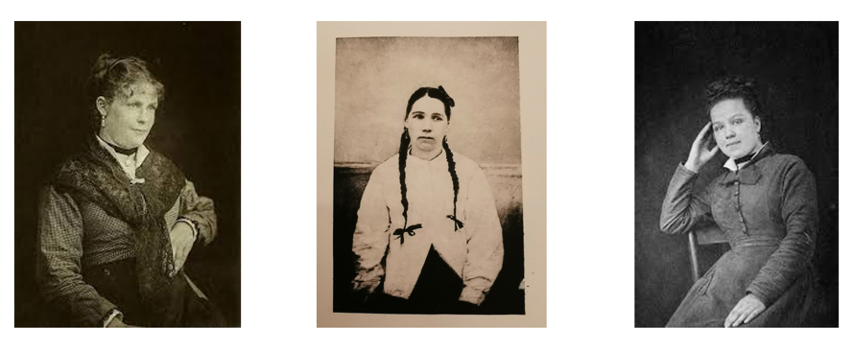
(Augustine (Louise Augustine Gleizes), Geneviève (Geneviève Basile Legrand) and Blanche (Marie Wittman) photographed on arrival at the Salpêtrière. Source: The Photographic Iconography of the Salpêtrière)
When I looked at the first volume of The Photographic Iconography of the Salpêtrière, I was struck by the young age of the patients: L. arrived at the Salpêtrière at the age of 18, after being accused by her employer of a theft of 500 francs, Madaleine came when she was 17, some patients suffered from anxiety and fear which made their lives impossible. They all were diagnosed as hysterical.These women faced significant barriers to securing stable employment, safe working conditions, and personal autonomy. They were impacted by violence and social injustice. As Asti Hustvedt noted, “hysteria was at least partly a manifestation of the limitations imposed on women during an era that strictly restricted female roles.”[11]
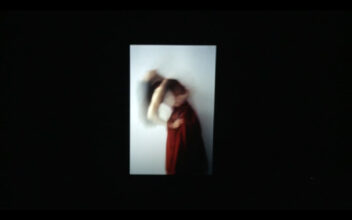
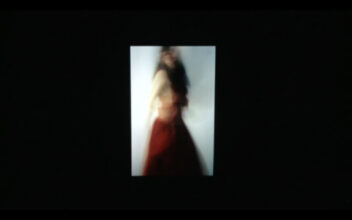
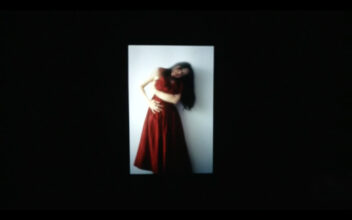
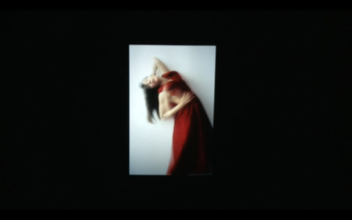
In her work from 2011, The Rehearsal (dedicated to Augustine), British visual artist Jessa Fairbrother engages in a dialogue with Augustine, the most photographed patient at the Salpêtrière. This series examines themes of femininity, perception, and the autonomy to act on one’s own terms. Featuring a female figure in an iconic red dress, the series of self-portraits is marked by blurry imagery and poses reminiscent of operatic or cinematic scenes, projected with a theatrical flair. The title, The Rehearsal, reflects the work’s dramatic elements. Fairbrother, also a trained actor, combines her skills in image-making and performance to critique popular portrayals of femininity, drawing significantly from the Salpêtrière’s medical photographic output.
Fairbrother explains, “The long exposures and movement in the photographs highlights a lack of fixity in the self-portraits which form the work. Here images flit between multiple characters drawn from a wide spectrum of fictional experiences in search of the ideal performance.”[12]
In her work, the female character contrasts sharply with Augustine by exercising full control over her performance. She takes charge of the act and places her presence at the center of the piece. Wearing a striking red dress, she powerfully embodies femininity and confidently asserts her independence and allure. Her performance is self-directed, with no male figure present behind the camera.
When examining images from the Salpêtrière, it is important to recognize that they were captured by male medical professionals – educated, often wealthy, and in positions of power – who were in charge of the institution. These images portray women who were often impoverished, traumatized, vulnerable and lacked education. This highlights a significant power imbalance inherent in the act of photographing on the hospital premises. Fairbrother dismantles this imbalance in The Rehearsal; she creates an independent performance.
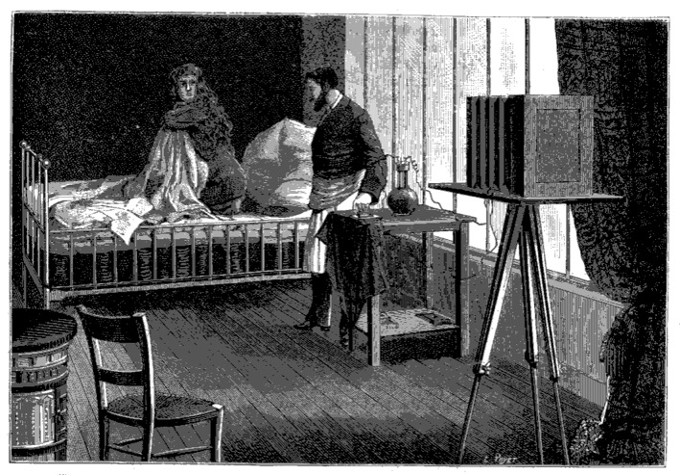
(Image of the photographic studio published in an article by A. Londe in La Nature journal in 1883 who was the director of photography at the Salpêtrière after P. Regnard who took images for The Photographic Iconography.[13])
I’d also like to look at this work in the context of Augustine’s life. From a patient who was treated at the Salpêtrière she became an employee (a so-called ‘ward girl’), and was made to perform under the hypnosis. She was again photographed quite extensively as evident in volume 3 of The Photographic Iconography. She only managed to escape from this restrictive, suffocating environment when she dressed up as a man and left the hospital freely and unnoticed. The Rehearsal could be interpreted as Augustine’s ultimate performance, where she is finally able to present herself freely as a woman.
The blurriness of the images in Fairbrother’s work has a metaphoric quality. The lack of specific facial features of the protagonist make her a universal female figure. “Performance of womanliness is one of the dominant themes in my artistic practice” [14], confirms Fairbrother.
Interestingly, any blurry images which appeared in the first edition of The Photographic Iconography were replaced with drawings in the second edition. A drawing may have been considered more “truthful” compared with an image registering a movement and therefore presenting some blur.
In the words of Albert Londe , a chemist, who was later appointed the director of photography at the Salpêtrière, “The photographic plate is the scientist’s true retina … a simple print before the eyes tell for more than a complete description.”[15]
I encountered The Photographic Iconography when I was researching hysteria for my literary photobook, I Also Fight Windmills, in which I visually interpreted a novel entitled Hysterical Women by the trilingual, largely-forgotten writer Sophie Gaudier-Brzeska. [16] Gaudier-Brzeska lived in Paris at the turn of the previous century, not even a decade after Dr Charcot’s death. She was based not far from the Salpêtrière itself. I always wondered whether she encountered stories or visual material related to hysterical patients of the Salpêtrière. If she did, did they inspire her descriptions of female rages, seizures and deep low moods?
The Salpêtrière female patients captured in The Photographic Iconography hold dramatic poses – their bodies are twisted, in convulsions or contortions. Given how static their convulsing bodies look in these images and how long it took to expose a photograph at the time it’s likely that the medics employed different methods to keep their patients’ bodies still in the hospital’s photographic studio. It obviously poses a question about the spontaneity of the attacks presented in The Photographic Iconography and the ethics of the methods in which they were obtained. [17]
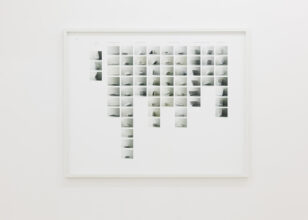
When I looked at these images, I was also struck by the arresting similarity between the photographed hysterical poses and the religious poses of the saints in the reproductions of paintings in my grandmother’s house. This resemblance spurred me to take action. I began by removing the individuals – often Augustine – from the photographs depicting hysterical episodes, some of which were categorized by Dr Charcot as Attitudes Passionelles (“passionate poses”). The French medic classified this stage of a hysterical attack as a moment in which a patient presented a variety of emotional states such as terror or ecstasy.
Without the subject in the frame, the poses themselves became more distinct, revealing a clearer connection to the images from my childhood. I also eliminated the suggestive captions from these photographs, which were laden with erotic and religious terminology such as crucifixion, a call, and amorous supplication, etc. This process led to the creation of Dispassionate Attitudes.
It was striking to observe the similarities between photographs of hysteria and religious paintings depicting saints receiving stigmata, divine revelations, or engaging in acts such as praying or crucifixion (e.g. Saint Teresa of Avila, St. Catherine of Siena, St. Agatha, Margaret Mary Alacoque, Angela of Foligno and others). The resemblance is particularly ironic given the progressive and secular stance of the staff at the Salpêtrière. Those who promoted secularisation in the medical profession relied heavily on established religious imagery for their medical documentation. This “retina of truth” as A. Londe put it when he talked about photography was influenced by the visual language of the past, a shared cultural heritage for both the medical practitioners and their patients.
It was also important to me that the viewer was no longer faced with the discomfort of meeting the eye of a suffering patient but saw only their pose as it was recorded in the photographic studio. The void, empty poses expose the confining role women were meant to perform. My aim in Dispassionate Attitudes was to reveal the confusion between the language of religion and the language of science (and indirectly the language of photography itself).
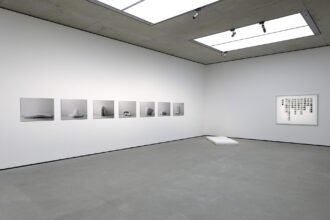
There is also another way of dealing with the uncomfortable contents of The Photographic Iconography. In her work entitled attitudes passionelles, German artist Valerie Schmidt removed the subjects of the Salpêtrière photographs and replaced them with a mattress. She comments, “What is particularly striking when looking at various photographs from the end of the nineteenth century is that hysterics could suffer a hysterical attack almost exclusively on mattresses. The mattress was always a kind of counterpart beneath the actual patient. [18]
Schmidt’s work becomes a playful critique of the medical classification of hysteria. An object – the mattress – is moulded very skilfully to fit difficult positions, repeating the acrobatic movements of the patients. We are no longer faced with human suffering in these photographs but instead are presented with tongue-in-cheek tableaux.
Schmidt explained, “I’ve always been interested in the performative aspect of photography. When working on attitudes passionelles, I felt that the outcome of my work with the mattress was no less true than the original tableau by Paul Richer.” [Richer was an artist employed by Dr Charcot to draw hysterical women before photography was brought in to the Salpêtrière]. “In my work, the mattress became a hysteric.”[19]
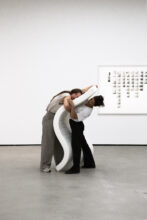
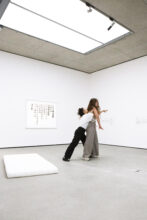
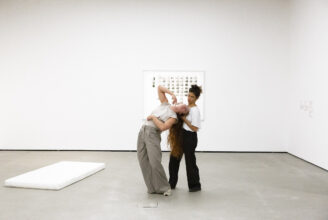
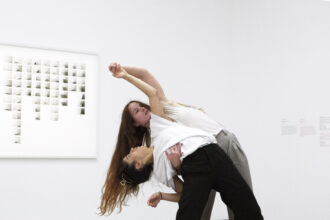
Schmidt’s work became a double act when she collaborated with two dancers Jeanne Procureur and Luisa Heilbron from the BODHI PROJECT who performed a dancing piece in which the mattress was a protagonist. Schmidt added, “In this collaboration, one actor forces the other to take a pose and then moves away, watches how she does it. This piece in which we wanted to maintain roughness of movement is very much about rape, aggression, directing or pushing women into presenting something fixed.”[20]
In this fascinating performance she directed, Schmidt explores the physicality of human interactions and the tension between being shaped into something and wanting to move freely. By adding the improbable partner – the mattress – the performance brings in the domestic and the medical into the bodily mix. Both its familiarity and its oddness echoes the paradoxical nature of hysteria. It is significant that the dancers are female – like the photographed patients of The Photographic Iconography.
In her other work, deleting babiński, Schmidt explores the role of male medics in the presentations of hysterical patients to the public who were often under the influence of hypnosis. This work directly references a famous painting by André Brouillet “Une leçon clinique à la Salpêtrière” from 1887 in which a handsome doctor Joseph Babiński who worked under Dr Charcot brings in a female patient whose loose robe uncovers top parts of her body as she becomes hypnotised.
In her series of eight photographs Schmidt depicts a woman collapsing in an empty space – into the unconscious – while the body of a male holding her is almost entirely removed (apart from his hands). Schmidt adds, “She holds herself during her fall, while the male hands only adorn her body as obscure applications. The powerless pose of the unconscious becomes a pose of imbalance in balance.” [21]
The act of removing the medic’s position of power and control and reducing his presence to only one body part enables the female protagonist to become the centre stage. She fills the frame with her presence. The performance is hers.
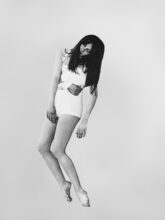
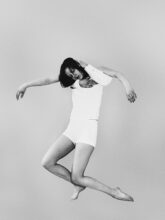
A similar result, although achieved by different means, was the focus of my second intervention in the visual contents of The Photographic Iconography. When I cut out the individuals captured in dramatic poses, often evoking religious scenes from the medical photographs, I wanted to take these women out of this very restrictive environment and bring their agency back to them. I placed them on a chemigram, a photographic experiment in which chemicals interacting with a photo sensitive paper give often uncertain outcomes. I used expired photographic paper to create an unpredictable and unconstrained environment. The patients float there freely, taking different shapes.
The images are not fixed, which means that with time they get darker and darker, leaving them to constantly evolve. In this way, I made the metaphorical act of walking out of the medical photographic studio possible.
Viewing this work in the context of Augustine’s real escape from the Salpêtrière, Lunar Women make the same possible for other patients. The work also addresses the disproportion of authority in the relationship between the photographer and the photographed (powerful medic – powerless patient) in the medical premises. What was important for me when I was working on this series, was to find a different way in which photographically the depicted hysterical patients could exist beyond the constraints of the studio set-up. I wanted to transform photography’s role in the medical setting from something confining to something freeing.
Photographs of hysterical women from the Salpêtrière continue to provoke artists who take lead from their theatrical, performative nature, creating works which bring agency to their subjects. The images urge a thoughtful and sensitive reaction. Artists responding to them often challenge the power imbalance woven into the act of taking photographs. A male presence, and subsequently the male gaze is frequently removed from the process. These are often bodily expressed or bodily considered critical encounters with the archive. These works can definitely be read as a homage to hysterical women.
[1] A. Hustvedt, Medical Muses (London: Bloomsbury, 2011), p. 14.
[2] G. Didi-Huberman, Invention of Hysteria, trans. A. Hartz (Cambridge: MIT Press, 2003), p. 13.
[3] I used two editions of Iconographie photographique de la Salpêtrière: service de M. Charcot / par Bourneville et P. Regnard. I accessed the first edition online at Wellcome Collection: wellcomecollection.org/works/gnwg7zzf and the second edition as a print publication at the Bodleian Library in Oxford. For simplicity I will refer to them as The Photographic Iconography although, as far as I could tell, it has never been published in English.
[4] G. Didi-Huberman, Invention of Hysteria, p. 17.
[5] G. Clark, The Photograph (Oxford: Oxford University Press, 1997), p. 13.
[6] A. Hustvedt, Medical Muses, p. 154-155.
[7] G. Didi-Huberman, Invention of Hysteria, p. 29.
[8] Freud wrote: he was, as he himself said, a ‘visuel’, a man who sees’ – quoted from L. Appignanesi, Mad, Bad and Sad (London: Virago Press, 2009), p. 145.
[9] A. Hustvedt, Medical Muses, p. 6.
[10] A. Hustvedt, Medical Muses (London: Bloomsbury, 2011).
[11] A. Hustvedt, Medical Muses, p. 4.
[12] Quote from J. Fairbrother’s website: jessafairbrother.com/projects/the-rehearsal-dedicated-to-augustine (accessed Aug 2024).
[13] A. Londe, La photographie en médecine. Appareil photo-électrique, La Nature, v 1, 1883, p. 216..
[14] From my conversation with the artist, August 2024
[15] G. Didi-Huberman, Invention of Hysteria, p. 32.
[16] Information about the book is available here: aniaready.com/i-also-fight-windmills-a-literary-photobook
[7] In some of the images of The Photographic Iconography, we can see straightjackets being employed or nursing staff being behind the patient. Researches have also pointed out the use of drugs, the system of rewards for compliance in the hospital. For more see L. Appignianesi,Mad, Bad and Sad, A. Hustvedt, Medical Muses, G. Didi-Huberman, Invention of Hysteria.
[18] From the material offered by the artist.
[19] From my conversation with the artist, April 2024.
[20] Ibid.
[21] From the artist’s website: valerieschmidt.de/ART
__________
About the author
Ania Ready is a Polish-British photographic artist and author based in Oxfordshire, UK. She works with photography, archives, and texts. She has exhibited her work internationally in group and solo shows in the UK, Poland, Italy, Switzerland, Latvia, Canada and New Zealand. Last year she published a literary photobook I Also Fight Windmills.
aniaready.com
@aniaready